Quick Answer
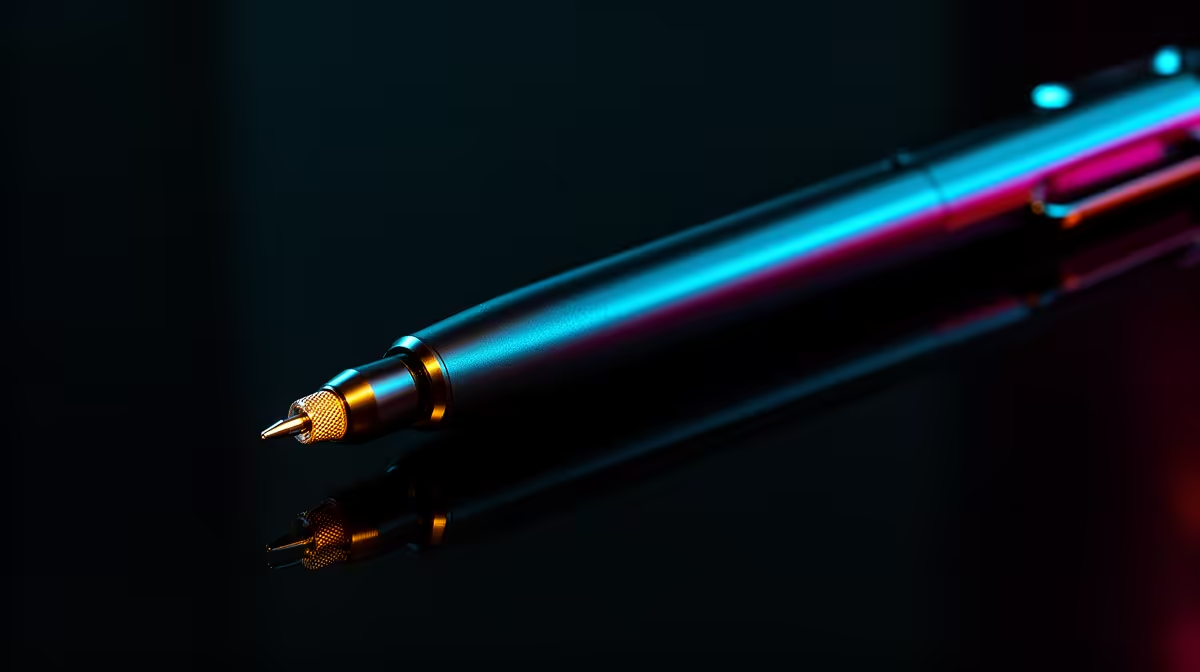
An active stylus uses electronic components to communicate pressure, tilt, and position to the screen, producing pressure-sensitive, precise strokes. A basic touch pen (passive stylus) is a conductive rubber tip that simply mimics a finger tap, with no pressure sensitivity, no tilt, and no palm rejection. For writing and drawing, an active stylus is in a different performance category.
How Each Pen Type Interacts With the Screen ✏️
A basic touch pen triggers a capacitive screen the same way a fingertip does: it completes an electrical circuit through the conductive tip. The result is a fixed-weight mark with no variation, regardless of how hard you press. It works on any capacitive touchscreen but offers no advantage over your finger for drawing or handwriting. An active stylus, by contrast, uses internal electronics (a chip and sometimes a battery or EMR coil) to send digital signals to the tablet's sensor layer. The screen reads position, pressure (up to 4,096 levels on current-gen pens), and tilt angle, then feeds that data to the drawing software for a line that varies in weight and opacity just like a real pen or pencil would.
The Practical Difference for Writing and Drawing 🎨
For digital handwriting, the active stylus delivers consistent letter strokes with natural pressure variation, making notes legible and visually organised at a glance. A passive pen produces uniform strokes that look like a uniform-weight marker regardless of your handwriting style, and the tip often requires firm pressure, causing hand fatigue over long note-taking sessions. For drawing, the difference is stark: an active stylus allows hatching, shading, and brush effects that respond to hand pressure, while a passive pen produces only flat, weight-less marks. Palm rejection is another exclusive feature of active styli; the tablet ignores resting hand contact so you can write naturally without triggering stray marks.
Which One Makes Sense for Your Setup in SA 💡
Passive touch pens retail from R30 to R200 and are fine for basic touchscreen navigation, selecting text, or tapping through menus. Active styli start from around R400 to R800 for entry-level models and climb to R2,500 to R4,000 for professional-grade pens from Wacom. For students taking handwritten notes on a compatible Android tablet or Windows touchscreen laptop, an entry-level active stylus at R400 to R700 transforms the experience versus a basic touch pen. For illustrators and designers, a professional active stylus on a dedicated drawing tablet is essential; a passive pen cannot replicate the nuance needed for detailed illustration work.
Compatibility Check Before You Buy ⚡
Active styli use proprietary protocols tied to specific devices. A Microsoft Surface Pen only works fully with Surface hardware; a Wacom pen only works with Wacom tablets. Always verify your tablet or laptop model's supported stylus protocol (MPP, AES, or EMR) before purchasing an active stylus.
FAQ
Can I use a basic touch pen for note-taking at university?
You can use it for tapping and selecting, but for actual handwriting it is frustrating: strokes are uniform-weight, tips are often imprecise, and there is no palm rejection. For note-taking, an active stylus is the practical minimum.
Will an active stylus work on any touchscreen?
No. Active styli require a compatible digitiser in the screen. Most Android and Windows tablets have one, but not all. Laptops with standard touchscreens (not digitiser screens) will not respond correctly to active pen input.
Is there a middle ground between passive and active styli?
Some styli use a fine-tip disc or fibre tip instead of a round rubber cap, improving precision on capacitive screens without electronics. These are better than rubber-tip passive pens for navigation but still lack pressure sensitivity and palm rejection.
Considering the upgrade from a basic touch pen to an active stylus?
Evetech stocks a range of active stylus pens and compatible drawing tablets to suit SA students, remote workers, and digital artists at every budget.