Quick Answer
Adjustable actuation lets you shorten the travel distance before a keypress registers, cutting response time to as little as 0.1 mm pre-travel on Hall Effect boards. Fixed actuation locks that distance at the factory specification, usually 1.2 mm to 2.0 mm depending on the switch type, with no user control over the trigger point.
What Fixed Actuation Actually Means 🔧
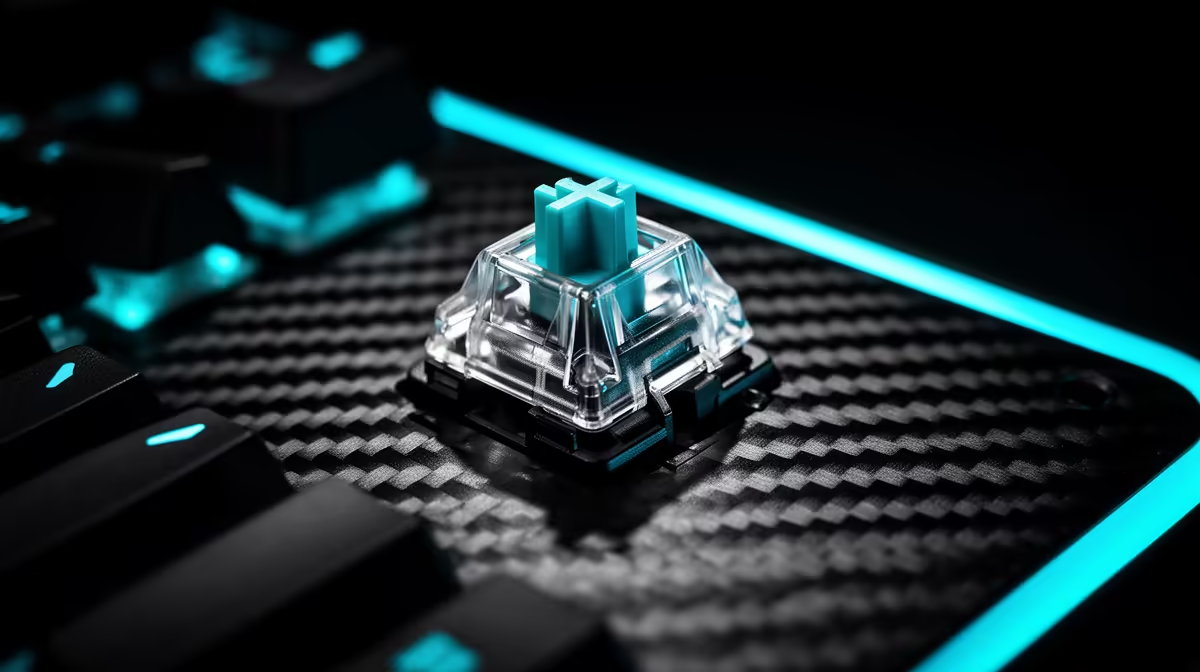
Fixed actuation switches ship with a single actuation point baked into the switch design. A Cherry MX Red, for example, actuates at exactly 2.0 mm every time. An optical switch like the Razer Red Optical fires at 1.0 mm via a light gate that cannot be repositioned. The advantage is consistency: every keypress triggers at the same depth regardless of how worn the switch becomes. For most gaming scenarios this is entirely adequate. The vast majority of gaming keyboards priced between R1,000 and R3,000 stocked in South Africa use fixed actuation, and countless professional esports players win tournaments on them daily.
How Adjustable Actuation Changes Input Speed 🚀
Hall Effect switches use magnets instead of physical contacts, which means the firmware can reinterpret the magnet position at any point in the travel range. Boards like the Wooting 60HE and similar Hall Effect gaming keyboards allow you to set actuation anywhere from 0.1 mm to 4.0 mm. Setting actuation at 0.1 mm means the key registers almost on touch, which can shave several milliseconds from your input-to-action window. Rapid Trigger, a related feature, resets the key the instant it begins moving upward rather than waiting for it to pass a fixed reset point, effectively eliminating the deadzones that slow repeated keypresses. The practical result in FPS titles is faster strafing and counter-strafing.
Choosing Between the Two for Your Setup 💰
For typing and casual gaming, fixed actuation is reliable and cost-effective. For competitive shooters where millisecond differences matter, adjustable actuation combined with Rapid Trigger gives a measurable edge in key repeat speed. In South Africa, Hall Effect keyboards with full adjustable actuation and Rapid Trigger start at around R2,500 to R4,000, a significant step up from fixed-actuation boards at R800 to R1,800. If you play at a high level in titles like Valorant or CS2, the investment is justified. For genres like strategy or RPG, fixed actuation is entirely sufficient.
Set Actuation Per-Key for Best Results ⚡
On Hall Effect boards with per-key actuation adjustment, set movement keys like W, A, S, D to 0.1 to 0.3 mm for fastest response, but keep typing keys like spacebar and enter at 1.5 mm or deeper to avoid accidental triggers. This split profile gives you speed where it counts without false inputs on support keys.
FAQ
Does adjustable actuation work with all games?
Adjustable actuation is a hardware and firmware feature that operates at the input level, so it works with any game that reads standard keyboard input. Rapid Trigger specifically benefits games with fast directional movement; the effect is less noticeable in slower-paced titles.
Can you break a Hall Effect switch by setting actuation too shallow?
No. Hall Effect switches have no physical contacts to wear, so operating at 0.1 mm actuation carries no mechanical risk. The magnet and sensor are non-contact components with lifespans typically rated at 100 million keypresses or more.
Is there a noticeable feel difference between the two types?
Fixed actuation switches often have a tactile bump or audible click at the actuation point, giving physical feedback. Hall Effect switches in analog mode have a smoother, linear feel with no tactile confirmation, which some typists find less satisfying but competitive gamers tend to prefer for speed.
Hunting for the fastest possible input?
Evetech stocks Hall Effect gaming keyboards with adjustable actuation and Rapid Trigger alongside a wide range of fixed-actuation boards. Find the right keyboard for your play style at Evetech.