Quick Answer
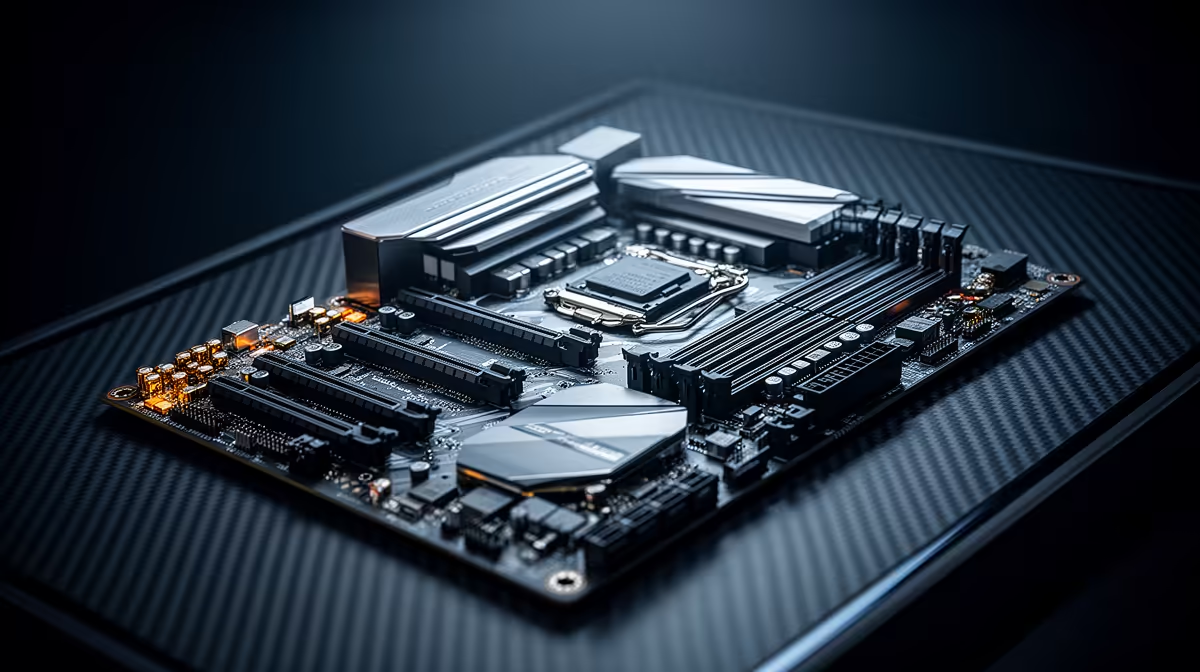
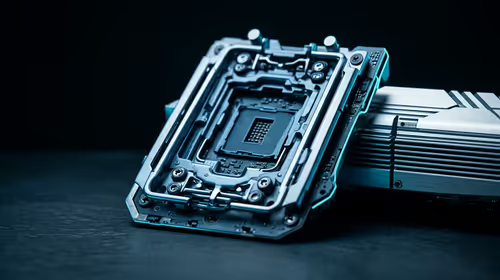
Before you order, confirm four things: CPU socket, chipset, RAM type and form factor. AMD's current AM5 socket covers Ryzen 7000, 8000 and 9000 CPUs across A620, B650, B850 and X870 chipsets, all on DDR5. Match these and the board drops straight in; miss one and the parts simply will not work together.
The compatibility checklist that prevents returns
Socket first — AM5 for current Ryzen, LGA1851 for Core Ultra; they are not interchangeable. Then chipset and RAM: every current platform is DDR5, so old DDR4 kits will not fit. Confirm the form factor (ATX, Micro-ATX, Mini-ITX) fits your case, and check the BIOS supports your exact CPU — a stocked board here usually ships ready.
Choosing the right tier for a typical SA setup
For a Ryzen 5 9600X or Ryzen 7 9700X, a B650 (R2,800) or B850 (R3,800) board covers it. X870 (~R6,000+) only adds USB4 and extra PCIe 5.0 lanes most gamers will not use. Count what you actually need: the number of M.2 slots, USB-C ports, and whether you want Wi-Fi 6E built in. VRM quality matters for a Ryzen 9 or Core Ultra 9; for a six- or eight-core chip almost any B-tier board is fine.
Memory, M.2 and SA buying notes
DDR5-6000 CL30 is the gaming sweet spot on AM5; check the board's QVL or buy a kit stocked alongside it. Two or three M.2 slots future-proof storage. Update the BIOS if you pair a brand-new CPU with an older board revision. Stick to brands with proper South African distribution so RMA stays painless if something fails inside warranty.
FAQ
How do I check CPU and motherboard compatibility?
Match the socket and chipset to your CPU, confirm the BIOS version supports it, and check the RAM type — all current boards are DDR5. Form factor must also fit your case.
Do I need an expensive X870 or Z890 board?
Only for serious overclocking or workstation I/O like USB4 and multiple Gen5 slots. For gaming, a B-tier board (B650/B850 or B760/B860) delivers the same gaming performance for far less.
What RAM should I pair with a new board?
DDR5-6000 CL30 is the sweet spot for AM5 gaming; Intel platforms are flexible around DDR5-6000 too. Check the board's QVL or buy a kit validated for it.
chipset, DDR5 RAM and form factor before checkout, and verify the BIOS supports your exact CPU — a B-tier board covers nearly every gaming build.