Quick Answer
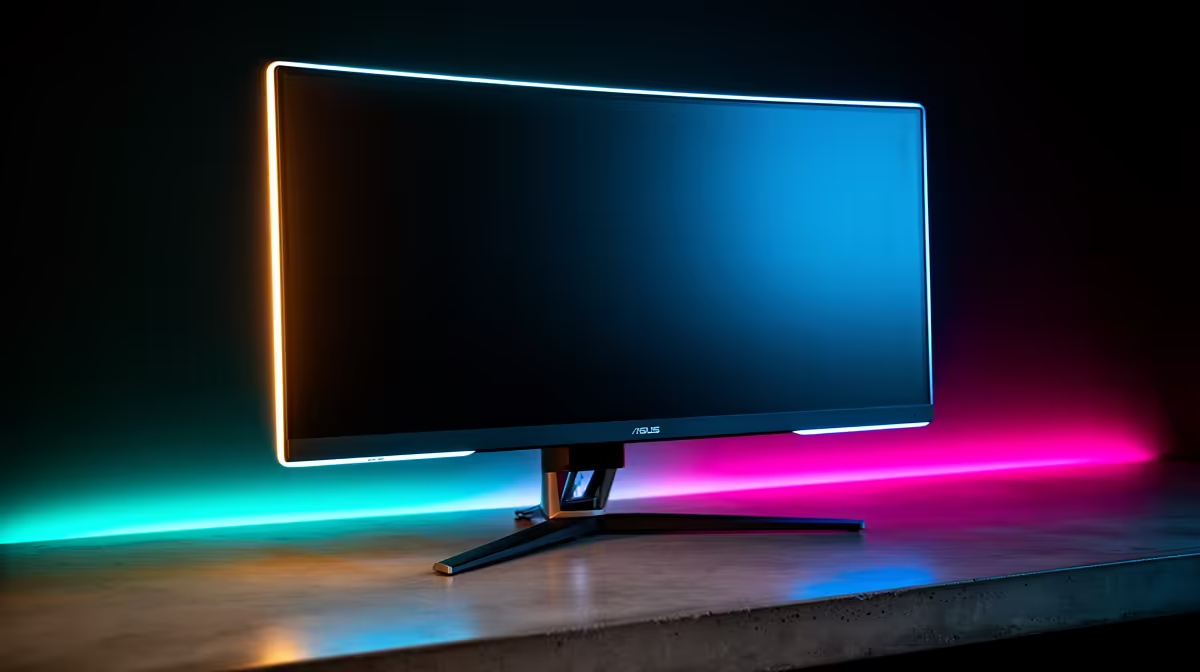
The ideal monitor for a mixed game library combines 4K resolution at 144Hz or above for story-driven titles and a fast IPS panel with 1ms response time for esports. Dual-mode panels that switch between 4K 160Hz and FHD 320Hz are the single-screen solution that covers both use cases without compromise.
Panel Resolution and Refresh Rates for a Split Library 🎮
Story games reward resolution: open-world environments, character faces, and environmental lighting all benefit from the texture and edge clarity that 4K provides at 32 inches. Esports titles reward refresh rate and response time: in CS2, Valorant, and Apex Legends, tracking a fast-moving target depends more on how often the screen updates than on pixel sharpness. A 1080p image at 320Hz resolves target motion more cleanly than a 4K image at 60Hz in a fast firefight. The monitor that covers both is a dual-mode Fast IPS panel, which lets you run 4K 160Hz for story sessions and FHD 320Hz when you queue ranked. Failing that, a 32-inch 4K 144Hz Fast IPS panel handles both adequately; you sacrifice some refresh rate ceiling but keep image quality consistent.
Colour and HDR for Story-Driven Games ✨
Premium story games like Cyberpunk 2077 and Alan Wake 2 invest heavily in visual atmosphere: volumetric lighting, deep shadow detail, and HDR-graded cinematics. A monitor with at least 90% DCI-P3 colour coverage and DisplayHDR 600 certification allows you to experience the colour grades these games are mastered for. On a standard sRGB panel in HDR mode, oversaturated reds and crushed blacks are common; on a genuine wide-gamut panel with local dimming, HDR looks noticeably more dynamic. For esports, colour accuracy is less critical but contrast matters for picking enemies against dark backgrounds. A Fast IPS panel's 1,000:1 contrast ratio is adequate; mini-LED backlit monitors with local dimming zones lift effective contrast in dark scenes considerably.
Adaptive Sync and Competitive-Mode Features 🏆
For the esports side of a mixed library, G-Sync Compatible or FreeSync Premium Pro is a baseline requirement, eliminating the screen tearing obvious at competitive sensitivities. ELMB Sync adds backlight strobing to sharpen each frame further. Some gaming monitors include a dedicated game-mode preset that reduces input lag by bypassing picture-enhancement features. On a 32-inch 4K panel the input lag in game mode should be under 5ms. For SA gamers who shift between genres, a monitor with named presets accessible via a hotkey makes the transition seamless.
Create Named Presets in the OSD ⚡
Set up one preset for story gaming (warm colour temperature, HDR on, brightness at 180 cd m2) and a second for esports (cool white point, ELMB on, brightness at 250 cd m2). Switching presets takes seconds and ensures you are always gaming with optimal settings for the genre.
FAQ
Is 144Hz fast enough for ranked esports play?
144Hz is the minimum most serious players use. Professional and top-ranked players often prefer 240Hz or above in CS2 and Valorant where high sensitivity makes higher refresh rates perceptible. For casual to mid-level ranked play, 144Hz is fully adequate.
How much does a quality dual-mode monitor cost in South Africa?
Dual-mode 4K 160Hz/FHD 320Hz monitors with Fast IPS panels and adaptive sync are priced from around R12,000 to R18,000 in South Africa as of mid-2026. Upper-tier models add HDR600, USB-C Power Delivery, and built-in USB hubs.
Do esports players actually use 4K monitors in professional competitions?
Most professional esports players compete at FHD on smaller panels to maximise frame rate. The 4K 160Hz mode on a dual-mode panel is for mixed-library home users. At home, the comfort of a 32-inch 4K story-game session benefits from the full resolution.
Need one screen that handles Elden Ring and ranked CS2?
Evetech stocks gaming monitors with dual-mode capability, Fast IPS panels, and adaptive sync, all locally stocked with South African warranty support.