Generating AI thumbnails and assets locally changes the maths on a content-creation PC. The model that produces the sharpest results, Flux, is hungry for graphics memory, and how much VRAM you put in front of it decides whether you wait seconds or minutes per image, and how much quality you keep. For a creator pumping out thumbnails, channel art, and product mockups, the graphics card is the single most important part of the build.
Quick Answer
A 16GB to 24GB NVIDIA graphics card is the right target. Flux at full FP16 precision wants roughly 24GB, but 16GB handles quantised Flux well for thumbnail and asset work with image quality that is hard to tell apart from the full model. Stepping to 24GB gives you full-precision headroom, faster generation, and room for heavier workflows. Build around the GPU first; everything else is secondary.
Why the GPU Is the Whole Decision
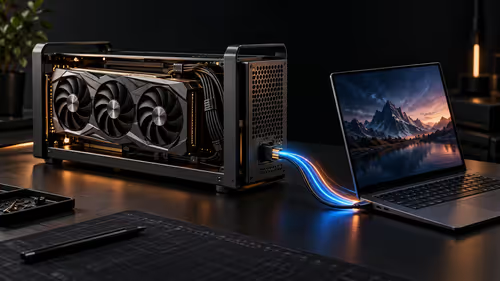
Local image generation lives almost entirely on the graphics card. The model weights, the image being built, and the supporting pipelines all sit in VRAM, and when they overflow, generation slows to a crawl as data spills into system memory. This is why a creator can get away with a modest processor and still produce thumbnails quickly, as long as the GPU has enough memory to keep the model resident.
Flux is the model most creators reach for because it produces clean text, sharp detail, and reliable composition, which is exactly what a thumbnail needs to stop a scroll. Full FP16 Flux wants around 24GB, but quantised versions shrink that footprint dramatically while keeping quality close to the original. FP8 quantisation cuts the VRAM demand to around 8-10GB with quality loss that is nearly invisible in blind comparisons. At more aggressive GGUF compression levels the model fits on a 12GB or 16GB card, with only the most demanding print-quality work revealing any softening.
Picking the GPU Tier for Your Workflow
The 16GB Sweet Spot
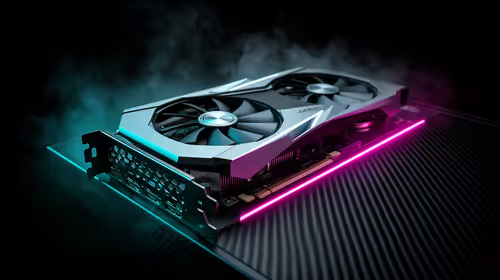
For a creator focused on thumbnails and channel assets, 16GB is the value tier that simply works. A card in this class runs quantised Flux smoothly, generates a thumbnail in a handful of seconds, and leaves room for the upscaling and refinement steps that turn a good image into a polished one. For most channels this is the sensible spend, and these cards sit consistently near the top of the graphics card best sellers list for exactly this kind of work.
The RTX 4060 Ti 16GB and the newer RTX 5060 Ti 16GB are the two names that come up most often in this tier. Both pair 16GB of memory with strong per-watt efficiency, keep noise levels reasonable during sustained generation, and handle Flux.1 Dev in FP8 without memory anxiety. For a creator who generates tens of thumbnails per day rather than hundreds, either card keeps pace without breaking the budget.
Stepping Up to 24GB and Beyond
A 24GB card unlocks full-precision Flux with no compromise, faster batches when you are generating many variations of a thumbnail, and the headroom to run more demanding pipelines like multiple control inputs at once. If asset generation forms a core part of your income rather than an occasional task, the extra memory pays for itself in time saved. The 32GB tier on the newest flagship takes that further, handling full FP16 Flux, high-resolution outputs, and complex multi-step workflows without ever rationing memory.
FLUX.2, released in January 2026, introduced a 4B-parameter model that runs at roughly 12GB in FP16 and drops to around 8GB when quantised. On a 16GB card this opens up faster generation with quality very close to the larger model, and it is worth factoring into your buying decision if you expect to adopt newer models as they arrive.
Where 16GB Starts to Strain
Push past thumbnails into high-resolution print work, long batch runs, or stacking several models and control networks together, and 16GB begins to feel tight. That is the signal to move up a tier. Knowing where your workload actually sits saves you from both overspending and underbuying.
Building the Rest of the Machine
Once the GPU is settled, the supporting parts are straightforward. Fitting the build with 32GB of system memory gives the operating system and editing tools room to breathe while the GPU handles generation. An NVMe SSD is non-negotiable: checkpoint files are large, and load times compound across a working day when you are swapping between Flux variants and upscalers. The processor matters less for generation itself, but a capable modern chip keeps the rest of your creative suite responsive, particularly if you edit video alongside generating assets. Purpose-built machines that balance these parts sensibly are available in the AI PC range at Evetech.
Optimising Your Generation Stack
The software side of local inference matters too. ComfyUI is the de facto front-end for serious Flux workflows, offering node-based control over every step of the pipeline. It handles FP8 and GGUF models natively and can route specific operations to your CPU to reduce VRAM pressure further, which makes a real difference on a 16GB card running complex multi-ControlNet setups. Pairing the right quantisation tier to your card's VRAM budget is more important than buying the highest-tier GPU you can find.
Keep It Local, Keep It Yours
The reason to build this rather than rent cloud generation is control. Local generation has no per-image cost, no monthly subscription, and no queue. For a South African creator, it also sidesteps the recurring offshore billing that cloud tools carry, and your prompts, drafts, and brand assets never leave your machine. Once the hardware is in place, the marginal cost of the next thousand thumbnails is effectively the electricity to run it.
Frequently Asked Questions
How much VRAM do I need for local AI thumbnails?
16GB is the practical sweet spot for thumbnail and asset work using quantised Flux, with quality close to full precision. 24GB gives you full-precision Flux, faster batches, and room for heavier workflows.
Can a 16GB card run Flux?
Yes. Flux runs well on 16GB using FP8 quantised versions, which cut the memory footprint while keeping image quality very close to the full model. For thumbnails and channel assets, the difference is rarely visible.
Do I need an expensive processor for this?
No. Image generation runs on the GPU, so the processor matters less for that task. A capable modern chip keeps your wider editing suite responsive, but the graphics card is where your budget should concentrate.
Is local generation cheaper than cloud tools?
Over time, yes. After the hardware spend there is no per-image fee, no subscription, and no queue, and your assets stay on your machine. For a creator generating regularly, owning the hardware beats recurring cloud costs.
How much RAM and storage should the build have?
A minimum of 32GB of system memory keeps the operating system and editing applications responsive while the GPU is busy with generation. For storage, pair a fast NVMe SSD with enough capacity to hold your checkpoint files without constant swapping, which cuts meaningful time off each session.
Build the rig around the graphics card and your asset pipeline takes care of itself. Compare in-Rand options across the AI PC and component range at Evetech and match the VRAM tier to the work you actually do.