Quick Answer
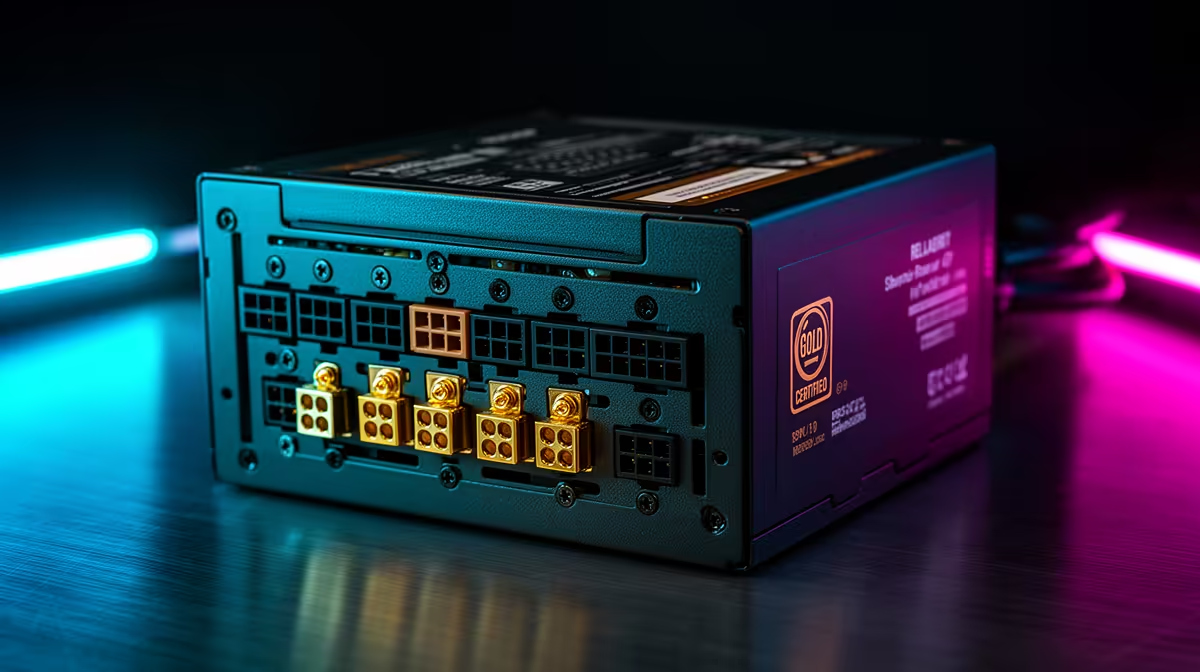
Yes, a 1,000W 80 Plus Gold PSU can run a high-end gaming PC without bottlenecks in virtually every current build configuration. Even an RTX 5090 paired with a Ryzen 9 9950X peaks around 850W under combined full load, leaving 150W of headroom before hitting the 1,000W ceiling.
Real System Power Draw at Maximum Load 🎮
Understanding whether a 1,000W Gold PSU will bottleneck a high-end build requires looking at actual measured system draw, not just adding TDP ratings. An RTX 5090 has a 575W TDP but typically draws 540W to 580W in real gaming workloads at 4K. A Ryzen 9 9950X operating under full CPU load draws 170W. Add 80W to 100W for three 120mm case fans, two NVMe SSDs, a 360mm AIO pump and ARGB lighting, and you land at roughly 800W to 850W total at the wall under simultaneous CPU-GPU stress, a scenario that rarely occurs in actual gaming. In games, the CPU load is typically 40% to 60% of maximum while the GPU runs at 95% or above, pulling around 700W to 750W total. A 1,000W Gold unit at 70% to 75% of rated load operates in its optimal efficiency band.
When 1,000W May Not Be Enough 🔧
There are edge cases where 1,000W can become limiting. Professional workstations running simultaneous CPU rendering on all cores (Blender, DaVinci Resolve) while the GPU also handles a compute task can push past 900W and approach 1,000W regularly. Overclocked systems with CPU power limits raised above 200W and a GPU simultaneously boosted above its stock TDP could also push into the 950W to 1,000W zone under sustained load. For these specific workloads, stepping to a 1,200W Gold unit, which costs around R500 to R800 more in SA, provides meaningful headroom without significant efficiency trade-offs.
Over-Current Protection and Transient Spike Handling ⚡
Beyond raw wattage, a quality 1,000W Gold ATX 3.0 unit handles the transient power spikes that modern GPUs produce. The RTX 5090 can draw brief spikes of 50% to 100% above its average load during intense compute bursts. An ATX 3.0 certified 1,000W PSU is tested to absorb these spikes without triggering OCP (over-current protection). A non-compliant older-design 1,000W unit may trip protection at these spikes, causing an instant system shutdown. This is why ATX 3.0 compliance matters just as much as the wattage figure printed on the label.
Run a Stress Test After Build Completion ⚡
After completing your high-end build, run a combined CPU and GPU stress test for fifteen minutes using tools like OCCT or FurMark alongside Cinebench. Monitor system power draw via a wall-socket watt meter or your PSU software dashboard. Confirming your actual draw is under 85% of rated PSU capacity gives you confidence that headroom exists for transient spikes.
FAQ
Will my RTX 5090 throttle if the PSU cannot supply enough power?
Yes. If the PSU hits its protection threshold, the system either shuts down or the GPU throttles its clock speed to reduce draw. This manifests as sudden FPS drops during intense scenes rather than a system crash in some cases.
Is there any scenario where a 1,000W unit is too much for a gaming PC?
A 1,000W PSU running a system that never exceeds 400W operates at 40% load, which is below the optimal efficiency range for most Gold units. You are not wasting electricity, but you paid for capacity you are not using. Match wattage closer to your actual load.
Does PSU wattage affect GPU or CPU overclocking headroom?
Directly, yes. An overclocked RTX 5090 with a raised power limit requires the PSU to supply more watts. A 1,000W unit with 850W already in use has little margin for a 15% GPU overclock that pushes draw by another 80W to 90W.
Confident a 1,000W Gold PSU is the right choice for your build?
Evetech stocks a full range of 1,000W Gold and Platinum units with ATX 3.0 compliance and local warranty support.