Quick Answer
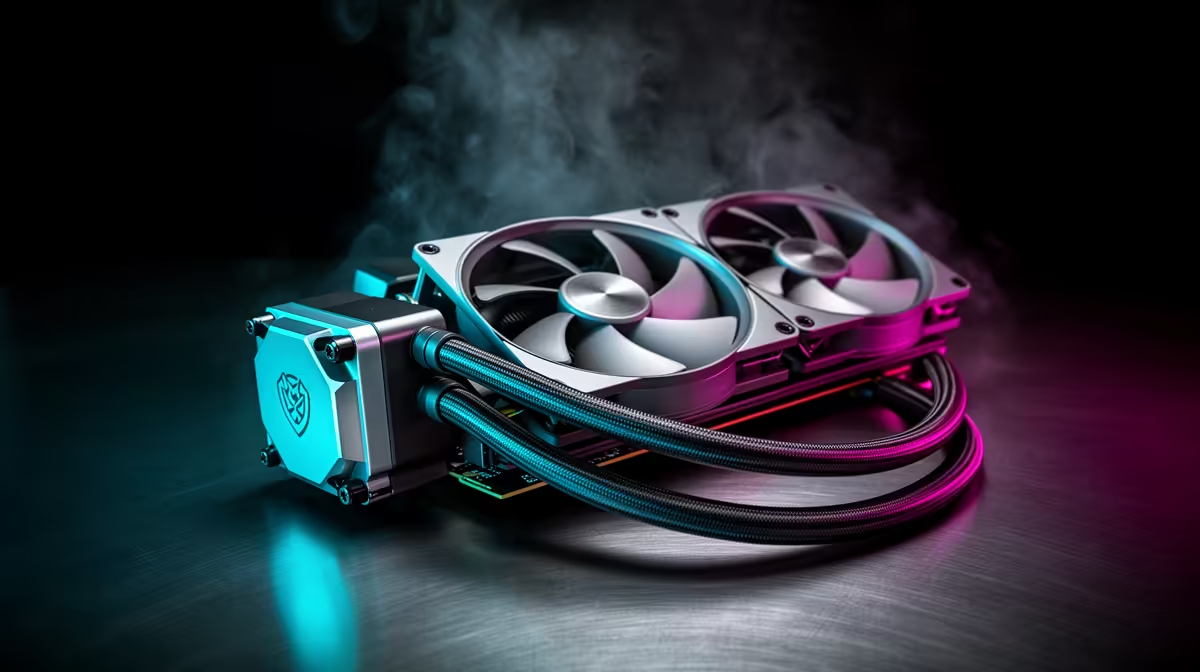
Yes, many current-generation premium AIOs ship with mounting hardware in the box that supports AM5, AM4, LGA1851, and LGA1700 simultaneously. This means a single AIO purchase can cover all four major current and recent CPU platforms, making it a sound investment for builders who plan to reuse their cooler across an upgrade cycle.
Which Mounting Hardware Is Required for Each Socket 🔧
AM4 and AM5 use the same 54 mm x 90 mm bolt spacing, so the same backplate and standoff kit covers both AMD sockets on most AIOs. Intel LGA1700 and LGA1851 also share a common mounting pattern, introduced with Alder Lake (12th gen) and maintained through Arrow Lake (Core Ultra 200-series). This means a cooler with two mounting kit sets, one AMD and one Intel, physically covers all four platforms. The practical implication is that upgrading from a Ryzen 5000-series AM4 build to a Ryzen 9000-series AM5 build, or from a 13th-gen LGA1700 build to a Core Ultra LGA1851 build, does not necessarily require a new cooler. Check the manufacturer's compatibility page to confirm the specific unit you own includes updated brackets for the newer sockets.
What to Verify Before Reusing an Older AIO 🔍
Before reusing an existing AIO on a new platform, verify three things.
Manufacturer Mounting Kit Support Policies 🖥️
The two main policies across brands are "included in box" and "request separately." Brands that include all four socket kits in the box make cross-platform reuse trivial. Brands that ship a single-platform kit and sell additional brackets separately require a small additional purchase (typically R150 to R300 for an upgrade kit) when moving to a new socket. Corsair, ASUS ROG, and Cooler Master have historically provided free or low-cost socket upgrade kits when new platforms launch. Confirming your brand's policy before purchasing a new CPU is a simple pre-upgrade step that can save the cost of a new AIO entirely.
Post-Move Temperature Check ⚡
After remounting your AIO on a new socket, run a 10-minute stress test using Cinebench R24 multi-core loop and check CPU package temperature in HWiNFO64. A properly remounted AIO with fresh thermal paste should show temperatures within 3 to 5 degrees Celsius of your previous platform's results at equivalent TDP. A large spike (more than 10 degrees Celsius above expectation) indicates a mounting or paste issue requiring a reseat.
FAQ
Will my AIO's thermal performance change when moving from LGA1700 to LGA1851?
Not significantly, since both sockets use the same mounting pattern and clamping force. The main variable is whether the AIO's cold plate adequately covers the new CPU's IHS. Core Ultra 200-series chips have similar IHS dimensions to their 13th/14th-gen predecessors, so cold plate coverage is generally comparable.
Do I need to replace thermal paste when moving an AIO to a new socket?
Yes. Removing and remounting a cold plate disturbs the thermal paste contact layer. Always clean both the CPU IHS and the cold plate with isopropyl alcohol and apply fresh paste before remounting. Dried or disturbed paste on a remount can add 10 to 20 degrees Celsius to peak temperature.
Can I use an AM4 backplate on an AM5 motherboard?
Physically yes, since the hole spacing is identical. However, AMD recommends AM5-specific mounting hardware to ensure correct contact pressure for the new socket's pin structure. Use an AM5-rated backplate when available rather than carrying over the AM4 kit.
Planning an upgrade and want to reuse your AIO across a new platform?
Evetech lists socket compatibility and included hardware for every AIO in stock, so you can confirm cross-platform support before purchasing your next CPU.