Quick Answer
For most South African gaming builds, a functional rigid bracket at R150 to R350 does the job as well as an ARGB version at R300 to R600. Choose ARGB only if your build already has a synchronised lighting ecosystem and a glass side panel worth showing off.
The Core Job: Stopping PCIe Slot Stress 🔧
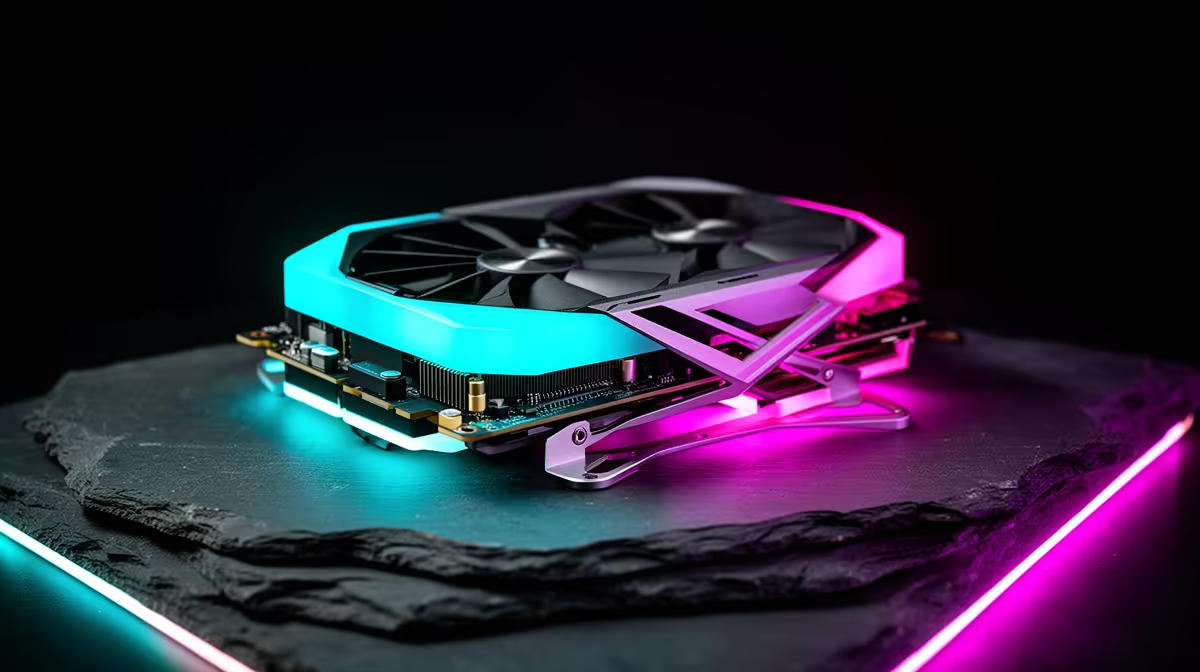
Both functional and ARGB GPU support brackets exist to counteract the downward torque that heavy cards place on the PCIe x16 slot. A triple-fan RTX 5080 or RX 9070 XT can weigh over 1.8 kg, and that weight, cantilevered off the slot, slowly flexes the motherboard over time. A rigid bracket neutralises this by transferring the load to a PCIe slot cover or case bracket rail.
The practical difference emerges in adjustability and build quality. Budget functional brackets are often steel with a fixed height notch system, which means you need the right notch to sit flush under your card. ARGB adjustable brackets typically use a threaded column or friction-lock slider, giving you finer height control.
When ARGB Actually Earns Its Price Premium 💡
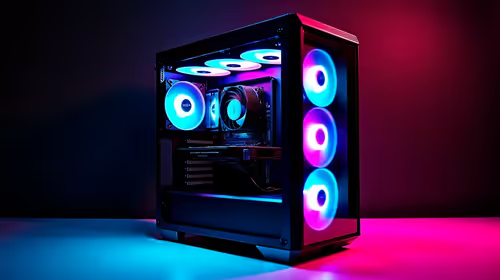
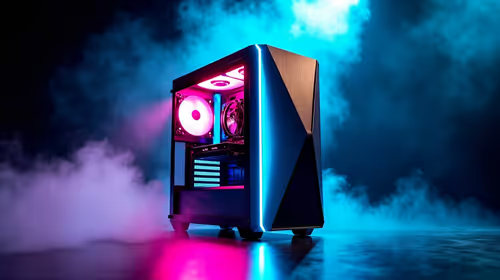
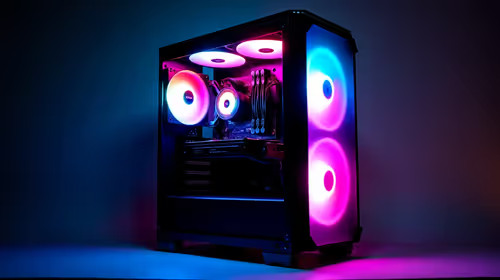
If your build runs a synchronised ARGB ecosystem through ASUS Aura Sync, MSI Mystic Light, or Gigabyte RGB Fusion, adding an ARGB bracket that connects to a motherboard header means the lighting reacts to the same profiles as your fans and RAM. In a showcase build with a glass front and side panel, this creates a seamless effect from the front intake fans to the GPU sitting in the middle of the case.
For competitive-focused setups where the case is closed and the panel is solid, or for a secondary rig in a home office, the ARGB premium is wasted money. Spend that R150 to R250 difference on an extra case fan or better thermal paste instead.
Evaluating Fit for SA Build Scenarios 🖥️
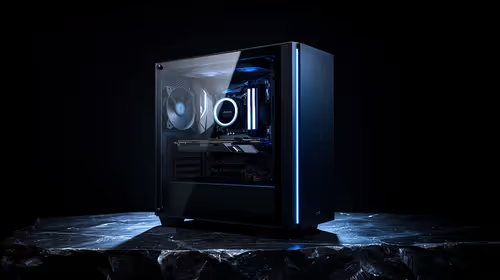
Budget gaming builds in the R15,000 to R25,000 range typically use mid-tower cases like the Lian Li Lancool or Corsair 4000D series. These cases have a standard PCIe slot bracket row, and a functional steel support fits without modification. High-end builds at R40,000 and above more commonly feature open-frame or glass-panel cases where aesthetics are part of the investment, making the ARGB option a rational choice.
For SA builders doing a white-themed build, a white ARGB bracket is one of the few accessories that contributes to both structural integrity and visual coherence. In a standard black build, a plain black steel bracket is invisible and perfectly adequate.
Check Bracket Compatibility With Your Slot Row ⚡
Before ordering any bracket, count how many PCIe slot covers your case has below the GPU slot. Some compact mid-towers only have one spare slot below the GPU, which limits which bracket designs will fit. A bracket that requires two free slots will not sit correctly in a tighter case.
FAQ
Do ARGB brackets connect to the motherboard or to a controller?
Most ARGB brackets include a 3-pin ARGB header cable that connects directly to a motherboard ARGB header or to an included controller box if your motherboard has no free header. Check that your motherboard has a spare 3-pin 5V ARGB header before buying a lighting-enabled bracket.
Can I use a GPU bracket on a PCIe riser cable setup?
If your GPU is mounted vertically on a riser cable, a traditional slot-based bracket will not align correctly. Vertical mounts usually hold the card securely by design, so a separate support bracket is not needed. Confirm your riser kit includes a locking mechanism for the GPU before relying on it alone.
How much sag is too much before I need a bracket?
Any visible droop when viewed from the side panel is worth correcting. If the back plate of the GPU is visibly angled downward rather than horizontal, the PCIe slot is already under stress. Cards over 1.5 kg should have support from day one regardless of how much sag is currently visible.
Sorting out GPU sag on your current build?
Evetech carries both functional and ARGB GPU support brackets to suit any case layout and budget. Check what is currently stocked to find a bracket that matches your card height and aesthetic.