Hitting 'deploy' in Warzone, only for your frames to tank? Or maybe your shiny new RTX card is delivering lackluster performance? It’s a frustrating feeling many South African gamers know too well. Often, the culprit isn't your GPU… it's a CPU bottleneck, silently sabotaging your rig's potential. This guide will help you spot it and, more importantly, fix it for good.
What Exactly is a CPU Bottleneck?
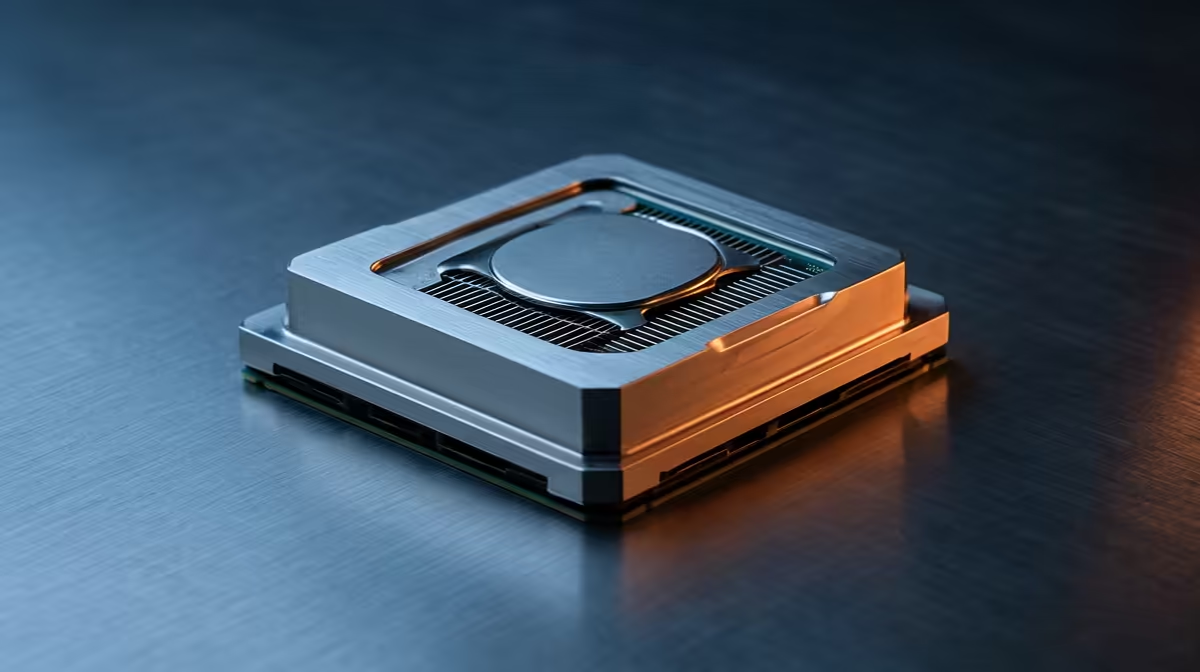
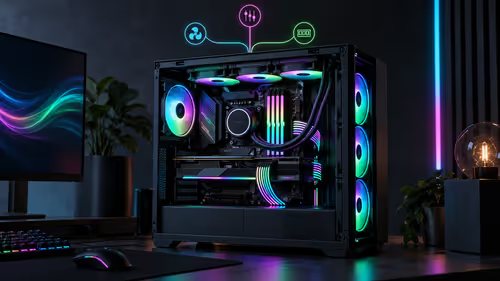
Think of your gaming PC as a high-speed production line. Your Graphics Card (GPU) is a powerful machine that renders beautiful frames, and your Central Processing Unit (CPU) is the manager feeding it the instructions—what to draw, where to put it, and how physics should work.
A CPU bottleneck happens when the manager (CPU) can't give instructions fast enough for the machine (GPU) to work at full capacity. Your powerful GPU ends up waiting around, leading to stuttering, lower-than-expected frame rates, and wasted potential. It’s a common problem, especially after upgrading only one component in your system.
How to Spot a CPU Bottleneck in Your Rig 🔧
Before you start shopping for new parts, you need to confirm that a CPU bottleneck is actually the problem. It’s easier to diagnose than you think. Here are two simple methods.
Check Your Component Usage
This is the most reliable way to identify a bottleneck.
- Fire up your favourite game.
- Press
Ctrl+Shift+Esc to open the Windows Task Manager and click on the "Performance" tab. - Look at your CPU and GPU utilisation percentages while the game is running.
If you see your CPU usage consistently hitting 90-100% while your GPU usage is significantly lower (e.g., 60-70%), you've found your bottleneck. Your CPU is running flat-out and can't keep up.
Listen to Your Games
Some games are notoriously hard on the processor. Titles with complex AI, lots of players, or intricate physics simulations (like Civilization VI, Microsoft Flight Simulator, or large-scale battles in Total War) will expose a weak CPU quickly. If you experience smooth performance in graphically intense but simple games, yet suffer from major stutters in these CPU-heavy titles, it's a strong sign your processor is the weak link.
Fixing Your CPU Bottleneck: The Upgrade Path 🚀
While you can sometimes ease a minor bottleneck by closing background apps or lowering CPU-intensive game settings (like shadows and view distance), the only real, long-term solution is an upgrade. A balanced PC is a happy PC.
Choosing a new processor can feel daunting, but it usually comes down to two teams. Exploring the powerful single-core performance found in many Intel CPUs is a great starting point for gamers focused on maximum frame rates. Alternatively, the excellent multi-core value from the latest AMD CPUs can crush both gaming and productivity tasks, offering incredible versatility.
Check Your Motherboard First!
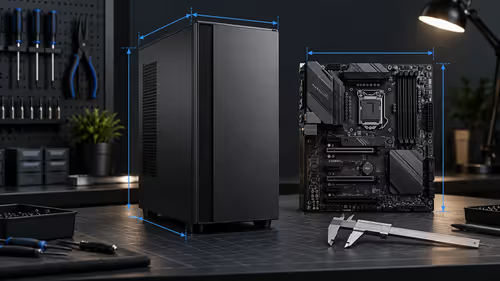
Before you splash out on a new CPU, double-check your motherboard's socket type (e.g., AM5 or LGA 1700) and BIOS version. A quick search on the manufacturer's website can save you a massive headache and ensure compatibility. ✨
Ultimately, the best CPU is one that pairs well with your GPU, preventing either component from holding the other back. This balance is the key to unlocking the smooth, high-FPS experience you deserve.
Ready to Smash the Bottleneck?
Don't let a sluggish processor hold your graphics card hostage. Explore our massive range of CPUs to find the perfect match for your rig and budget. Shop all CPU processors at Evetech and unlock the performance you paid for.