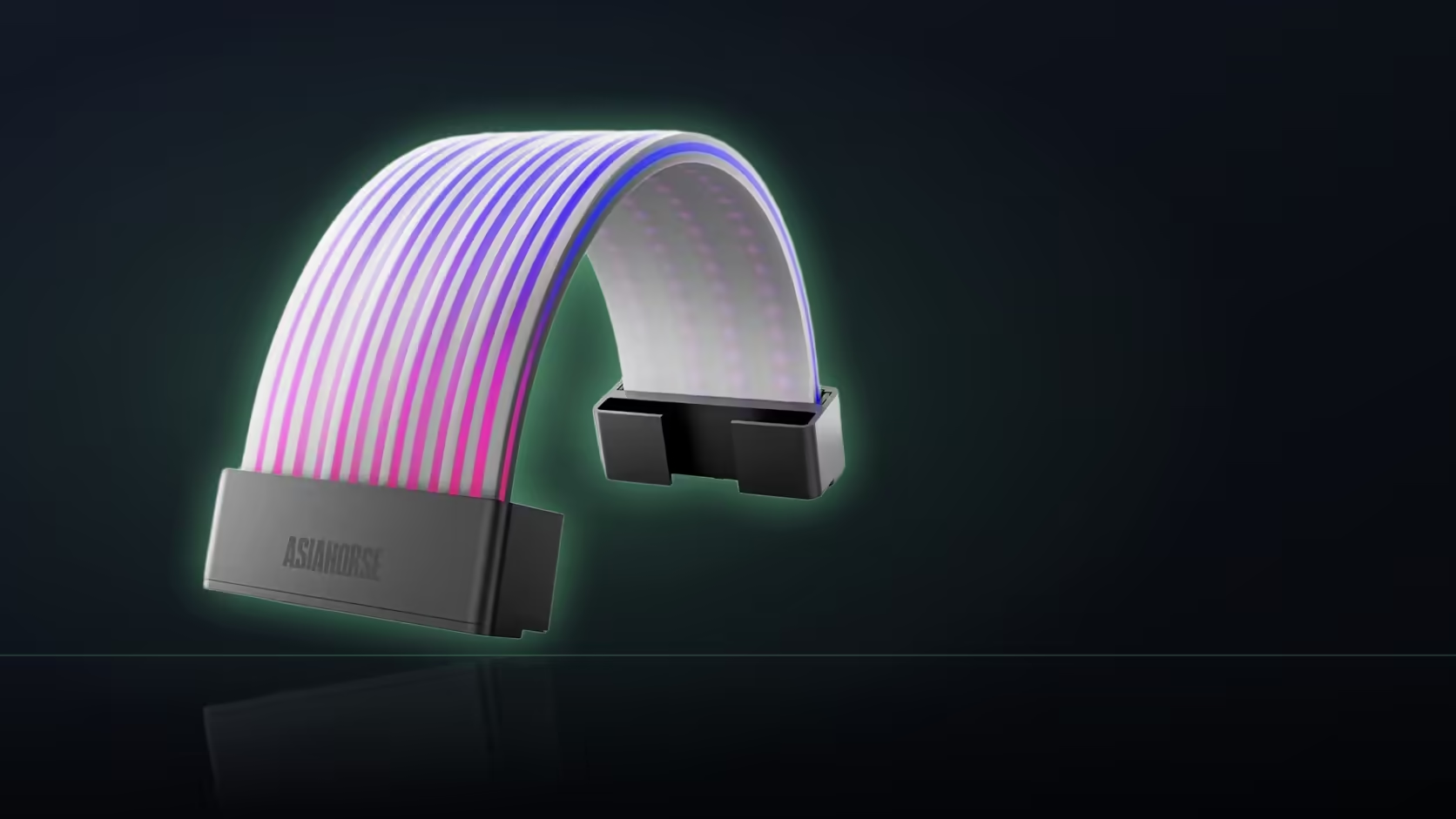
Cables bend. Moulded shells don't. That single mismatch is the real design constraint behind fitting AsiaHorse's Aurora ARGB cover kit onto any given build, and it matters more than most other factors in deciding where either shell can actually go.
Quick Answer
A power supply cable can follow whatever curve a case layout demands, but the Aurora kit's shells are rigid, fixed-length covers built around a straight section of that cable. Where a run bends through the area a shell would need to occupy, the cover has to work around that bend rather than clip across it - which makes the straightness of the run, not just its length, the real deciding factor in where either R699 shell can sit.
🧱 Why the shell needs a straight run
Both covers are moulded to a fixed shape and length, and a moulded shell simply can't flex to follow a curve the way the cable underneath it can. For the shell to close properly, the section of cable inside it has to run in a straight line matching the shell's own profile - any bend within that span leaves the shell either unable to close cleanly or sitting awkwardly over a cable it's fighting against.
🌀 What happens where the visible run curves
If the section a buyer wants to light happens to curve - which is common wherever a cable emerges from a shroud and turns towards its destination - the shell ends up sitting on whichever straight portion of that run is long enough, and that portion may not be the section originally intended to show. The curve itself simply can't be covered.
Is re-routing the cable usually the better fix?
Generally, yes. Reshaping how the cable is routed costs nothing beyond a few minutes of adjustment, and it's the step that actually opens up the placement options rather than working around a fixed curve. A cable pulled straighter through the area a shell needs to cover almost always gives more flexibility than trying to force a shell over a bend.
📏 How much straight length is actually needed
At minimum, the shell's own length - which differs between the two covers, since the board shell and the graphics shell aren't the same size - plus a little extra room to actually clip it shut without the mechanism fighting the cable's shape at the edges.
🧭 What a straight span actually looks like in practice
Picturing this in the abstract is harder than seeing it on the cable itself. A genuinely straight span is one where the cable, laid flat, doesn't visibly drift left or right or dip up and down along its length - a standard that's easy to check by eye once the side panel is off and the run is fully visible. Cables that look "mostly straight" from a distance often reveal a gentle drift once examined closely, which is exactly the kind of curve that can still prevent a shell from closing evenly even though it wouldn't be obvious at a glance.
🤏 Does a gentle curve matter?
A very slight bow in the cable may be tolerable, since a small amount of give exists in how the shell sits. A shell genuinely forced over a real curve is a different matter - it stresses the clip points and tends to sit unevenly, which isn't something worth accepting just to avoid rerouting a cable.
🎯 Which run is more likely to curve?
The graphics run, generally, since it often turns as it comes up out of a power supply shroud on its way to the card's power sockets - a change of direction that's frequently built into the case layout itself rather than something the builder chose.
🧰 Tools that make straightening easier
A basic cable comb, even one not fitted permanently, can act as a temporary jig to hold a run flat while checking whether it will actually take a shell - useful for confirming a fit before committing to a final position. Gentle, deliberate bends by hand, rather than forcing a cable around a tight radius, tend to hold their shape better over time too, which matters for a run that's meant to stay straight under a fixed shell for the life of the build rather than springing back to its original curve after a few weeks.
✅ Settling the route before ordering
Confirming a genuinely straight span of the right length exists, before the Aurora kit itself arrives, is worth doing precisely because placement depends entirely on it - there's little point measuring a shell against a run that will need rerouting anyway. Evetech's cable management accessories are the natural tool for straightening a run before a cover ever gets involved. Anyone still undecided between a rigid cover and a more flexible lighting product can weigh the two against each other in the case lighting range.
A rigid cover isn't automatically the wrong choice for a build with an awkward route - it's simply a choice that pushes the work earlier, into the routing itself, rather than letting the lighting product absorb the awkwardness the way a flexible cable can. Which trade-off suits a particular build better tends to come down to how much routing flexibility already exists once everything else is installed, and whether reshaping a run is genuinely practical at that point, or whether the case layout itself leaves too little room to work with.
Frequently Asked Questions
Why does the shell specifically need a straight cable run?
Because it's a moulded cover of fixed length, so the cable inside it has to follow that same straight line for the shell to close properly.
What happens if the visible run actually curves?
The shell sits on whichever straight portion of that run is long enough, which may not be the exact section originally intended for it.
Is re-routing the cable usually the better fix?
Often yes, since reshaping the run costs nothing and opens up the placement options far more than working around a fixed bend.
How much straight cable length is actually needed?
At least the shell's own length - which differs between the board cover and the longer graphics cover - plus a little room to clip it shut.
Does a slight curve in the cable matter much?
A slight bow may be tolerable, but a shell genuinely forced over a real curve stresses the clip points and tends to sit unevenly.
Which of the two runs is more likely to curve?
The graphics run, since it often turns as it emerges from a power supply shroud on its way up to the card.
Should the route be confirmed before the kit is even ordered?
Yes - knowing a straight span of the right length exists is worth confirming first, since placement depends entirely on it.
Wondering if your cable route suits a rigid cover?
Browse Evetech's cable management and lighting accessories to see which fits your routing best.