Quick Answer
Budget R180 to R400 for a quality 21.6Gbps (HBR2, DisplayPort 1.2) cable at 1.5 metres in South Africa in 2026. Cables below R150 at this spec frequently use undersized conductors that fail at 4K at 60Hz under real-world conditions, while cables above R450 at this bandwidth tier are priced on premium branding rather than meaningful performance improvement.
Where the Money Goes Inside the Cable 🔧
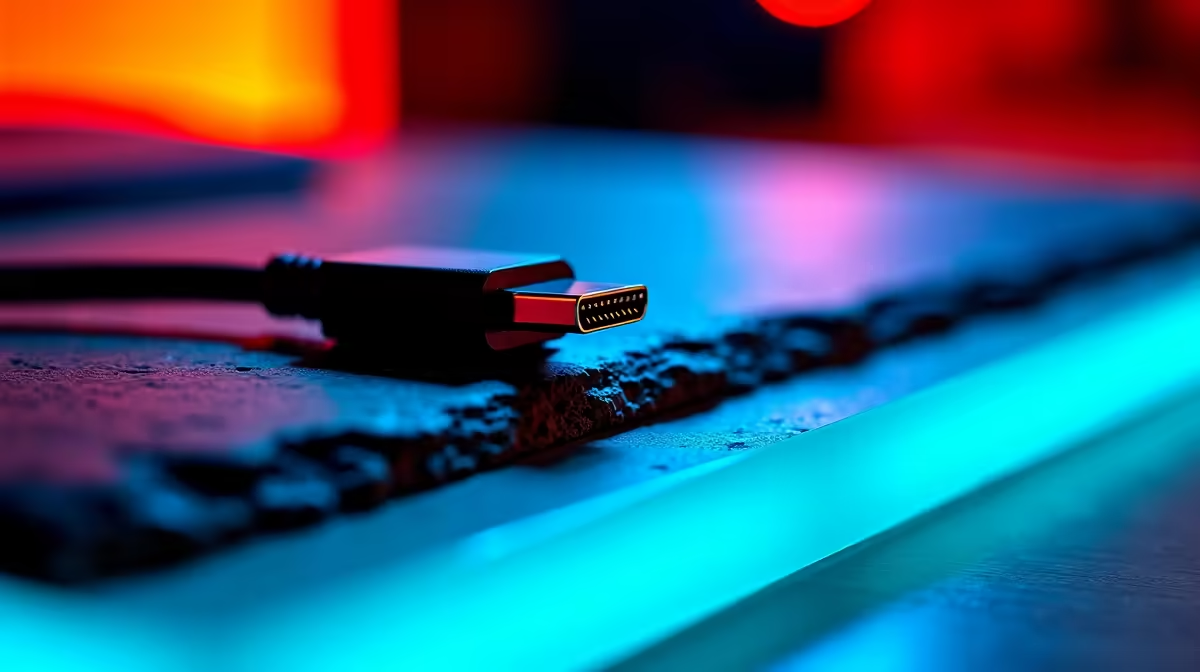
An HBR2 cable at 21.6Gbps uses four main signal lanes plus a ground return, all running as differential pairs that must be impedance-matched to 100 ohms. This requires precisely twisted wire pairs with consistent geometry and shielding, which is where cable cost concentrates. The conductor gauge for signal pairs at this bandwidth should be 26 to 28 AWG for runs up to 2 metres. Shielding (foil around each pair plus an overall braid) adds material cost. Gold-plated contacts on both connector ends protect the junction from oxidation. A well-engineered cable in this spec uses roughly R60 to R120 in materials at scale, which explains why the R180 to R350 range from reputable local suppliers represents genuine quality without excessive margin.
Price Tiers and What They Deliver in SA 💰
At R100 to R180, cables may carry HBR2-level marketing but often use 30 AWG conductors that marginally pass at 4K at 60Hz in electrically quiet environments but fail intermittently in busy setups or at cable runs above 1.5 metres. At R180 to R350, you get cables with proper 26 to 28 AWG signal conductors, foil plus braid shielding, and genuine gold-plated contacts, which perform reliably at 4K at 60Hz over 1.5 to 2 metre runs in any home office or gaming setup. At R350 to R500, cables add braided outer jackets for durability and more robust strain reliefs, useful if the cable is moved regularly. Above R500 for an HBR2 cable, you are paying for packaging and branding, as the signal performance is identical to a well-made R300 cable.
When It Makes Sense to Spend More 📦
The only justified reason to spend above R400 on an HBR2 cable is if you need a braided cable for an articulating monitor arm where the cable flexes daily, or if you need an extended 3 metre length for an unusual desk layout (in which case an active cable at R500 to R800 is the correct product). For a fixed desktop run from a gaming PC or workstation to a 4K monitor, R200 to R350 spent at Evetech on a local stock HBR2 cable is the correct budget. Spending more does not improve the 4K at 60Hz experience in any measurable way for a standard setup.
Buy the Cable Before the Monitor Arrives ⚡
New 4K monitors rarely include a DisplayPort cable in the box, and unboxing a R6,000 to R12,000 display only to find you cannot run it at full resolution because you are missing an HBR2 cable is a common frustration. Order the cable at the same time as the monitor so you can verify 4K at 60Hz on the day of installation.
FAQ
Is a more expensive cable worth it for a 4K monitor in a home setup?
For a fixed 1.5 metre desktop run, the R180 to R350 range covers the requirement completely. Spending above R450 on an HBR2 cable for a home setup provides no signal quality benefit.
Can I use the same cable for both DisplayPort 1.2 and DisplayPort 1.4 devices?
An HBR2 cable used on a DisplayPort 1.4 source and monitor will operate at HBR2 speeds, capping at 4K at 60Hz. If you want to reach 4K at 120Hz or 1440p at 240Hz on a DisplayPort 1.4 setup, you need an HBR3 cable, which costs R50 to R100 more than an HBR2 cable locally.
What is the cheapest cable that reliably handles 4K at 60Hz in South Africa?
A locally stocked cable priced at R180 to R220 from an established retailer like Evetech that explicitly states HBR2 or DisplayPort 1.2 compliance is the minimum reliable option. Cheaper unbranded cables can work but lack consistent quality control.
Buying a 4K monitor and need the right cable?
Evetech stocks HBR2-rated DisplayPort cables starting from competitive local prices, with same-day availability for Johannesburg, Cape Town, and Durban orders.