Quick Answer
Prioritise performance first (pump platform and radiator size matched to your CPU's TDP), then consider display features only if your case has a visible side panel and you have budget headroom above R3,500. Aesthetics should drive the colour choice but never the radiator size or pump quality.
Step One: Match Cooling Performance to Your CPU 🔧
The first question is always thermal: what is your CPU's TDP and what room temperature do you game in? For South African builders in Gauteng and Limpopo where summer ambient reaches 28 to 35 degrees Celsius, add 8 to 10 degrees to any international benchmark result to get a realistic local temperature estimate. A Ryzen 7 9700X (65W gaming, 88W all-core) is adequately served by a quality 240mm AIO at R1,500 to R2,200. A Core Ultra 9 285K or Ryzen 9 9950X (up to 250W and 170W respectively) needs a 360mm unit from a reputable pump platform. Buying a display-AIO at the wrong radiator size is always the wrong trade: a 240mm LCD AIO does not outperform a 360mm standard AIO on a hot CPU, regardless of how impressive the screen looks.
Step Two: Evaluate Display Features for Your Use Case 🖥️
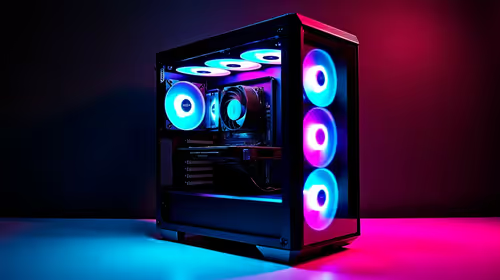
LCD and AMOLED pump displays add R1,000 to R4,000 to the cost of an AIO in South Africa without delivering thermal gains. They are worth considering when your case sits on your desk with the glass panel facing you, when you stream or create video content where the PC is on camera, or when the build is a showcase system for display rather than purely a gaming tool. If your PC is under a desk or in a closed case, a display AIO is money spent on something you will never see during a gaming session.
Step Three: Aesthetics Are the Final Filter 🎨
Once performance and display features are resolved, use aesthetics to choose between equivalent models. White versus black is the most common SA builder decision: white AIOs suit all-white or white-and-glass builds and are stocked at Evetech in several models. Black suits stealth builds and is more universally compatible with mixed-colour components. ARGB versus fixed-colour is a software question: ARGB lets you change colours any time; fixed LED units are limited to their set colour. For ecosystem consistency, choose an AIO from the same brand as your motherboard (ROG with Asus, MSI Mag Coreliquid with MSI boards) to simplify RGB synchronisation through a single software interface.
Set Your Budget Ceiling Before Researching AIOs ⚡
Decide your maximum spend before reading AIO reviews, because display AIOs are genuinely impressive and easy to justify emotionally. Fixing a ceiling (for example, R4,000 maximum) forces you to evaluate units within that range rather than being drawn upward by premium display models that offer no thermal benefit for your specific CPU.
FAQ
Can a display AIO hurt thermals by drawing USB power?
No. The USB header used by LCD display AIOs draws minimal power (under 1W) and has no measurable effect on CPU thermals or pump performance. The display is electrically isolated from the pump motor circuit.
Is an ARGB ring on the pump head visible through most cases?
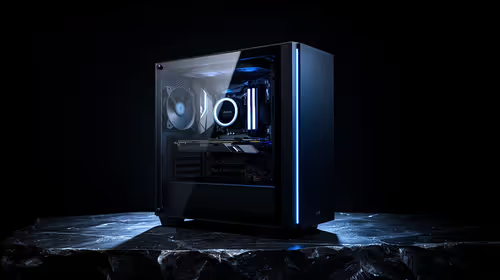
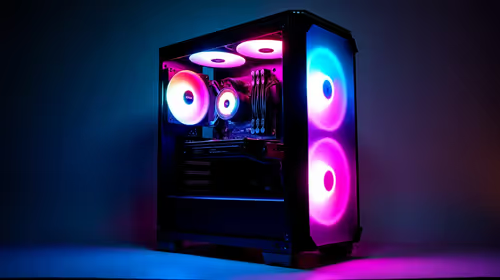
In most glass-panel mid-tower and full-tower cases, yes. The pump head sits directly above the CPU socket and the ARGB ring faces the side glass panel. A correctly mounted AIO with a lighted pump head is visible in almost any build with a tempered glass panel.
Which matters more for a South African summer gaming setup: radiator size or fan quality?
Radiator size determines the maximum heat load the AIO can handle, while fan quality determines how efficiently it reaches that capacity. Both matter, but if you can only upgrade one, choose the correct radiator size first. A 360mm with average fans still outperforms a 240mm with premium fans on a 170W CPU in a hot room.
Not sure which AIO tier is right for your build and budget?
Evetech stocks AIOs from straightforward 240mm and 360mm standard units to full LCD and AMOLED display models, all with local pricing in ZAR. Browse the CPU cooler section to compare tiers side by side.