Quick Answer
High-pitched fan whine is caused by harmonic resonance in fan blades vibrating at their natural frequency under motor excitation. LCP blades eliminate this because their crystalline molecular structure has a much higher stiffness-to-weight ratio than ABS plastic, pushing the blade's resonant frequency far above the 1 to 4 kHz range that human hearing finds most irritating.
The Physics of Fan Whine 🔧
Every fan blade has a natural resonant frequency determined by its mass, stiffness, and geometry. When a motor drives a blade at an RPM that excites that frequency, the blade vibrates harmonically and radiates sound. ABS plastic blades have low stiffness relative to their mass, placing their resonant frequency in the 2 to 5 kHz zone where human hearing is most sensitive. As bearings wear over time, vibration input increases and whine becomes progressively more pronounced.
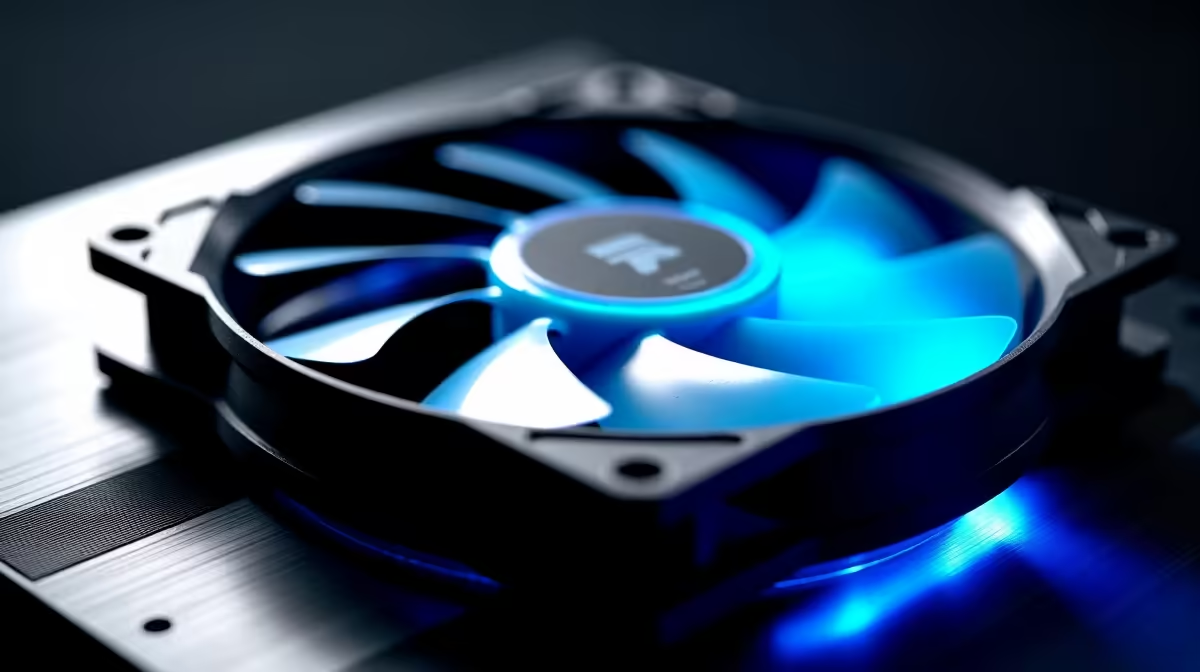
LCP's aligned polymer chains produce a material roughly twice as stiff as ABS at the same weight. That stiffness pushes blade resonant frequency above 8 to 10 kHz, where perceived noise is far lower. Fans like the Lian Li Uni Fan SL-Inf 120 use LCP blades and measure below 24 dBA at 1,900 RPM, where ABS-blade fans in the same class typically register 30 to 34 dBA with noticeable tonal components.
Pairing LCP Blades with the Right Bearing 🖥️
LCP blades address harmonic resonance, but whine can also originate from the bearing itself. Sleeve bearings develop play as lubricant degrades, creating rattling at low RPM. Ball bearings generate high-frequency bearing noise. The ideal pairing for silent operation is LCP blades plus Fluid Dynamic Bearings (FDB), where a hydrodynamic oil film keeps the shaft centred with zero metal-to-metal contact. This combination produces noise floors under 20 dBA at mid-range RPM in a 120mm form factor.
Practical Steps to Eliminate Whine in an Existing Build 💰
Start by identifying the source: use your motherboard's fan software to drop each fan to minimum RPM one at a time and listen for changes. Once you isolate the offending fan, replace it with an LCP-bladed alternative. Anti-vibration rubber mounts further reduce frame resonance transmitted to the case. In South Africa, replacement LCP fans retail around R350 to R600 each, or R1,100 to R1,800 for a triple pack, currently stocked at Evetech.
Lower Your Fan Curve Before Replacing ⚡
Before spending on new fans, check if your motherboard PWM fan curve is set too aggressively. Reducing max RPM from 2,000 to 1,500 often eliminates the resonant frequency range that causes whine in ABS fans. Use BIOS fan curve settings or Fan Control software to set a gentler ramp that starts only above 65 degrees Celsius CPU temp.
FAQ
Can anti-vibration mounts fully replace LCP blades for eliminating whine?
No. Anti-vibration mounts reduce structurally transmitted vibration through the case frame but do not address airborne sound radiated by a resonating blade. LCP blades are required to reduce the whine source itself.
Does fan whine get worse in SA summer heat?
Yes. Higher ambient temperatures push fan RPM higher to maintain thermals. Spending more time at high RPM increases the chance of exciting blade resonance and accelerates bearing lubricant degradation in sleeve-bearing fans.
How do I verify a fan genuinely uses LCP blades?
Look for LCP or Liquid Crystal Polymer in the product datasheet, not just marketing copy. Legitimate LCP blades are noted in detailed technical specifications and typically appear semi-translucent compared to matte ABS blades.
Tired of fan whine ruining your gaming or work environment?
Browse LCP-bladed fan packs and precision coolers at Evetech, stocked locally for SA builders.