Quick Answer
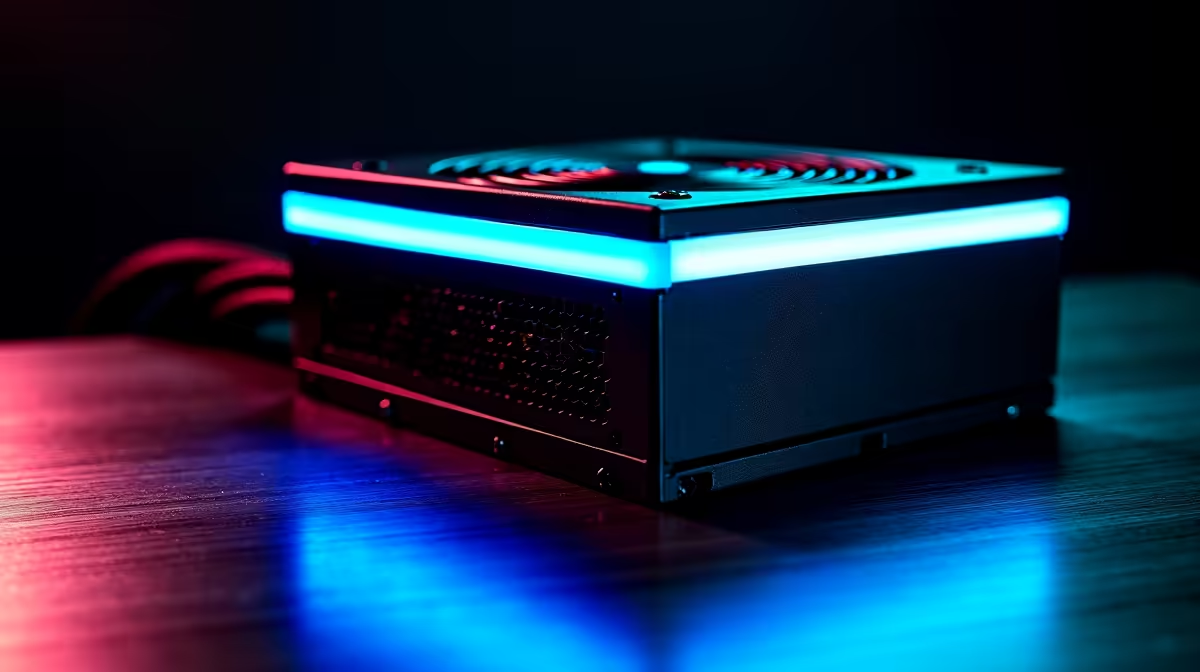
A future-proof PSU for an SA gaming rig needs 80 Plus Gold or Platinum rating, 850W or higher wattage for current and next-gen GPU support, native 16-pin 12V-2x6 PCIe 5.0 cabling, and a seven-to-ten year local warranty. Budget R3,500 to R5,500 for a unit that will serve through two to three GPU upgrade cycles without replacement.
Why Wattage Headroom Is the First Decision 💡
GPU power consumption trends only upward. The RTX 3090 drew 350W, the RTX 4090 drew 450W, and the RTX 5090 draws 575W. A build today around an RTX 5070 Ti peaks at 650W to 700W total system draw. A 750W Gold unit handles this, but leaves no headroom for the next GPU generation. Buying an 850W or 1000W Platinum unit now at R4,000 to R5,000 absorbs one or two GPU upgrade cycles without a PSU swap. A PSU replacement in SA, including potential workshop labour and the cost of the new unit, closes that price gap considerably. Treat wattage headroom as an insurance policy.
Connector Standards and PCIe 5.0 Readiness 🔧
The 16-pin 12V-2x6 connector is now standard on RTX 50-series and select RX 9000-series cards. Older PSUs using two or three 8-pin adapters introduce resistance and heat under sustained high-draw loads like ray tracing at 4K. A future-proof purchase means a PSU shipping with a native 12V-2x6 cable, which the majority of Tier-1 units released since mid-2024 include. Also confirm SATA run counts: some premium modular units cap at four SATA connectors per cable, adequate for most builds but worth checking against a planned high-drive-count configuration.
SA Grid and Voltage Considerations 🇿🇦
South African mains supply runs at 230V AC nominal with a tolerance of plus or minus 10 percent. Quality Tier-1 PSUs with active PFC handle this range without stress. Units with a manual 115V/230V voltage selector must be confirmed at the 230V position before first boot: running SA 230V supply through a 115V setting destroys the unit immediately. Virtually all modern ATX PSUs are auto-switching universal input, but verify this on the spec sheet of any unit under R2,500 from an unfamiliar brand. Cape Town summer ambients can push case internals above 40°C; Japanese-spec 105°C capacitors in Tier-1 units handle this, generic 85°C caps do not.
Plan for Two GPU Generations, Not One ⚡
When sizing your PSU, look up the TDP of the next-next GPU tier above your current purchase. If buying an RTX 5080 today, size for a theoretical 650W next-gen flagship. Choose a PSU that keeps the system at or below 80 percent load at that projected peak. This single rule prevents a forced PSU replacement when you upgrade in two to three years.
FAQ
Should I buy 1000W or 1200W for future-proofing in South Africa?
For most SA gamers building around a single GPU, 1000W Platinum is the future-proof sweet spot through two GPU upgrade cycles. Choose 1200W only for flagship GPU and high-core-count HEDT CPU pairings, or multi-GPU compute workloads.
Does a longer PSU warranty mean better build quality?
Generally yes. Manufacturers offering seven-to-ten year warranties only do so if their QA and component specs support it. Under three years on a premium unit signals a low-cost-positioning build rather than a longevity-first design.
Can a gaming PSU power a home NAS or server alongside a gaming rig?
A quality PSU can, but gaming PSUs are optimised for variable high-load cycles. A dedicated server PSU designed for 24/7 steady-state draw is a better fit for always-on NAS units, though a Platinum gaming PSU still outperforms most budget server alternatives.
Build it once, build it right.
Evetech stocks Gold and Platinum-rated PSUs in 850W, 1000W, and 1200W capacities, all with local SA warranty, ready for today's hardware and tomorrow's upgrades.