So, you’re hunting for a new creative powerhouse. You’ve asked for advice and been flooded with opinions: “You HAVE to get a Mac,” or “Just get the one with the most RAM.” It’s enough to make your head spin. Here in Mzansi, getting the right tool for the job without breaking the bank is key. Let’s cut through the noise and bust five common myths about choosing laptops for graphic design in SA. 💻
Myth 1: You Must Buy a MacBook for "Real" Design Work
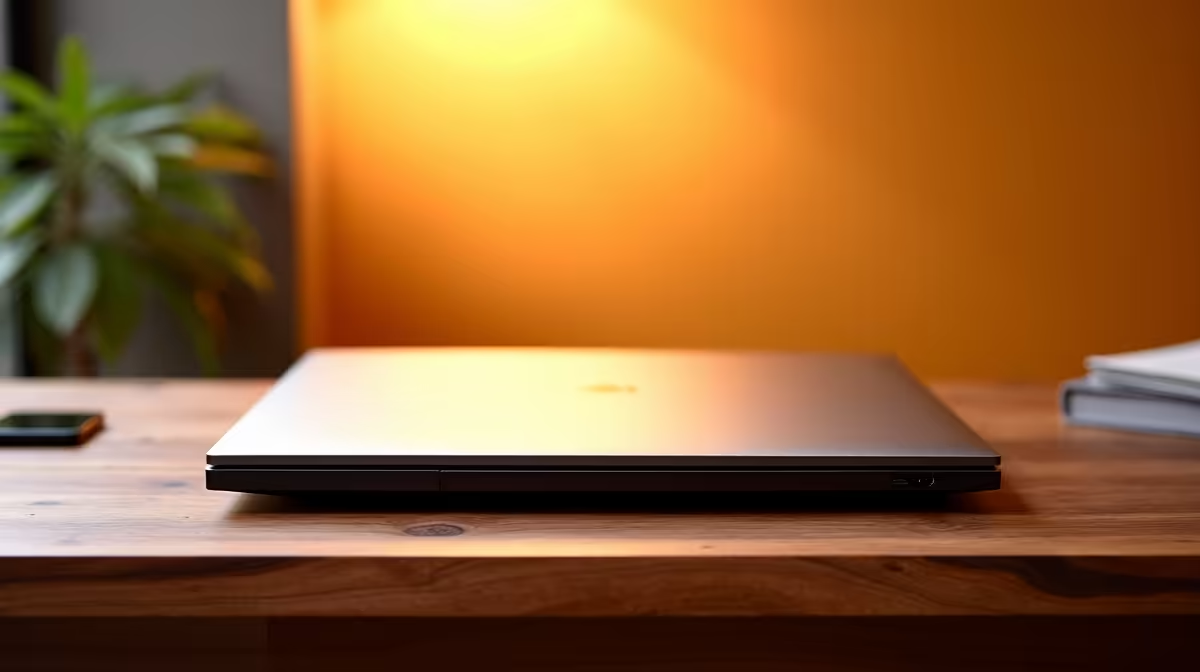
This is probably the oldest myth in the book. While Apple makes beautiful machines, the idea that they are the only choice for creatives is seriously outdated. Today, Windows laptops offer incredible power, wider hardware choices, and far better value for your hard-earned Rands.
Many of the most powerful gaming laptops are actually perfect for designers. They come packed with high-end NVIDIA or AMD graphics cards, top-tier processors, and fast, colour-accurate screens that give any MacBook a run for its money. Plus, you get the freedom to upgrade components down the line… something you just can’t do with a sealed Apple machine.
Myth 2: A Strong Graphics Card is Only for 3D and Video
Think your work in Photoshop and Illustrator doesn’t need a beefy GPU? Think again. Modern creative software is smarter than ever, offloading demanding tasks from the CPU to the Graphics Processing Unit (GPU) for a much smoother experience.
This is called GPU acceleration. It speeds up everything from applying complex filters and effects in Photoshop to live-rendering vector paths in Illustrator. A capable graphics card means less lag, faster exports, and a more fluid workflow. Choosing one of the better laptops for graphic design in SA means prioritising a decent dedicated GPU, even for 2D work. ✨
Check Your GPU Settings 🔧
In Adobe apps like Photoshop and Illustrator, you can check if GPU acceleration is enabled. Go to Edit > Preferences > Performance and ensure the "Use Graphics Processor" option is ticked. This simple check can dramatically boost your app's responsiveness!
Myth 3: More Cores and More RAM Are Always the Answer
While it's tempting to just throw money at the highest numbers, smart spec selection is more nuanced.
CPU: It's a Balancing Act
For a long time, the focus was purely on clock speed (GHz). Then, it shifted to core count. The truth? You need both. Many design tasks, like manipulating a single object, rely on fast single-core speed. But others, like rendering a preview or exporting a file, use all the cores they can get. This is why both the latest ranges of powerful AMD laptops and the newest Intel laptops on special offer a fantastic mix of high clock speeds and multiple cores to handle modern creative workloads.
RAM: Find the Sweet Spot
RAM (Random Access Memory) is like your digital workspace. 8GB is simply not enough for professional design in 2024.
- 16GB: The perfect starting point for most designers using apps like Photoshop, Illustrator, and InDesign.
- 32GB: The sweet spot. It allows you to run multiple heavy applications simultaneously without your system slowing to a crawl.
- 64GB+: Only necessary if you’re working with massive 8K video files, complex 3D scenes, or huge multi-gigabyte Photoshop files.
Don't pay for RAM you won't use. For most South African designers, 16GB or 32GB is the smart choice.
Myth 4: Any 4K Screen is a Professional Screen
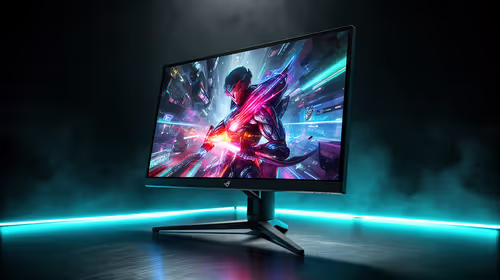
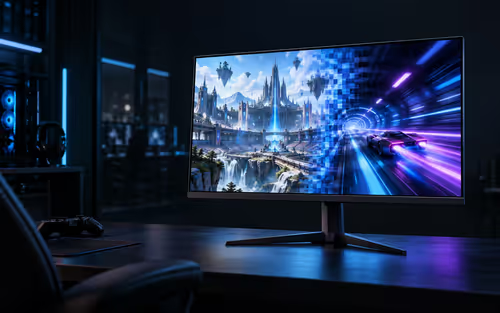
Resolution is only one part of the picture. A cheap, washed-out 4K screen is far worse for design work than a high-quality Full HD (1080p) or QHD (1440p) display with excellent colour accuracy.
When evaluating a screen for your design laptop, look for these specs:
- Colour Gamut: Look for displays that cover close to 100% of the sRGB colour space. For print and photo work, high coverage of Adobe RGB or DCI-P3 is even better.
- Brightness: A brighter screen (measured in nits) is easier to use in different lighting conditions. Aim for 300 nits or more.
- Panel Type: IPS (In-Plane Switching) panels offer the best colour reproduction and viewing angles.
A screen that shows true-to-life colour is non-negotiable. Don't let the 4K marketing buzz distract you from what really matters.
Myth 5: A Good Design Laptop Costs a Fortune
Perhaps the most damaging myth is that you need to spend R40,000 or more to get a machine that can handle professional creative work. That might have been true years ago, but not anymore. 🚀
The technology inside laptops has become so powerful and efficient that even mid-range machines can easily handle demanding design tasks. By focusing on a balanced spec sheet—a modern 6 or 8-core CPU, 16GB of RAM, a dedicated NVIDIA RTX 3050 or better, and a colour-accurate screen—you can find some incredible laptop specials that deliver serious performance without emptying your wallet.
The best laptop for graphic design in South Africa isn't the most expensive one; it's the one that intelligently matches its power to your specific needs and budget.
Ready to Find Your Perfect Match?
The myths are busted, and the path is clear. Finding the right creative tool is about smart choices, not just big price tags. Explore our massive range of laptop specials and find the perfect machine to bring your visions to life.