Quick Answer
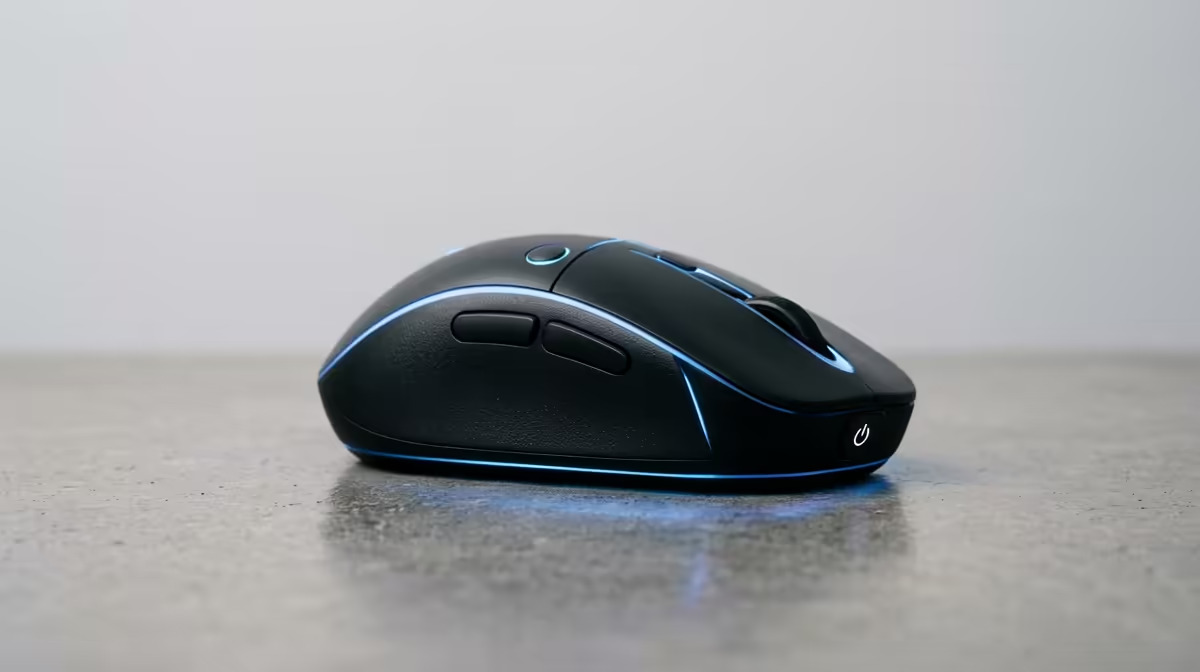
Bluetooth wins for portability because it requires no dongle, occupies no USB port, and pairs directly to any laptop or tablet. Nano receiver wireless is slightly faster and more reliable in congested RF environments but burns a USB-A port and risks losing the receiver during travel.
Bluetooth Mouse Advantages for Mobile Users 📡
A Bluetooth mouse pairs directly to a laptop, phone, or tablet with no physical adapter needed. For students at UCT, Wits, or UJ who carry laptops all day, this eliminates the risk of losing or snapping a nano receiver. Bluetooth 5.0 and above provides stable 10-metre range with latency around 7 to 20 ms in gaming Bluetooth mode, or 20 to 50 ms in standard HID mode, which is imperceptible for scrolling and clicking in office applications. Battery life on Bluetooth mice is generally longer than 2.4 GHz nano receiver mice because Bluetooth uses lower average transmission power. The Logitech MX Anywhere 3 is a strong Bluetooth productivity mouse costing around R1,200 to R1,500 at Evetech and also supports multi-device pairing across up to three devices via Bluetooth or Logitech's Logi Bolt receiver.
Nano Receiver Advantages for Desk Use 🖱️
Proprietary nano receivers running on 2.4 GHz provide latency as low as 1 ms on gaming-grade mice like the Razer DeathAdder V3 HyperSpeed or Logitech G305. They are immune to Bluetooth congestion, which is relevant in university libraries, coffee shops, and shared student accommodation where dozens of Bluetooth devices compete for the same spectrum. A nano receiver also provides a consistent connection quality across older laptops that may lack Bluetooth 5.0 and run an inferior BT stack. The USB port cost is manageable at a fixed desk but becomes a real friction point when travelling with a laptop that already has its ports occupied by storage, a dongle, or a hub.
Which to Choose Based on Your Situation 💼
If you move your laptop daily between home, campus, and a library: choose Bluetooth and keep the nano receiver at home in a safe spot. If you work at a fixed desk and prioritise the lowest possible click latency: use the nano receiver. If you own multiple devices (laptop plus tablet plus desktop): a Bluetooth mouse with multi-device pairing handles all three without swapping receivers. Many users in SA compromise with a dual-mode mouse that supports both, using the nano receiver at home and Bluetooth while commuting.
Store Your Nano Receiver Inside the Mouse ⚡
Logitech G305 and several other nano receiver mice have a storage slot in the battery compartment or underside. Always place the receiver there when travelling. If your mouse lacks this, store the receiver in a small pill organiser or zip pouch alongside your charging cable so it is never loose in a bag.
FAQ
Does Bluetooth cause lag during gaming?
Standard Bluetooth HID mode has 20 to 50 ms latency, which is noticeable in fast FPS games. Gaming-optimised Bluetooth modes (LE Audio, Bluetooth LE gaming) reduce this but are still not as fast as proprietary 2.4 GHz. For casual gaming and all office tasks, standard Bluetooth is fine.
What if my old laptop lacks Bluetooth?
A USB Bluetooth 5.0 adapter costs around R100 to R250 and installs without additional drivers on Windows 10 and 11. This adds Bluetooth to any laptop with a free USB-A port and is cheaper than replacing the mouse.
Can a Bluetooth mouse connect to both a laptop and tablet simultaneously?
Only if the mouse supports multi-device pairing profiles. Check the spec sheet for this. Most standard Bluetooth mice pair to one device at a time, requiring a manual disconnect and reconnect to switch.
Looking for a wireless mouse that fits your on-the-go lifestyle?
Check out the full range of portable wireless mice at Evetech, available with Bluetooth, nano receiver, or both.