Quick Answer
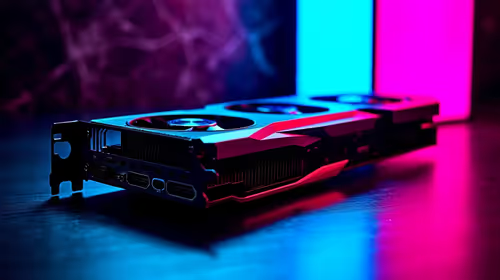
A PCIe 5.0 graphics card installed in a PCIe 4.0 x16 slot operates at PCIe 4.0 speeds due to backward compatibility. For all gaming workloads in 2026, this causes no measurable fps difference because current GPUs do not saturate PCIe 4.0 x16 bandwidth. You will not lose gaming performance by running an RTX 5090 or RX 9070 XT in a PCIe 4.0 slot.
Understanding PCIe Generations and Bandwidth 🔧
PCIe 5.0 x16 offers approximately 128 GB/s of bidirectional bandwidth. PCIe 4.0 x16 offers 64 GB/s. PCIe 3.0 x16 offers 32 GB/s. The PCIe bus transfers data between GPU VRAM and system RAM, a pathway that current gaming workloads use relatively lightly. Benchmarks comparing RTX 50-series cards in PCIe 5.0 versus PCIe 4.0 x16 slots consistently show less than 1 to 2 percent fps difference in gaming across all tested titles. The bandwidth ceiling of PCIe 4.0 x16 is not reached by any current-generation GPU during gaming.
Where PCIe 5.0 Actually Makes a Difference 💡
PCIe 5.0 GPU bandwidth becomes relevant in AI inference workloads where large model weights stream continuously between system RAM and VRAM, in scientific computing with frequent host-to-device data transfers, and potentially in future game streaming architectures that transfer assets dynamically rather than pre-loading them. For South African gamers and creators building systems today on AMD X870E or Intel Z890 platforms (which natively offer PCIe 5.0 x16 GPU slots), PCIe 5.0 is a genuine future-proofing benefit for non-gaming workloads. X870E boards with PCIe 5.0 GPU support are available in South Africa from around R5,000 upward.
Should You Upgrade Your Motherboard for PCIe 5.0? 💰
If your current board is PCIe 4.0 and you are buying an RTX 5080 or RTX 5090 purely for gaming, no motherboard upgrade is needed on PCIe grounds alone. If your build also involves heavy AI inference, content creation with large asset streaming, or future-proofing for workloads not yet fully defined, a PCIe 5.0 platform makes sense when building new. For existing Ryzen 5000 or Intel 12th or 13th-gen platform owners in South Africa: keep the board, buy the GPU, and route the upgrade budget toward the GPU itself rather than a platform migration that provides no gaming gain.
Verify Your Slot Is x16 Not x4 or x8 Before Buying ⚡
Some budget motherboards label a physical x16-length slot as electrically x4 or x8, which does reduce GPU bandwidth significantly. Check your motherboard's specification page for the GPU slot's electrical configuration, not just its physical size. A PCIe 4.0 x16 electrical slot is ideal; a PCIe 4.0 x8 electrical slot still causes no gaming performance loss with current GPUs but may matter for future workloads.
FAQ
Does a PCIe 5.0 GPU in a PCIe 3.0 slot cause gaming performance loss?
In most gaming scenarios at 1080p and 1440p, the difference remains under 3 percent. At 4K with very high GPU utilisation in certain open-world titles, a PCIe 3.0 x16 slot may occasionally show 3 to 5 percent lower performance compared to PCIe 4.0 x16, but this is rarely the primary bottleneck.
Which AMD and Intel platforms in South Africa support PCIe 5.0 for the GPU slot?
AMD X870E paired with Ryzen 9000-series CPUs and Intel Z890 paired with Core Ultra 200-series CPUs both offer PCIe 5.0 x16 GPU slots. Lower-tier chipsets on both platforms may use PCIe 4.0 for the GPU slot even on the same CPU generation.
Is it worth paying more for a PCIe 5.0 motherboard in South Africa in 2026?
For gaming-only builds, the PCIe 5.0 GPU slot does not justify the premium alone. The additional cost of an X870E over an X670E or B650E board is better justified by other features like PCIe 5.0 NVMe slots, superior VRM quality, and connectivity options.
Building or upgrading a gaming PC and unsure which platform to choose?
Evetech stocks PCIe 5.0 motherboards, the latest RTX 50-series and RX 9000-series GPUs, and full build component ranges. Browse the components category at Evetech for expert selection.