Quick Answer
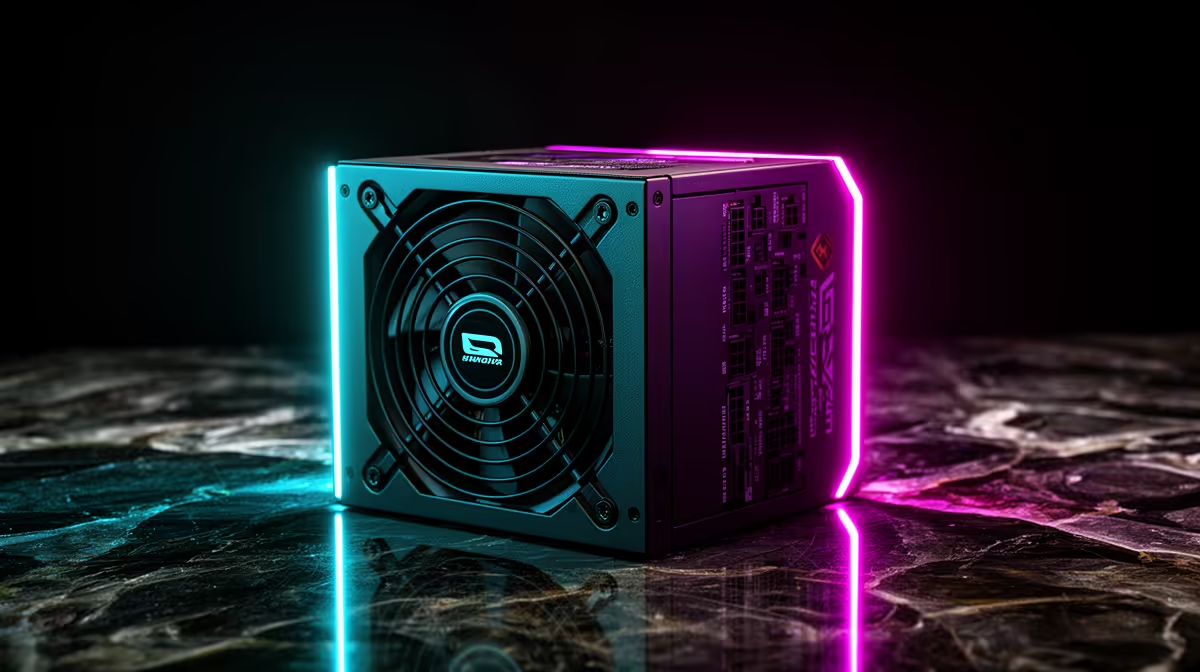
Building with a PCIe Gen 5.1 GPU in South Africa requires a PSU with a native 16-pin 12V-2x6 connector, ATX 3.0 or ATX 3.1 compliance, and at least 1,000W for high-end cards like the RTX 5090. Budget R4,000 to R5,500 for a unit that meets all three requirements from a brand with local warranty support.
Why PCIe Gen 5.1 Changes Your PSU Requirements 🔌
PCIe Gen 5.1 GPUs carry significantly higher TDPs than previous generations. The RTX 5090's 575W TDP is the most prominent example, but even mid-tier Gen 5.1 cards draw 200W to 300W more than their predecessors at the same performance tier. More critically, PCIe Gen 5.1 GPUs exhibit steep transient power spikes during shader-heavy rendering that older PSU designs were never tested against. ATX 3.0 specification requires PSUs to handle 200% transient excursions, meaning a 1,000W ATX 3.0 unit must sustain 2,000W for brief milliseconds without tripping its protection circuits. Without this compliance, your GPU can cause unexpected system shutdowns mid-game at precisely the wrong moment.
Choosing the Right Wattage for Gen 5.1 SA Builds 🎮
The wattage decision for a PCIe Gen 5.1 build depends on your GPU tier. An RTX 5060 Ti (150W to 160W TDP) pairs comfortably with a 650W Gold unit. An RTX 5070 Ti (285W TDP) with a Ryzen 7 9800X3D (120W TDP) lands around 500W system draw, making a 750W Gold the sensible choice with headroom. An RTX 5080 (360W) with a Ryzen 9 9900X (120W) reaches 600W-plus system load, pointing to an 850W unit minimum. The RTX 5090 (575W) with any current high-end CPU mandates a 1,000W unit, with 1,200W preferred for prolonged 4K rendering workloads. All these calculations assume Gold-rated units; a less efficient PSU requires an additional wattage buffer.
SA Market Considerations: Warranty, Stock and Pricing 🌍
South African gamers face two practical challenges with high-wattage PSU purchases. First, the rand-dollar exchange rate means units priced at R4,000 today may rise to R4,500 in six months if the rand softens. Buying during stable exchange periods or Evetech promotions locks in lower costs. Second, premium 1,200W and 1,600W ATX 3.0 units are not always stocked locally in depth, meaning stock can deplete quickly after a major GPU launch. Checking availability at Evetech immediately after your GPU decision is made, rather than days later, avoids disappointment. Warranty coverage of five to ten years is non-negotiable for purchases in this price range.
The 12V-2x6 Connector Seats Differently to Old 8-Pin ⚡
The 16-pin 12V-2x6 connector has a secondary sense pin row that requires a deliberate firm push to seat fully. An improperly seated cable can cause intermittent power delivery issues under load. When installing, press firmly until you hear or feel the latch engage, then give a light tug to confirm the connector is locked.
FAQ
Is ATX 3.1 worth waiting for over ATX 3.0 for a Gen 5.1 GPU build?
ATX 3.1 refines the 12V-2x6 connector locking mechanism but is functionally very similar to ATX 3.0 for end users. If you need a PSU now, a current ATX 3.0 unit is fully compatible with PCIe Gen 5.1 GPUs.
Can a non-ATX 3.0 PSU run an RTX 5090 safely?
Only if the PSU is rated well above the GPU's TDP and uses a quality adapter cable. The risk is not immediate failure but instability under transient load spikes. For a card costing R20,000 or more, using a non-compliant PSU is not advisable.
How does SA altitude affect PSU cooling for high-wattage units?
Johannesburg sits at roughly 1,750m above sea level. Thinner air reduces convective cooling efficiency slightly. Premium PSUs with larger heatsinks and quality fan designs compensate for this, but a unit running at the very limit of its rated wattage will run hotter in Joburg than at sea level in Cape Town.
Pairing a PCIe Gen 5.1 GPU with the right PSU in South Africa?
Evetech stocks ATX 3.0 compliant power supplies at every wattage tier, all with local warranty support and full connector compatibility.