Quick Answer
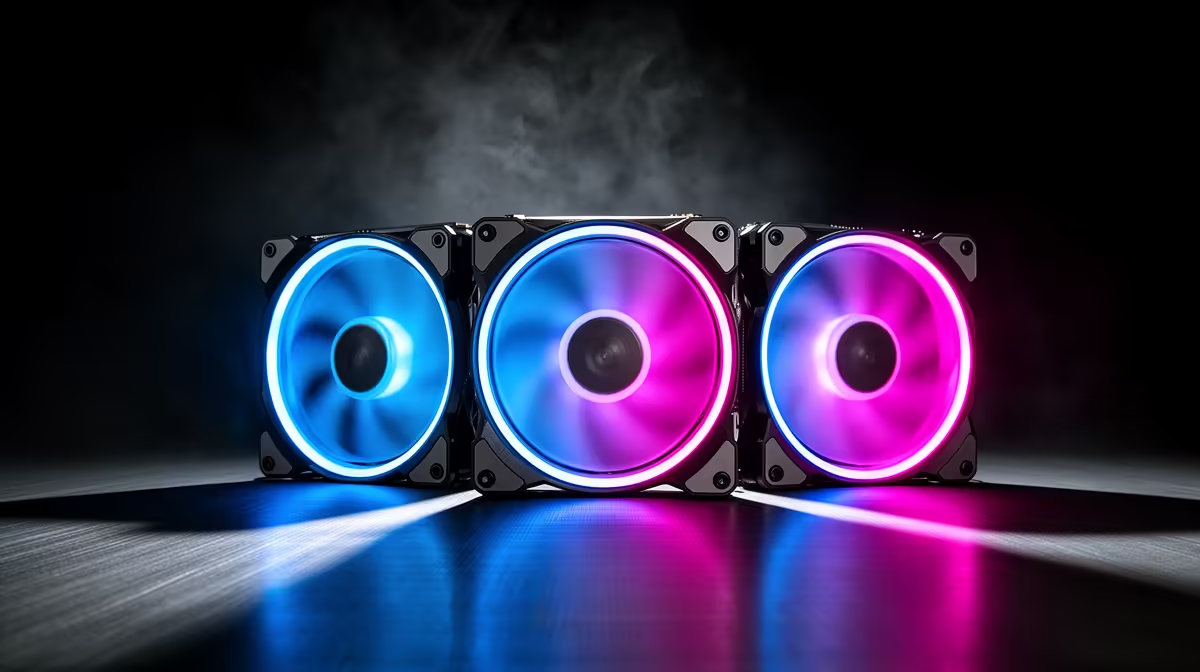
Pre-installed ARGB fans deliver immediate value by reducing upfront component cost and providing a coordinated colour theme from day one. Adding fans later gives you full control over brand, blade design, CFM rating, and noise level. For first builds on a R8,000 to R15,000 budget, the pre-installed fans in a good mid-tower case are adequate. Enthusiasts with premium components gain more from choosing aftermarket fans that match their specific thermal and acoustic targets.
What You Get With Pre-Installed Case Fans 🔧
Mid-tower cases in the R1,500 to R3,500 range typically ship with three to four 120mm ARGB fans and an integrated hub or controller. Fan quality in this tier varies: common pre-installed fans deliver 40 to 55 CFM at 1,200 RPM with 25 to 35 dB noise, adequate for an RTX 5070 or RTX 5060 Ti gaming build. They are designed to look consistent with the case aesthetic rather than optimised for maximum airflow. Pre-installed fans connect to the hub for lighting control, while PWM speed control routes through a 4-pin header on the motherboard. Cases in the R2,000 to R3,500 range often bundle FDB-bearing fans rather than sleeve-bearing units, noticeably improving longevity.
When Aftermarket Fans Justify the Cost 💰
Aftermarket ARGB fans from premium brands use fluid dynamic bearings and optimised blade geometry to deliver 15% to 25% more CFM at the same RPM, or equal CFM at significantly lower noise. For an RTX 5090 or Ryzen 9 9950X under sustained workloads, the thermal difference can reach 8 to 12 degrees Celsius versus mediocre stock fans. Aftermarket 120mm ARGB fans cost R150 to R350 each locally; replacing a three-fan set adds R450 to R1,050 to the build. This spend is justified when the CPU and GPU together exceed R25,000 and thermal performance affects boost clock sustainability.
Lighting Sync Considerations 🌟
Adding aftermarket fans later creates a potential lighting sync complication. Pre-installed fans and the hub are designed to work together. Adding fans from a different brand may require a second hub or a direct 5V ARGB header connection, and animations may not sync perfectly between different vendors. For seamless sync, stick to one ARGB ecosystem: either use your motherboard's ARGB headers with software like ASUS AURA Sync or MSI Mystic Light, or use a universal hub that accepts any 5V 3-pin ARGB device.
Plan Fan Placement Before Building ⚡
Decide upfront whether the case fans are permanent or placeholders. If planning to upgrade fans later, install them in the final configuration during the initial build so you dismantle the system only once. Reseating fans after a GPU or AIO is installed requires more disassembly than doing it from scratch.
FAQ
Are pre-installed case fans good enough for overclocking?
For moderate overclocking of a Ryzen 7 9700X or Core Ultra 7 265K, pre-installed fans in a quality mid-tower provide adequate case airflow. Extreme all-core overclocking generating 150W or more sustained CPU heat benefits from higher-quality exhaust fans.
Can I mix pre-installed and aftermarket ARGB fans in the same case?
Yes, but lighting sync requires all fans to share the same 5V 3-pin ARGB protocol and compatible software. Mixing brands sometimes produces different LED brightness levels, making the internal lighting look uneven.
How many case fans does a high-end gaming PC actually need?
Three to five fans cover the vast majority of gaming builds: two to three front intakes, one rear exhaust, and optionally one or two top exhausts. More fans beyond five do not meaningfully improve temperatures for a single-GPU gaming build.
Choosing between a case with included fans or a bare case to fill yourself?
Evetech stocks both options alongside aftermarket ARGB fan sets, all available with local warranty and delivery across South Africa.