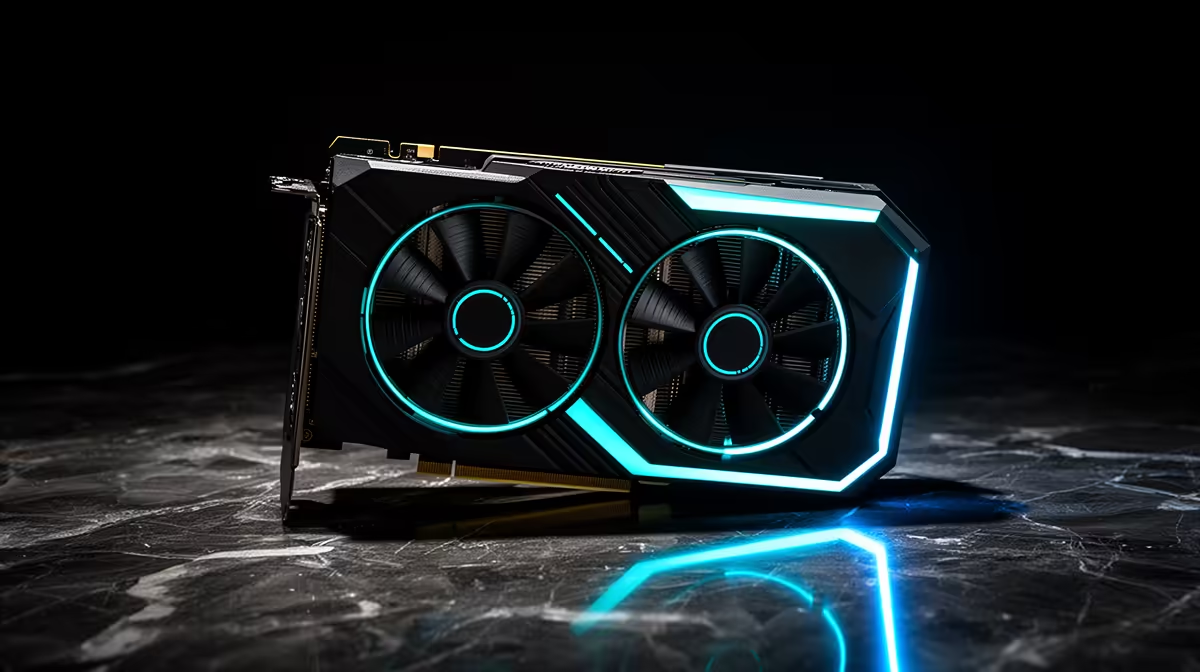
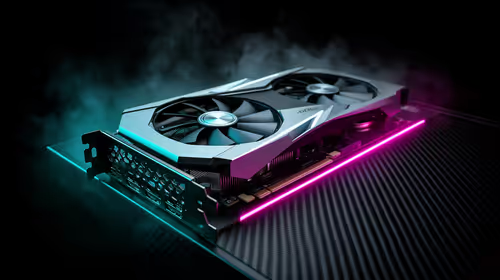
The gap between the RTX 5080 and the RTX 5090 for AI coding is not really a gap in raw speed. It is a wall, and the wall is built out of video memory. The 5080 carries 16GB of GDDR7, the 5090 carries 32GB, and that doubling is what decides whether you can run several local coding agents at once or whether you keep leaning on cloud models for anything ambitious.
Quick Answer
For local AI coding, the RTX 5090's 32GB of VRAM is the threshold that lets you run larger models and multiple agents at the same time, while the RTX 5080's 16GB comfortably handles single-agent work on models up to roughly 14B parameters. If your workflow is one coding assistant on a 7B to 14B model, the 5080 is the smart buy. If you want several local agents running concurrently or 30B-plus models, the 5090 is the one that clears the bar.
Why VRAM, Not Speed, Is the Deciding Factor
Local language model inference is limited by memory more than by compute. The model's weights have to fit in VRAM, and so does the KV cache, which is the running context each agent keeps in memory while it works. When everything fits, the GPU streams tokens quickly. When it does not fit, the model spills to system RAM and throughput collapses, or it simply will not load.
The RTX 5090 also has far higher memory bandwidth, on the order of 1.8TB/s against the 5080's roughly 960GB/s, and because inference is memory-bandwidth-bound that bandwidth is the main reason the 5090 generates tokens faster on the same model. But bandwidth only helps models that already fit. The capacity question comes first, and it is where the two cards genuinely diverge.
The 16GB Card: What the RTX 5080 Can and Cannot Do
Sixteen gigabytes is enough for a lot of real work. The 5080 runs 7B to 13B models entirely in VRAM at strong speeds, posting well over 100 tokens per second on an 8B model in current testing. For a single coding assistant, refactoring, autocomplete, explaining a codebase, or running one agent through a task, that is a responsive, capable local setup.
Where the ceiling sits
The practical ceiling for the 5080 is around a 14B model at usable quantisation. Push past that and you run out of room. More to the point for agentic work, every additional concurrent agent needs its own slice of VRAM for context. On the 5080, you typically get one solid agent, or two small ones, before the KV cache starts competing with the model weights for the same 16GB. The card does not get slower in a graceful way at that point; it hits a hard limit.
The cloud-agent pattern
This is why the 5080 pairs naturally with a hybrid approach. You run a fast local model for the constant, low-latency tasks, and you call a cloud model for the heavy reasoning or the moments you need a bigger context window. The 16GB is sufficient precisely for that cloud-assisted style of working, where the local card handles the volume and the cloud handles the peaks.
The 32GB Card: What the Extra Memory Unlocks
The RTX 5090's 32GB changes the kind of work you can keep local. It holds 30B-class models, such as a 32B coding model at a sensible quantisation, fully in VRAM, and it has room for quantised versions of even larger models. For someone who wants their best local model to be genuinely strong rather than merely convenient, that capacity is the difference.
Running multiple agents at once
The headline use case is concurrency. With 32GB you can load a capable model and still have room for several agents' worth of context running in parallel, which is the foundation of a local multi-agent workflow: one agent planning, another writing code, a third reviewing, all on the same machine without paying per token. The 5090 sustains multiple concurrent sessions on a mid-sized model where the 5080 would already be out of memory. That is the multi-agent VRAM wall in one sentence, and the 5090 is on the right side of it.
The cost of clearing the wall
None of this is free. The 5090 sits at a much higher price and draws considerably more power, so it wants a strong PSU and good airflow. The honest framing is that you are paying for capacity and bandwidth, not for a modest frame-rate bump. If your local AI work never approaches the 16GB ceiling, that money buys headroom you will not use.
Which One Fits Your Workflow
Match the card to how you actually code, not to the spec sheet. If you run one assistant on a small-to-mid model, lean on cloud APIs for the rest, and care about value, the 5080 is the rational pick and a strong gaming card besides. If your plan is a self-hosted multi-agent setup, larger local models, or long sessions where sending everything to a cloud provider gets expensive, the 5090's 32GB is what makes that viable.
Both cards anchor serious local-AI builds, and you can see how they slot into complete configurations across our AI and creator PC range at Evetech. For buyers who want the full machine specified around the GPU rather than the card alone, our best-selling prebuilt PCs show the cooling, memory and power pairings that keep either card stable under sustained inference loads.
Frequently Asked Questions
Is 16GB of VRAM enough for AI coding?
For a single coding agent on models up to about 14B parameters, yes, the RTX 5080's 16GB is enough and fast. It becomes the limit when you want larger models or several agents running at the same time, since each agent's context competes for the same memory.
Why does the RTX 5090 run larger models the 5080 cannot?
Because a model's weights must fit in VRAM to run at full speed. The 5090's 32GB holds 30B-class models entirely in memory, while the 5080's 16GB cannot, forcing those models to spill to system RAM where throughput drops sharply.
Does the 5090 generate tokens faster than the 5080?
Yes, on models that fit both cards. The 5090's much higher memory bandwidth makes it faster token-for-token, because local inference is limited by memory bandwidth rather than raw compute.
Can I run multiple local AI agents on the RTX 5080?
You can run one solid agent or two small ones. Beyond that, the running context of each agent competes with the model weights for the 16GB, which is the point where the 5080 hits its limit and the 5090's 32GB pulls ahead.
Is the price gap worth it for a hobbyist?
Only if you genuinely need the capacity. A hobbyist running one assistant and using cloud models for heavy tasks will not exhaust 16GB, so the 5080 is the better value. The 5090 earns its premium for multi-agent and large-model local work.