


PCIe 5.0 vs PCIe 4.0 for Strategy and Sim Games in SA
PCIe 5.0 and PCIe 4.0 differ most in lane support, compatibility, and upgrade value for strategy and sim games. SA buyers should match the choice to their actual hardware and games.
Read moreDeciding whether to wait for Intel Nova Lake or build now turns on one key platform fact: Nova Lake uses a brand-new LGA1954 socket, meaning current LGA1851 buyers face a full board and CPU replacement to upgrade. Builders who do not need a system today and can hold
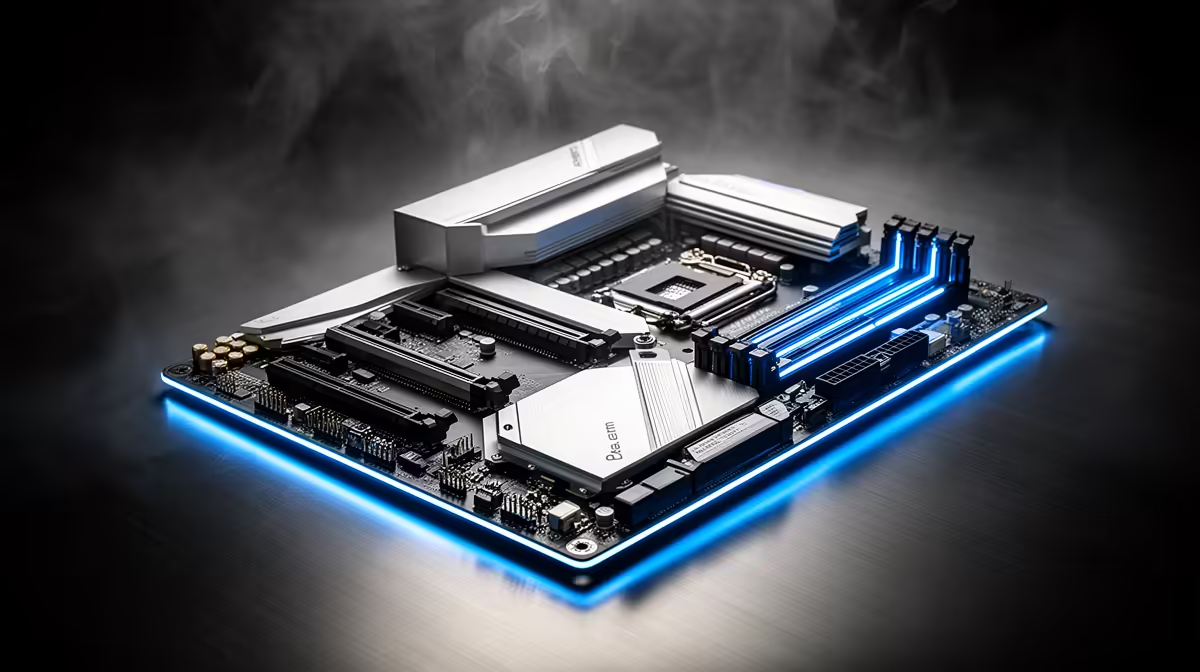
There is one fact about Intel's upcoming desktop generation that settles most of the wait-or-build argument: Nova Lake moves to a brand-new LGA1954 socket. That means today's LGA1851 motherboards will not accept a Nova Lake chip, so anyone buying now and hoping to drop in the next generation later is mistaken. The real question is not whether Nova Lake will be good, it is whether your timeline can absorb the wait.
If you need a PC today, build now, because Nova Lake's new LGA1954 socket means current LGA1851 boards cannot be upgraded to it anyway, so there is no drop-in path to wait for. If you genuinely do not need a system for several months and want the newest platform, waiting for Nova Lake and its 900-series boards is reasonable. There is no half-measure that lets you have both.
The most common reason people buy current-gen and plan to upgrade is the dream of keeping the same motherboard and swapping only the CPU later. Nova Lake removes that option. It uses LGA1954, a physically different socket from the LGA1851 that current Intel desktop chips use, and it pairs with a new 900-series chipset.
So a build today on LGA1851 is, for CPU purposes, a closed platform. That is not a flaw, plenty of great systems are built on end-of-line sockets, but it reframes the decision. You are not choosing between "upgradeable now" and "upgradeable later." You are choosing between a complete, capable system today and a complete, capable system on a newer socket some months from now.
If your current machine is slow, broken, or holding back your work or gaming, the cost of waiting is real and immediate. Every month on a struggling PC is a month of lost performance you never get back.
Today's LGA1851 chips deliver excellent gaming and productivity performance, and the boards and memory for them are mature and well-priced. You are not buying something about to fall over; you are buying a known, stable platform with wide software and driver support.
A platform that has been on shelves for a while tends to have settled pricing and good stock, which matters in Rand terms where launch premiums hit hard. You can spec a full system today from the Intel CPU range at Evetech and have it running this week rather than guessing at next year's launch pricing.
Waiting makes sense under specific conditions. If your current PC is still doing its job, if you are not in a hurry, and if you specifically want the longest-lived, newest platform, then holding out for LGA1954 gives you a fresh socket with its own upgrade runway ahead.
A new socket generation typically brings architectural improvements, newer platform features, and a future upgrade path on the same board for at least a generation or two. Buying into a brand-new platform early means more years before you hit the same end-of-line wall again.
The catch is uncertainty and time. Launch pricing is usually high, early stock can be tight, and the first boards carry a premium. You also spend the intervening months on your old hardware. For SA buyers, early-adopter pricing in Rand can be steep, so patience needs to be real patience, not a few weeks.
Run your situation through three questions. First, do you need a working PC now? If yes, build now, the socket change makes waiting pointless for upgrade reasons. Second, is your current machine adequate for the next several months? If yes, you have the luxury of choice. Third, do you specifically value being on the newest platform over saving money? If yes, and you can wait, Nova Lake is worth holding for. If you cannot answer "I can comfortably wait" to all of that, build today. You can pair a current Intel chip with one of the ready-to-go systems in the best-selling PC range and skip the platform-timing gamble entirely.
Before locking in on any build timeline, it is worth knowing that Intel also released an Arrow Lake Refresh (Core Ultra 200S Plus) in early 2026, bringing chips like the Core Ultra 7 270K Plus and Core Ultra 5 250K Plus. These add extra efficiency cores and deliver up to 15% better gaming performance than the original Arrow Lake, priced from around USD 199 for the 250K Plus tier. If Nova Lake feels too far out and you want the best available Intel platform right now, the refreshed lineup is a stronger buy than the original Arrow Lake chips launched in 2024.
The one trap to avoid is buying an expensive LGA1851 motherboard today specifically to "future-proof" for Nova Lake. That future-proofing does not exist, because the socket changes. If you build now, build a balanced system for today's needs and value, not for an upgrade path that the platform change has already closed off.
No. Nova Lake uses the new LGA1954 socket and 900-series chipset, which are incompatible with current LGA1851 motherboards. A Nova Lake upgrade requires both a new CPU and a new board, so there is no drop-in path from today's platform.
Build now if you need a PC, since the socket change removes any upgrade benefit to waiting. Wait only if your current machine is fine for several months and you specifically want the newest platform and its future upgrade runway.
Yes. Today's LGA1851 chips offer strong gaming and productivity performance on a mature, well-supported platform with settled pricing. Being an end-of-line socket affects future upgrades, not how well the system performs right now.
Exact timing and pricing are not confirmed, and early launches typically carry a premium with limited stock. For SA buyers that early-adopter cost in Rand can be significant, so only wait if you can wait comfortably rather than a few weeks.
The main downside is being on a socket that will not accept the next generation, so a future CPU upgrade means a new board too. As long as you build a balanced system for today rather than over-spending on a non-existent upgrade path, the risk is small.
Need a PC that works today? Configure a current-generation Intel build at Evetech and stop waiting on a socket that will not fit your board anyway. https://www.evetech.co.za/PC-Components/buy-intel-cpu-166
No. Nova Lake uses the new LGA1954 socket and 900-series chipset, which are incompatible with current LGA1851 motherboards. A Nova Lake upgrade requires both a new CPU and a new board, so there is no drop-in path from today's platform.
Build now if you need a PC, since the socket change removes any upgrade benefit to waiting. Wait only if your current machine is fine for several months and you specifically want the newest platform and its future upgrade runway.
Yes. Today's LGA1851 chips offer strong gaming and productivity performance on a mature, well-supported platform with settled pricing. Being an end-of-line socket affects future upgrades, not how well the system performs right now.
Exact timing and pricing are not confirmed, and early launches typically carry a premium with limited stock. For SA buyers that early-adopter cost in Rand can be significant, so only wait if you can wait comfortably rather than a few weeks.
The main downside is being on a socket that will not accept the next generation, so a future CPU upgrade means a new board too. As long as you build a balanced system for today rather than over-spending on a non-existent upgrade path, the risk is small.
PCIe 5.0 and PCIe 4.0 differ most in lane support, compatibility, and upgrade value for strategy and sim games. SA buyers should match the choice to their actual hardware and games.
Read more
AM5 vs AM4 for video editing in 4K Difference explained is mostly about compatibility, budget, upgrade path, and setup fit. SA buyers should check device support and real needs before expecting a clear win from either option.
Read more
OLED vs QD-OLED for strategy and sim games buyers - what changes is mostly about compatibility, budget, upgrade path, and setup fit. SA buyers should check device support and real needs before expecting a clear win from either option.
Read more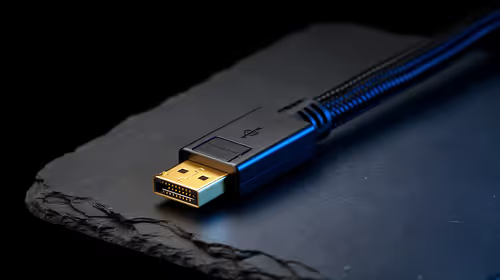
DisplayPort 2.1 and 1.4 differences matter when SA PC builders match GPUs, monitors, and refresh targets. Use this difference between displayport 2 1 and displayport 1 4 explained pc builders guide to avoid mismatched parts.
Read more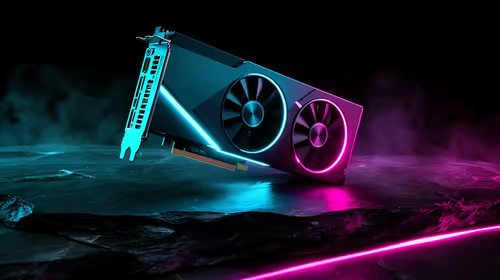
Ray tracing vs Path tracing depends on Strategy and sim games needs, platform limits, and budget fit. Compare compatibility, latency, upgrade path, and real setup constraints before choosing for an SA build.
Read more
wireless mouse guide for Gqeberha gamers should be shortlisted around the job it must do. South African buyers should compare sensor, shape, weight, and wireless latency, warranty path, and upgrade room before treating any pick as best.
Read more
From 1 October 2026, WhatsApp Business Platform service replies in South Africa are expected to cost about $0.0076, or 12 cents, per delivered message.
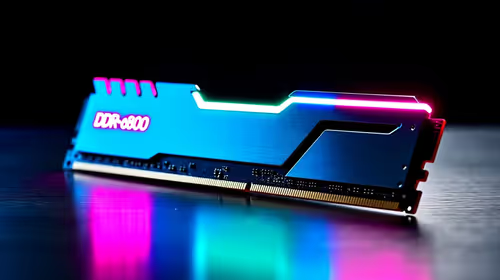
DDR5-8000 RAM Kits pros and cons depend on the build, budget, and workload. Weigh gaming needs, platform fit, power, cooling, warranty support, and South African pricing context before shortlisting it.
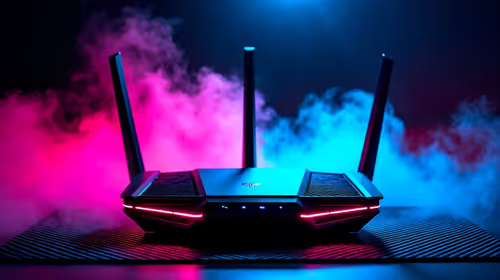
Wi-Fi 6E vs Wi-Fi 6 depends on AAA single-player gaming needs, platform limits, and budget fit. Compare compatibility, latency, upgrade path, and real setup constraints before choosing for an SA build.
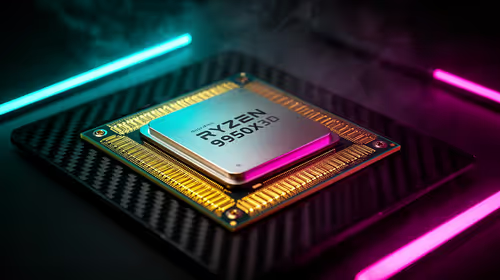
Ryzen 9 9950X3D dead pixel checks should isolate the panel first. Run colour fills, inspect the monitor menu, test another cable or input, and capture proof before linking it to the SA CPU upgrade.

YouTube will count public views from the first frame across video formats from 24 August, while earnings and eligibility remain tied to engaged viewing.
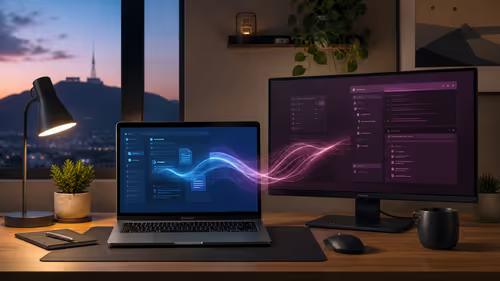
Canonical expects Ubuntu on WSL users to outnumber native Ubuntu desktop users before the end of 2026. The software is open source and runs inside supported Windows PCs.
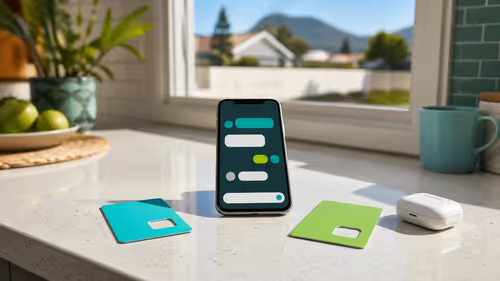
Telkom's daily bundles pair WhatsApp access with 10 all-network voice minutes. The R15 option includes 300MB, while the R17 option uses a fair-use threshold.
A 10,000-hour test found similar image retention across older and newer OLED TVs, while newer panels were brighter and more efficient. Local OLED monitors started at R9,999.
650W for RTX 5090 needs a full-build check, not a simple yes. Review GPU guidance, CPU draw, transient load, connectors, PSU quality, and upgrade plans before deciding.
PCIe 5.0 and PCIe 4.0 differ most in lane support, compatibility, and upgrade value for strategy and sim games. SA buyers should match the choice to their actual hardware and games.
How to fix FPS drops Windows 11 RX 9070 XT starts with GPU drivers, overlays, power plans, and frame pacing checks. For SA gaming PCs, verify chipset updates, HAGS, refresh rate, thermals, and per-game graphics settings.
AM5 vs AM4 for video editing in 4K Difference explained is mostly about compatibility, budget, upgrade path, and setup fit. SA buyers should check device support and real needs before expecting a clear win from either option.