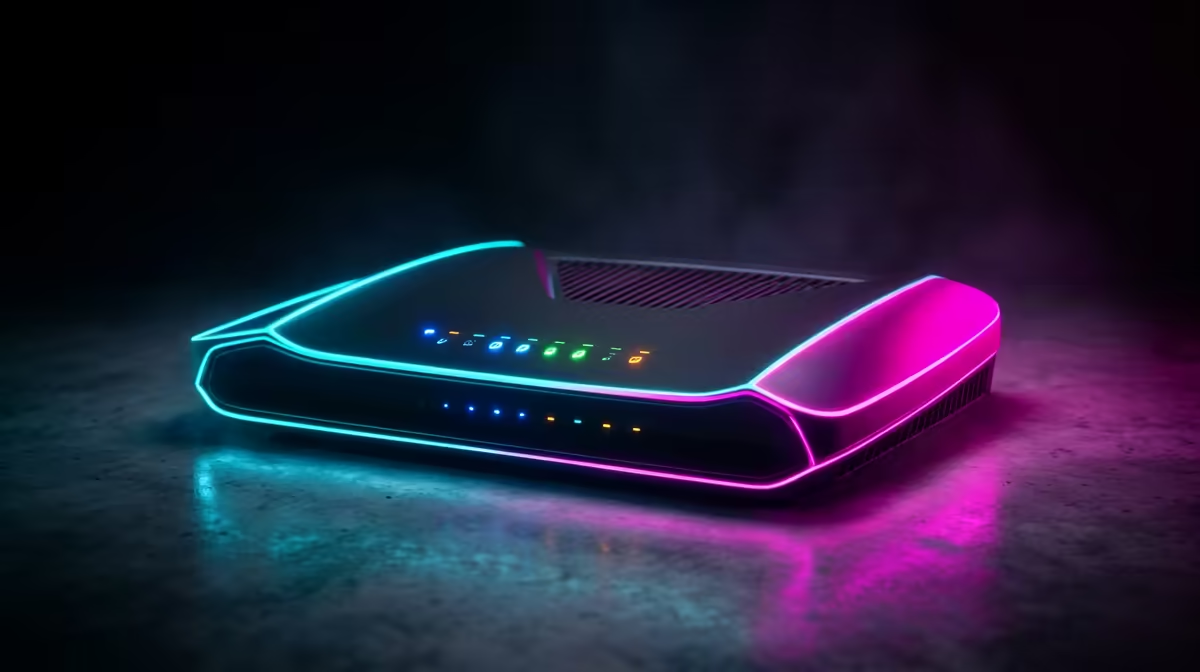
If you need a router this year, the answer is simple: buy Wi-Fi 7 now. Wi-Fi 8 is real and coming, but the standard is not even finalised until 2028 and consumer routers will not land in any meaningful way until late 2027 at the earliest. Holding out means living with an old router for two-plus years to chase a standard you cannot buy.
Quick Answer
Buy a Wi-Fi 7 router now. Wi-Fi 8 (802.11bn) is on track for finalisation around the first half of 2028, with products arriving from late 2027. Waiting delays a useful upgrade by two or more years, and Wi-Fi 8 keeps the same peak speeds as Wi-Fi 7 anyway, so there is little to gain by holding off.
What Wi-Fi 8 actually changes (and what it does not)
Here is the detail that reframes the whole decision: Wi-Fi 8 is not a speed jump. It uses the same 2.4GHz, 5GHz, and 6GHz bands as Wi-Fi 7, the same 320MHz channel width, the same 4096-QAM, and the same up-to-8 spatial streams. The theoretical peak stays around 23 Gbps, identical to Wi-Fi 7.
What Wi-Fi 8 targets instead is reliability. The headline goals are roughly 25 percent better throughput at a given signal quality, about 25 percent lower latency at the worst-case percentiles, and fewer dropped frames when a device roams between access points. Useful, especially in busy mesh networks, but not the kind of leap that justifies waiting years with whatever router you have now.
The timeline, plainly
IEEE 802.11bn, the standard behind Wi-Fi 8, is projected to be finalised around May 2028, with certification scheduled for early in that year. Early chipsets and a trickle of draft-based products may appear in late 2027, but a healthy, competitively priced consumer router market is a 2028 story.
That matters in South Africa because draft-era hardware tends to arrive late and at a premium locally, and certification is what guarantees devices from different brands actually work together. Buying a first-wave draft router is paying the most for the least mature version. Wi-Fi 7, by contrast, is fully certified, widely stocked, and dropping in price. The current networking range at Evetech already carries Wi-Fi 7 hardware across price points.
Why Wi-Fi 7 is the right buy for SA homes
Wi-Fi 7 is mature, certified hardware available today, and it brings the genuinely big upgrades you feel: 320MHz channels on the 6GHz band, Multi-Link Operation that runs across two bands simultaneously for lower latency, and high-order 4096-QAM for more data per transmission. On a good fibre line, this is what keeps a house full of devices responsive.
It is also future-friendly. Wi-Fi 8 will stay backward compatible with Wi-Fi 7 devices, so a Wi-Fi 7 router you buy now keeps working perfectly when Wi-Fi 8 arrives, and your phones and laptops will outlive the router anyway. Spending money to wait for a marginal reliability gain that is two years out is the weaker play. To see what SA buyers are pairing with their routers, the accessories best sellers at Evetech reflect real local demand.
What to look for in a Wi-Fi 7 router right now
Not all Wi-Fi 7 routers are equal, and for SA homes the most useful criteria are practical rather than spec-sheet deep.
A tri-band design, covering 2.4GHz, 5GHz and the cleaner 6GHz band, gives you the most flexibility. For a double-storey home or a property where a single router cannot reach every room, a Wi-Fi 7 mesh system is more valuable than a single high-end unit. Mesh nodes communicate over a dedicated 6GHz backhaul, which keeps the link between nodes fast without stealing bandwidth from your devices.
On throughput, South African fibre lines run from around 20Mbps entry-level to 1Gbps symmetrical at the top. A Wi-Fi 7 router with multi-gigabit WAN ports does not hurt, but any certified Wi-Fi 7 router outpaces the incoming line by a wide margin. Focus instead on coverage, the number of connected devices you run simultaneously, and whether the management app fits how you actually want to control the network. Those factors shape daily experience far more than the headline speed figure on the box.
Also worth considering: Wi-Fi 7 prices have moved meaningfully since the standard launched. Entry-level Wi-Fi 7 routers are now available at prices competitive with what mid-range Wi-Fi 6E gear cost at release. That pricing shift makes waiting for Wi-Fi 8 even harder to justify. You are no longer paying a premium to be on the current generation; you are paying standard market price for hardware that is proven, widely supported and will stay relevant for years.
Frequently Asked Questions
When will Wi-Fi 8 routers be available?
The Wi-Fi 8 standard is expected to be finalised around the first half of 2028, with certification early that year. A few draft-based products may surface from late 2027, but a proper consumer router market is a 2028 event.
Is Wi-Fi 8 faster than Wi-Fi 7?
Not in peak speed. Both top out near 23 Gbps and share the same bands, channel width, and modulation. Wi-Fi 8 focuses on reliability: lower worst-case latency, better throughput at weak signal, and smoother roaming.
Will a Wi-Fi 7 router still work when Wi-Fi 8 launches?
Yes. Wi-Fi 8 is backward compatible with Wi-Fi 7, so your router and devices keep working normally. A Wi-Fi 7 router bought now has years of useful life ahead.
Should I wait for Wi-Fi 8 if I need a router in 2026?
No. Waiting means using an older router for two or more years for a modest reliability gain. Buy Wi-Fi 7 now and upgrade much later if the reliability features ever justify it.
What is the real upgrade I get from Wi-Fi 7?
Wide 320MHz channels on 6GHz, Multi-Link Operation that uses two bands at once to cut latency, and higher-density 4096-QAM. Together these keep a busy household responsive on a fast fibre connection.
Need a router that delivers now instead of a standard that is years away? Wi-Fi 7 is the certified, available choice today. Explore the networking range at Evetech to find a Wi-Fi 7 router matched to your home and fibre speed.