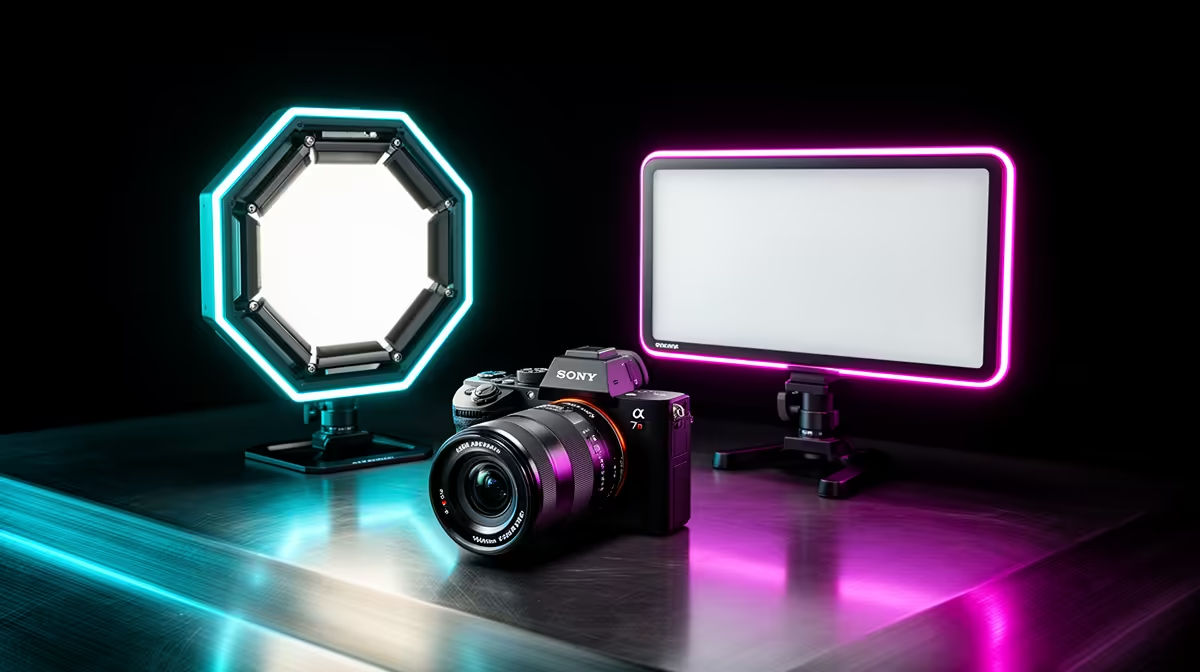
Two studio lights sit on the same spec sheet -- same wattage, same colour temperature, same price range -- and yet they produce fundamentally different results on a face. A softbox enclosure versus a flat panel light is not a question of which is technically superior. It is a question of what the physics of each source is doing and whether that output matches what your specific shot needs. Once you understand what is happening inside each fixture, the comparison stops being confusing and starts being a practical choice you can make without reading reviews.
Quick Answer
A softbox produces soft, wrapping light from a large diffused surface -- it is the better key light for flattering portraits and talking-head video. A flat panel throws a narrower, more directional beam suited to fill, rim, and background accent work. Most content creators end up using both, not choosing between them.
🔆 How Softbox Light Actually Works
A softbox houses one or more bulbs behind a white inner reflector, then covers the output with a translucent front diffusion panel. The diffusion panel turns several point sources of light into a single, large, uniform surface that emits light in many directions simultaneously. That spread is what creates the soft, gradual transitions between highlight and shadow on a curved surface like a face.
The size of that front panel is directly related to the softness of the shadows. A 60cm square softbox produces noticeably softer shadows at the same subject distance than a 30cm version. The bigger the emitting surface relative to the subject, the more directions the light wraps from, and the gentler the shadow edge. This is the physical reason a large softbox is the standard key light for portrait and video work.
Energy, heat, and bulk
A softbox running two 45W CFL bulbs adds noticeable warmth to a small, enclosed room. Not uncomfortably so for a single-hour shoot, but relevant if you are shooting for several hours in a compact koshuis room or a small flat in Cape Town. LED panel lights at equivalent output draw significantly less current and stay cooler throughout a long session.
⚡ How a Flat Panel's Output Differs
A flat LED panel emits light directly from a grid of LEDs mounted close together on a flat surface. This configuration produces a tighter, more collimated beam than a softbox, with harder shadow edges and less wrap around curved surfaces. At the same distance and power, the shadow beneath a subject's nose will be more sharply defined under a panel than a softbox.
That is not inherently a flaw. Hard light creates separation, definition, and a sense of depth that soft light cannot replicate. As a fill light dialled down to balance a softbox key, the panel adds enough brightness to open shadows without washing out the shaping the key creates. As a rim or hair light, the panel's directional output concentrates precisely where you aim it rather than spreading broadly across the background.
Dimming and portability
Most flat panel lights offer smooth 0 to 100 percent electronic dimming via a dial or a remote control. Softboxes do not dim -- their output is governed by the bulbs installed, and changing brightness means swapping bulbs or adjusting distance. For a solo creator adjusting the lighting balance between setups without moving stands, the panel's instant dimming is a genuine advantage.
Panels also require no assembly. A softbox needs its rods inserted, the diffusion panel attached, and occasionally the inner reflector fitted. A flat panel is a single unit that mounts to a stand in seconds and is ready to use. For creators who move between locations or frequently reconfigure their space, this makes a meaningful difference to setup time.
Pro Tip ⚡
Run your softbox as the key and your flat panel as the fill in a two-light portrait setup, with the panel on a dimmer. Once the softbox is positioned correctly, you can fine-tune shadow depth from where you are sitting by adjusting the panel output rather than dragging a stand. This is faster and keeps the key angle intact between adjustments.
🎯 Matching the Light to the Shot Type
For a talking-head video or podcast setup where the frame is locked and the subject is stationary, a softbox key gives the most consistently flattering result across different people and skin tones. The broad output is forgiving of small movements and does not require the subject to hold a precise position relative to the source.
For product photography or a detailed shot where you want to see texture -- the surface of a keyboard, the weave of a fabric, the edge of a case -- a panel's harder light is more revealing. Soft light from a large source fills in surface detail that harder light would emphasise. Choose based on whether you want to reveal or flatter.
For background lighting on a two-person setup or a wider frame, a flat panel aimed at the backdrop delivers targeted colour or brightness without washing the whole room. A softbox doing the same job would spill broadly and make it difficult to keep the subject and background exposures independent.
Frequently Asked Questions
How do a softbox and a flat panel affect a face differently?
A softbox produces gradual shadow transitions that wrap the face gently, reducing the appearance of uneven skin texture and sharp bone shadows. A flat panel creates harder shadow edges that add definition and separation. Softboxes are more forgiving as a key light for general portrait and video work. Panels suit accent roles where the harder beam quality serves the shot.
Which is better as a key light for content creation?
For most content creator setups -- solo talking-head video, podcast recording, video calls -- a softbox is the more flattering key light because its large output surface wraps the face and produces soft shadows that look natural at normal viewing distances. A panel used as a key typically requires more careful positioning to avoid hard shadows that distract from the content.
When does a flat panel outperform a softbox?
In tight spaces where a 60cm box will not fit, as a fill or rim light where directional control matters, and for product or detail shots where harder light reveals texture. Panels are also quicker to set up, run cooler in a small room, and dim electronically -- advantages that matter during long sessions or when moving between locations.
Can I dim a softbox the same way I can dim a panel?
Not with the same ease. Softboxes do not have a dimmer dial -- you adjust brightness by moving the light further from the subject, swapping to lower-wattage bulbs, or reducing the number of bulbs in a multi-bulb fixture. LED flat panels dim from full output to near-zero at a turn of a knob or a button on a remote, which makes mid-session ratio adjustments significantly faster.
Which runs cooler during a long shoot?
LED flat panels run substantially cooler than CFL softbox bulbs at equivalent output. Two 45W CFLs in a softbox add heat to the room that becomes noticeable over a two-to-three-hour session in a small, poorly ventilated space. An LED panel drawing the same effective output generates a fraction of that heat, which matters for comfort during longer content days.
Ready to choose the right studio light for your content setup?
Browse the softbox kits and LED panel lights at Evetech and build a two-light arrangement that covers both flattering key and precise accent work.