



PCIe 5.0 vs PCIe 4.0 for Strategy and Sim Games in SA
PCIe 5.0 and PCIe 4.0 differ most in lane support, compatibility, and upgrade value for strategy and sim games. SA buyers should match the choice to their actual hardware and games.
Read moreLEGO SPIKE Essential targets SA grades 1-5 and SPIKE Prime covers grades 6-8, mapping to Foundation, Intermediate and Senior Phase curriculum. Schools need classroom sets designed for group use, curriculum alignment and daily durability.
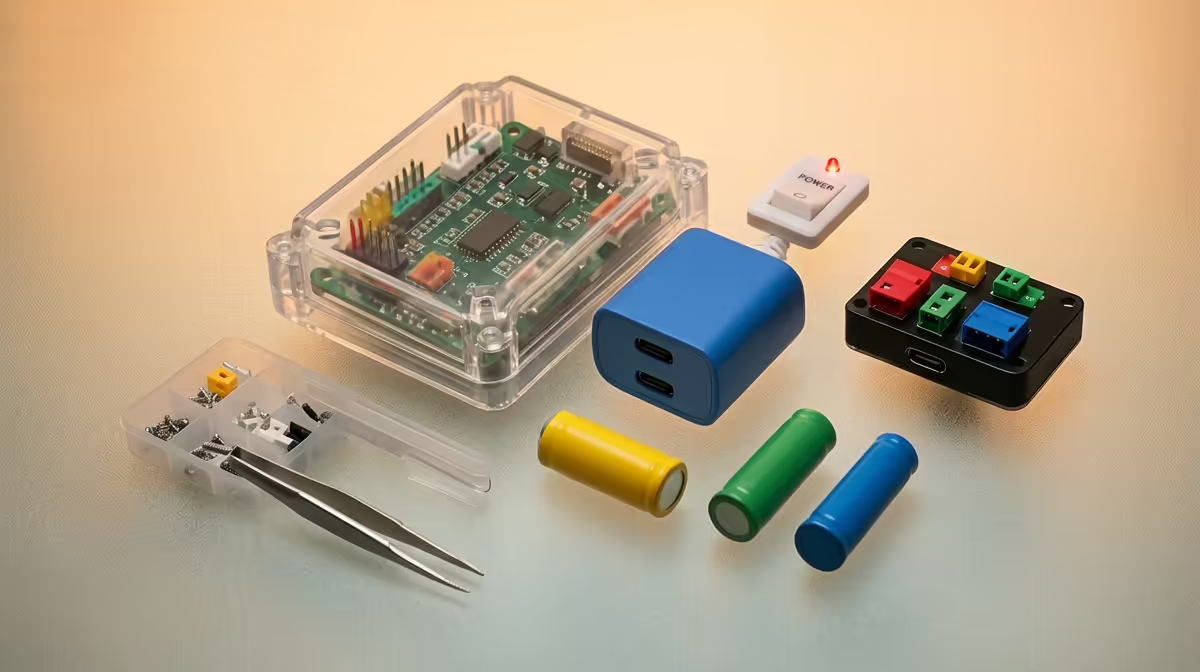
Kitting out a classroom for coding and robotics is a different problem from buying a kit for one child at home. A school needs sets built for groups of hands, aligned to the grades it teaches, and tough enough to survive being packed away and pulled out every day for years. STEM kits for schools that get this right map cleanly onto the curriculum phases, so a teacher can open a unit and teach it rather than inventing lessons from a box of parts. The LEGO SPIKE family has become the default answer for exactly this reason.
For South African schools, LEGO Education SPIKE Essential targets the Foundation and Intermediate phases, roughly grades 1 to 5, while SPIKE Prime covers the Senior phase, roughly grades 6 to 8. Both come with structured lesson units aligned to the local Coding and Robotics curriculum, are sold through an authorised regional reseller, and are built as durable classroom sets for repeated group use rather than single-child play.
A home kit can be fiddly, fragile, and light on lesson material because one motivated parent or child fills the gaps. A classroom kit cannot. It has to survive thirty pairs of hands, store and restock quickly between lessons, and arrive with teaching material a non-specialist educator can pick up and run. Three requirements drive every sensible school purchase.
The kit must map to what the grade is meant to learn. South Africa's Coding and Robotics curriculum is structured by phase, so a kit that comes with units written against those phases saves teachers enormous preparation time and keeps the work assessable.
Classroom sets are designed so a small group shares one kit, with enough parts and a build flow that suits collaborative work. That is a different design from a single-user home robot.
Daily use across a full school year punishes hardware. Robust parts, organised trays, and quick teardown matter as much as the technology inside, because a kit that takes twenty minutes to reset never gets used twice in a day.
SPIKE Essential is the primary-school workhorse, aimed at the Foundation and Intermediate phases, broadly grades 1 to 5. Its strength is a narrative, play-led approach where young learners solve problems framed as relatable stories, which keeps engagement high in the age group most likely to lose interest in dry instruction.
The system ships with a structured curriculum of units, each containing several short STEAM lessons sized for a normal class period. That structure is the real value for a school, because it turns a box of bricks and a hub into a teachable sequence. Learners meet basic coding ideas, simple algorithms, and early problem-solving in a form that suits small hands and short attention spans.
Use SPIKE Essential where you need an entry point that introduces coding and robotics without overwhelming young learners or their teachers. It builds the foundation that the Senior-phase kit then extends.
SPIKE Prime steps up for the Senior phase, broadly grades 6 to 8. It combines LEGO Technic building with a multi-port programmable hub and a coding language based on Scratch that can progress toward text-based Python. This is the platform behind many school competition teams, which speaks to both its capability and its durability under heavy use.
At this level learners move into conditional statements, loops, sensor-driven behaviour, and proper algorithmic thinking. The block-to-text pathway is the key feature: a class can start in familiar drag-and-drop blocks and grow into Python without changing platforms, which lets a single investment serve a wide range of abilities.
Because SPIKE Prime is a competition standard, schools that adopt it gain a route into structured robotics contests, giving keen learners somewhere to channel the skills they build in class.
Buy in sets, not single kits, and size the order to your class numbers and your group-work ratio. Budget for spare parts from day one, because pieces go missing and a depleted kit slows a whole lesson. Make sure at least one teacher per phase has time to work through the provided units before teaching them, so the curriculum material actually gets used. The supporting infrastructure matters too, from charging and storage to the tablets or computers that run the coding software, and the right classroom accessories and spares keep a deployment running smoothly. For schools also building out connected-classroom or maker-space hardware, the smart home and connected device range offers components for project-based extension work.
The headline price of a set is only part of the picture. Spread that price across the learners who share it over several years of lessons, add a modest annual allowance for replacement parts, and the true cost per child per year is usually far lower than a first glance suggests. Framing the purchase this way, as a multi-year teaching asset rather than a one-off toy, makes the case far easier when budgets are tight.
Hardware is the easy part. The programmes that succeed are the ones where teachers feel confident running the lessons, and that confidence comes from preparation time and a little support. Build in time for the teachers who will deliver coding and robotics to work through the units themselves before they stand in front of a class, ideally in a short workshop rather than alone at a desk.
A set that lives in a cupboard teaches nothing. Plan a clear timetable so the kits move between classes and grades, and assign someone responsibility for checking parts and charging between sessions. A simple routine for packing kits away with everything accounted for prevents the slow attrition of pieces that otherwise leaves a set unusable within a year. Sustained, organised use is what turns the initial spend into years of teaching value.
SPIKE Essential is built for the Foundation and Intermediate phases, roughly grades 1 to 5, while SPIKE Prime targets the Senior phase, roughly grades 6 to 8. The split lines up with the phase structure of the local Coding and Robotics curriculum.
Yes. The SPIKE systems are supplied with structured lesson units designed against curriculum phases through the authorised regional reseller, which is what makes them practical for teachers to deploy and assess rather than improvise around.
Plan around group work rather than one kit per learner. A small group shares each set, so order enough sets for your typical class size divided by your preferred group size, and add spare parts to cover loss and wear over the year.
Yes. It begins in block-based coding and progresses to text-based Python on the same hardware, so a single platform serves a wide spread of abilities and gives advanced learners somewhere to go, including school robotics competitions.
No. The strength of these classroom kits is the structured unit material, which lets a non-specialist teacher follow a prepared lesson sequence. Some preparation time per phase is needed, but deep coding expertise is not a prerequisite to teach the early units.
Planning coding and robotics for your school year? Explore the classroom STEM and robotics range at Evetech and equip every phase with kits your teachers can actually run.
SPIKE Essential is built for the Foundation and Intermediate phases, roughly grades 1 to 5, while SPIKE Prime targets the Senior phase, roughly grades 6 to 8. The split lines up with the phase structure of the local Coding and Robotics curriculum.
Yes. The SPIKE systems are supplied with structured lesson units designed against curriculum phases through the authorised regional reseller, which is what makes them practical for teachers to deploy and assess rather than improvise around.
Plan around group work rather than one kit per learner. A small group shares each set, so order enough sets for your typical class size divided by your preferred group size, and add spare parts to cover loss and wear over the year.
Yes. It begins in block-based coding and progresses to text-based Python on the same hardware, so a single platform serves a wide spread of abilities and gives advanced learners somewhere to go, including school robotics competitions.
No. The strength of these classroom kits is the structured unit material, which lets a non-specialist teacher follow a prepared lesson sequence. Some preparation time per phase is needed, but deep coding expertise is not a prerequisite to teach the early units.
PCIe 5.0 and PCIe 4.0 differ most in lane support, compatibility, and upgrade value for strategy and sim games. SA buyers should match the choice to their actual hardware and games.
Read more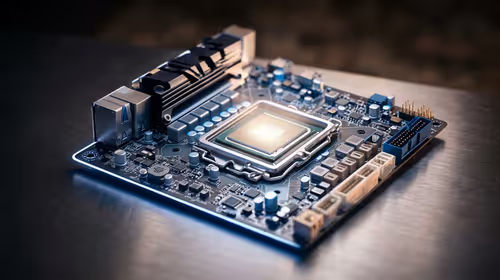
AM5 vs AM4 for video editing in 4K Difference explained is mostly about compatibility, budget, upgrade path, and setup fit. SA buyers should check device support and real needs before expecting a clear win from either option.
Read more
OLED vs QD-OLED for strategy and sim games buyers - what changes is mostly about compatibility, budget, upgrade path, and setup fit. SA buyers should check device support and real needs before expecting a clear win from either option.
Read more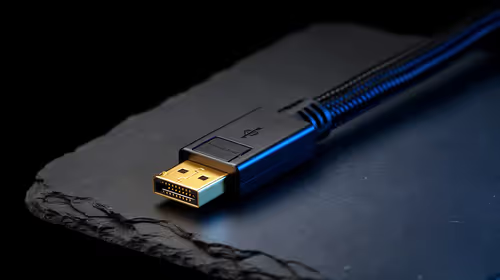
DisplayPort 2.1 and 1.4 differences matter when SA PC builders match GPUs, monitors, and refresh targets. Use this difference between displayport 2 1 and displayport 1 4 explained pc builders guide to avoid mismatched parts.
Read more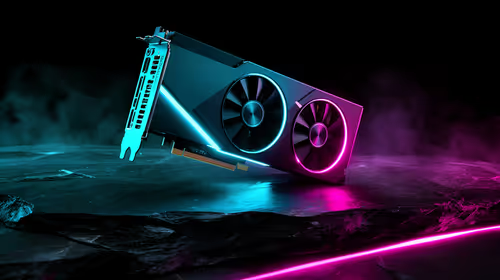
Ray tracing vs Path tracing depends on Strategy and sim games needs, platform limits, and budget fit. Compare compatibility, latency, upgrade path, and real setup constraints before choosing for an SA build.
Read more
wireless mouse guide for Gqeberha gamers should be shortlisted around the job it must do. South African buyers should compare sensor, shape, weight, and wireless latency, warranty path, and upgrade room before treating any pick as best.
Read more
From 1 October 2026, WhatsApp Business Platform service replies in South Africa are expected to cost about $0.0076, or 12 cents, per delivered message.
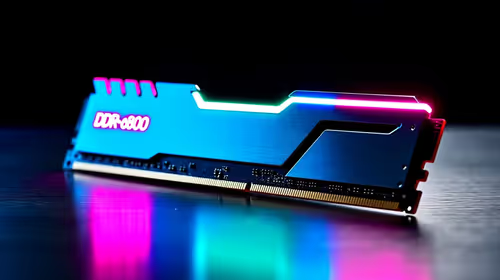
DDR5-8000 RAM Kits pros and cons depend on the build, budget, and workload. Weigh gaming needs, platform fit, power, cooling, warranty support, and South African pricing context before shortlisting it.

Wi-Fi 6E vs Wi-Fi 6 depends on AAA single-player gaming needs, platform limits, and budget fit. Compare compatibility, latency, upgrade path, and real setup constraints before choosing for an SA build.

Ryzen 9 9950X3D dead pixel checks should isolate the panel first. Run colour fills, inspect the monitor menu, test another cable or input, and capture proof before linking it to the SA CPU upgrade.

YouTube will count public views from the first frame across video formats from 24 August, while earnings and eligibility remain tied to engaged viewing.
Canonical expects Ubuntu on WSL users to outnumber native Ubuntu desktop users before the end of 2026. The software is open source and runs inside supported Windows PCs.
Telkom's daily bundles pair WhatsApp access with 10 all-network voice minutes. The R15 option includes 300MB, while the R17 option uses a fair-use threshold.

A 10,000-hour test found similar image retention across older and newer OLED TVs, while newer panels were brighter and more efficient. Local OLED monitors started at R9,999.
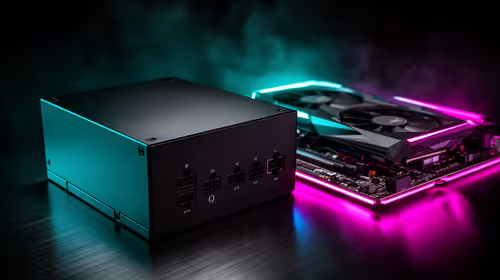
650W for RTX 5090 needs a full-build check, not a simple yes. Review GPU guidance, CPU draw, transient load, connectors, PSU quality, and upgrade plans before deciding.
PCIe 5.0 and PCIe 4.0 differ most in lane support, compatibility, and upgrade value for strategy and sim games. SA buyers should match the choice to their actual hardware and games.
How to fix FPS drops Windows 11 RX 9070 XT starts with GPU drivers, overlays, power plans, and frame pacing checks. For SA gaming PCs, verify chipset updates, HAGS, refresh rate, thermals, and per-game graphics settings.
AM5 vs AM4 for video editing in 4K Difference explained is mostly about compatibility, budget, upgrade path, and setup fit. SA buyers should check device support and real needs before expecting a clear win from either option.