Quick Answer
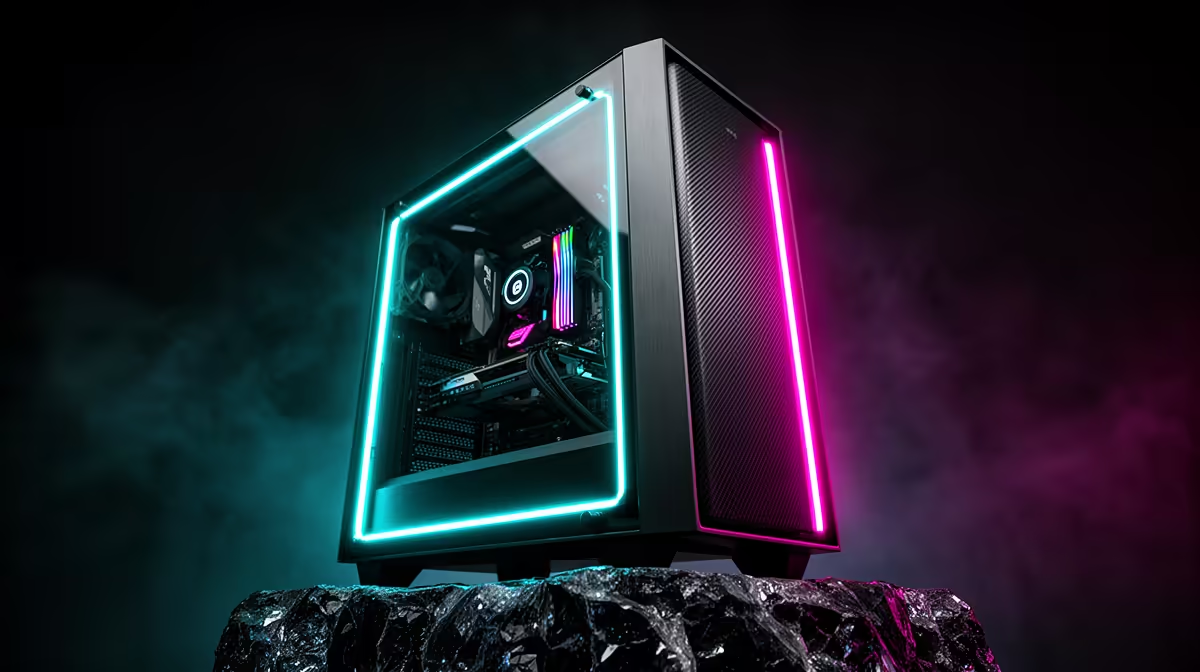
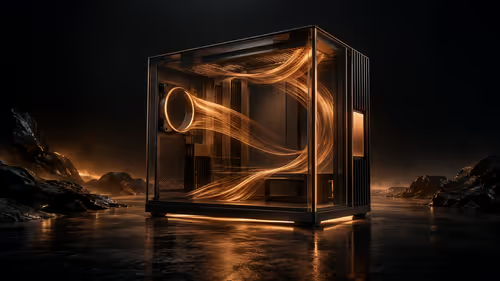
A full-tower E-ATX gaming case must explicitly support boards up to 305mm wide (E-ATX standard) with correctly spaced standoffs. Key features to verify are: front 420mm radiator support, GPU length clearance above 360mm, and sufficient cable routing cutouts for the larger cable count that E-ATX boards require.
What Sets E-ATX Cases Apart from Standard ATX Full Towers 🖥️
E-ATX motherboards extend the ATX width from 244mm to 305mm, adding PCIe lane support, additional M.2 slots, expanded power delivery components, and often dual memory channels for workstation use. The case motherboard tray must accommodate this extra width without obstructing the board's rear I/O panel or applying pressure to edge-mounted components.
Not all cases labelled full tower support E-ATX correctly. Some list E-ATX compatibility but only for boards at 272mm or 285mm, not the full 305mm specification. Before purchasing, cross-reference the case's maximum motherboard width in the specification table against your exact board's dimensions.
Radiator and Cooling Support at the E-ATX Scale 💧
Builds that justify an E-ATX board, typically featuring a flagship CPU and one or two high-end GPUs, produce heat that benefits from maximum radiator surface area. Full-tower E-ATX cases commonly support 420mm front mounts, 360mm top mounts, and 360mm side mounts simultaneously, enabling multi-radiator custom loops with combined surface area of over 1,100mm.
For a single CPU and GPU custom loop on an E-ATX build, a 420mm front radiator and a 360mm top radiator covers both components with substantial cooling headroom. The Lian Li O11 Dynamic EVO XL, priced locally at approximately R5,000 to R6,500, supports this configuration and has been a popular choice for custom loop builders in SA.
GPU and Storage Clearance in Full Towers 🔧
Flagship GPU cards like the RTX 5090 in triple-slot designs can reach 340mm in length and over 60mm in thickness. Full-tower E-ATX cases typically offer 400mm to 420mm of GPU length clearance and up to four PCIe slot openings for thick designs.
Storage support in full towers generally includes four to eight 3.5-inch HDD bays and multiple 2.5-inch SSD mounting positions.
Route Power Cables Before Mounting the Motherboard ⚡
In a full-tower E-ATX build, the 24-pin ATX cable and dual EPS 8-pin CPU connectors require more routing length than in a mid-tower. Pre-route all power cables through the back panel cutouts before mounting the motherboard, then connect them after the board is seated. Attempting to route cables around an already-mounted E-ATX board with its large VRM heatsinks is significantly more difficult.
FAQ
How heavy is a fully built full-tower E-ATX gaming PC?
Expect 18 to 25 kg for a full build including an E-ATX board, dual PSU setup or high-wattage single PSU, multiple HDDs, 420mm radiator with fans, and a flagship GPU. This weight makes transport to LAN events challenging without a dedicated PC carry case.
Are full-tower cases good for airflow without liquid cooling?
Yes, with the right fan configuration. A full tower with three to four 140mm front intake fans, one to two 140mm top exhaust fans, and a 140mm rear exhaust provides substantial airflow for air-cooled E-ATX builds.
What is the price range for quality E-ATX full-tower cases in South Africa?
Quality E-ATX full towers from reputable brands like Lian Li, Fractal Design, Corsair, and be quiet! range from R3,500 to R8,000 locally. Budget options under R2,500 that claim E-ATX support often cut corners on cable management space, radiator mounting quality, or panel fitment.
Planning a full-tower E-ATX gaming or workstation build?
Evetech stocks full-tower cases with verified E-ATX support from Lian Li, Fractal Design, Corsair, and more, with local warranty and delivery. Browse the cases section to find the right enclosure for your build.