Quick Answer
Gold-plated connectors prevent corrosion and maintain stable contact resistance over time. Aluminium connector housings resist mechanical deformation, cracking, and EMI ingress better than plastic. Together, these two features are the most meaningful build quality indicators on a display cable. Neither improves digital signal quality when new, but both preserve signal integrity over years of use.
Gold-Plated Connectors: What the Spec Means 🔧
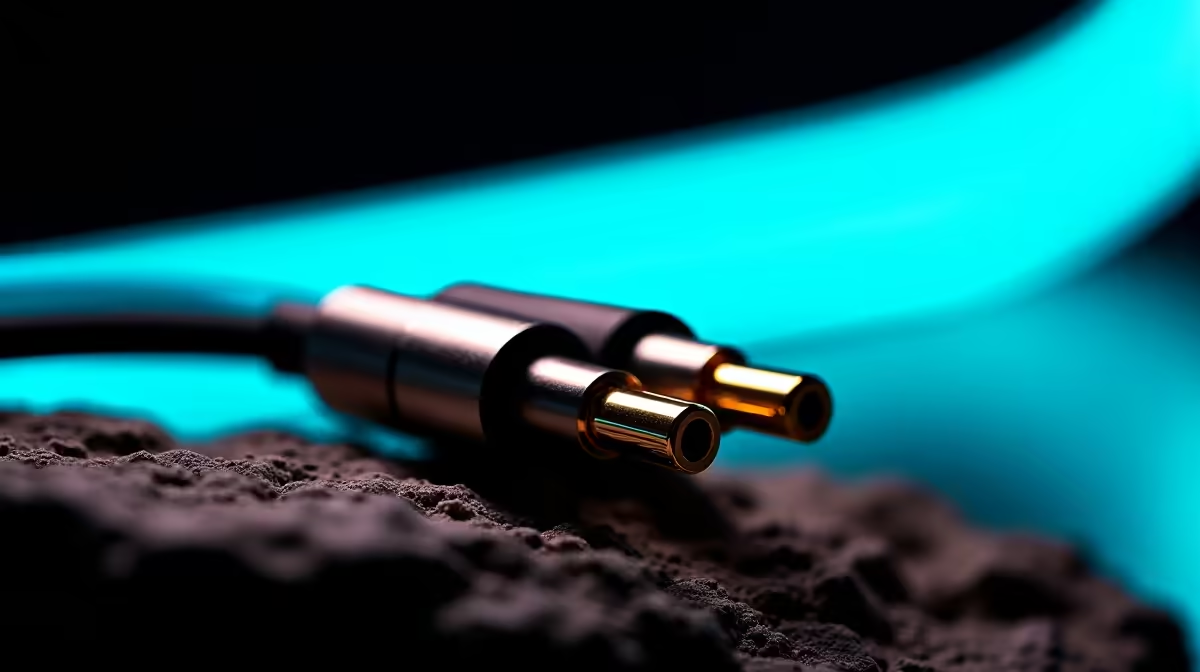
Gold applied at 15 to 30 microns over a nickel undercoat maintains contact resistance below 10 milliohms over thousands of insertion cycles. Tin oxidises rapidly, particularly in SA's coastal cities like Durban and Cape Town, where persistent humidity causes tin contacts to degrade within two to three years. Oxidised contacts increase resistance enough to disrupt DisplayPort link training. The nickel undercoat is equally important: it prevents gold from diffusing into the base copper over time and provides the hardness to withstand pin-to-socket pressure. Budget cables with flash gold under 5 microns skip the nickel undercoat and provide minimal protection.
Aluminium Housing Construction and EMI Rejection 📡
Aluminium housings deliver three advantages over plastic. Mechanical rigidity: they resist lateral flex that misaligns pins during insertion. EMI shielding: a properly grounded aluminium housing extends the cable's internal shielding to the connector point, closing the gap where the jacket ends. This gap is a real vulnerability at UHBR20 bandwidth (80 Gbps). In dense cable bundles alongside USB 3.0 and power leads, this shielding continuity is a genuine improvement. Plastic housings provide none of these benefits.
Evaluating Cable Construction in the SA Market 💰
Cables in the R250 to R400 range commonly have gold-plated contacts but plastic housings. The R400 to R600 range adds aluminium housings and braided jackets. For a Johannesburg desktop with a fixed install, a R350 cable with gold contacts and plastic housing is adequate: dry climate limits corrosion and a static cable sees no housing stress. For coastal Durban or a cable that is regularly reconnected, the R450 to R600 aluminium-housed range is the correct choice. The performance ceiling is always the DP version certification, independent of housing material.
Grip the Housing, Never the Cable Jacket ⚡
When inserting or removing a display cable, grip the connector housing firmly, not the cable jacket. Pulling by the jacket transfers stress to the internal conductor-to-connector junction, which is the most common physical failure point regardless of housing material. This habit extends any cable's lifespan significantly.
FAQ
Can I tell if a cable has genuine gold plating from the connector appearance?
Gold plating appears as a warm yellow-gold metallic finish on the contact pins. Nickel is silver-grey. A gold finish on the pins suggests gold plating, but thickness can only be confirmed from product documentation specifying micron depth.
Does aluminium housing make a DisplayPort cable heavier or stiffer?
Slightly heavier, yes. Quality aluminium-housed cables weigh 10 to 20 grams more than equivalent plastic-housed cables in 2m lengths. The additional weight is negligible in practice and the weight difference should not influence the purchase decision.
Are there cables with both gold plating and aluminium housing available in South Africa?
Yes. Cables combining both features are stocked locally from around R400 to R700 for 2m DP 1.4 and DP 2.1 options at retailers including Evetech. This specification tier represents the best long-term value for SA buyers.
Want a display cable built with proper materials for South African conditions?
Evetech stocks cables with gold-plated connectors and quality housing construction for gaming and workstation use. Browse the full selection at Evetech.