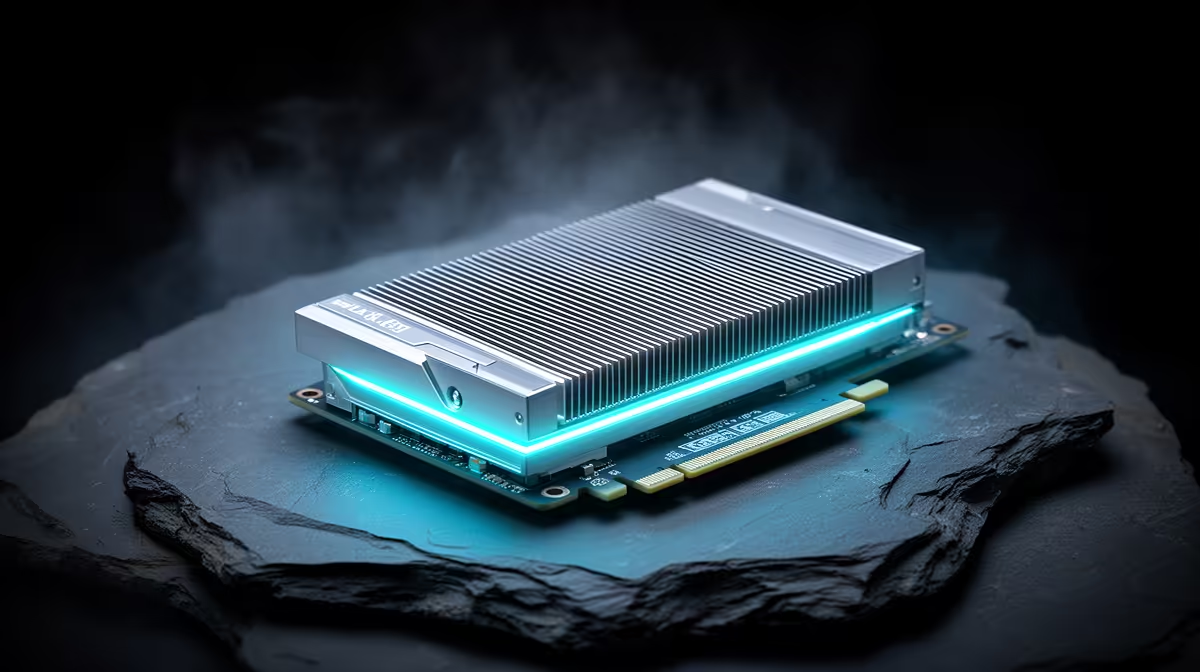
A 7B coding model squeezed to 4-bit lands at roughly 4.5 to 5GB on disk, and that single number is why an 8GB GPU is the realistic floor for running a local AI coding assistant. With the weights and a modest context window sitting entirely in VRAM, an entry card like an RTX 4060 churns out completions at speeds that feel interactive rather than sluggish, no cloud subscription, no token meter, and your code never leaves the machine.
Quick Answer
An 8GB GPU is the practical entry point for local AI coding: a 7B model quantised to Q4 fits in about 4.5 to 5GB of VRAM, leaving headroom for context, and delivers around 40 or more tokens per second. That is fast enough for occasional autocomplete and chat-style coding help without ever touching a cloud service.
Why 8GB is the line that matters
VRAM is the gate. A model must live entirely inside the GPU's memory to run at full speed; any spillover into system RAM and throughput collapses. A raw 7B model in full precision wants roughly 14GB, far beyond an entry card. Quantising it to 4-bit (Q4) compresses the weights to around 4.5 to 5GB with minimal quality loss for everyday coding tasks. Add about 1 to 1.5GB for the key-value cache that holds your prompt and recent context, and you land comfortably under 8GB.
That maths is the whole story. Below 8GB you are forced into smaller, weaker models or aggressive context limits. At 8GB you can keep a capable 7B coder resident with room to work. Above it you start fitting larger models, but for a hobbyist who wants the model there when inspiration strikes rather than running agentic sessions all day, 8GB hits the sweet spot.
What an 8GB card actually runs well
The standout for this tier is Qwen 2.5 Coder 7B, widely regarded as the strongest local coding model at its size, alongside general-purpose options like Llama 3.2 and Mistral 7B. In Q4 form on an 8GB card, these models typically deliver around 40 to 53 tokens per second depending on the exact model and card, which is brisk enough that completions appear as fast as you can read them.
That speed covers the bread-and-butter work: explaining an unfamiliar function, drafting a boilerplate class, suggesting the next few lines, or talking through a bug. Where an 8GB card runs out of road is long-context agentic coding, where a tool loops over a large codebase and needs both a bigger model and a much larger context window. That workload genuinely wants more memory, but it is not what most people reach for when they first try local AI.
Quantisation in plain terms
Quantisation reduces the numerical precision of a model's weights, trading a sliver of accuracy for a large drop in memory use. Q4 (4-bit) is the standard balance: it roughly thirds the footprint of a full-precision model while staying coherent for coding. Going lower than Q4 saves more VRAM but starts to dent the model's reliability on code, so Q4 is the setting most local-AI runners default to on 8GB hardware.
Beyond the GPU: the rest of the machine
The GPU is where the real work happens, but a capable local-AI box needs the rest of the machine to match. Sixteen GB of system memory keeps the OS and your editor from competing with the model loader, and a fast NVMe SSD speeds up multi-gigabyte model loads considerably. The AI-ready PCs at Evetech pair a current-generation 8GB card with a recent six-core CPU in exactly this balanced configuration.
Software is the easy part. Tools like Ollama and LM Studio download a quantised model and expose a local endpoint your editor can talk to, so within minutes of unboxing you can have a coding model answering prompts entirely offline. The PC best sellers at Evetech reflect which specs SA buyers are gravitating toward right now, which is a solid real-world signal on value.
Who should and should not stop at 8GB
An 8GB card is right for the hobbyist, student or developer who wants private, no-subscription AI for everyday coding and is happy with 7B-class models. If your ambition is running a 13B or larger model, juggling huge context windows, or driving multi-step agentic workflows, plan for 12GB or more from the outset; the jump unlocks bigger models rather than just more speed. For dipping a toe into local AI, though, 8GB is the honest, affordable starting line.
Context window: the hidden VRAM cost
VRAM is not just consumed by the model weights. Every token of your prompt and the model's reply lives in the key-value cache, which grows with the context window, the amount of text the model can consider at once. On an 8GB card this is the lever you actually tune day to day: a modest context of a few thousand tokens leaves the model comfortable, while pushing the context far higher eats into the same memory the weights need and can force a slowdown or a smaller model.
For everyday coding that is rarely a problem, since explaining a function or drafting a class needs only a few hundred lines in view. It becomes the limit when you try to feed the model an entire large file or several files at once, which is closer to the agentic workload that genuinely wants more VRAM. Knowing that the context window draws on the same memory budget helps you set it sensibly rather than maxing it out and wondering why performance dropped.
Why local, not cloud
The case for running on your own 8GB card rather than a cloud service comes down to three things. Privacy is the headline: your code and prompts never leave the machine, which matters for proprietary or sensitive work. Cost is the second: no subscription, no per-token metering, just the one-off hardware. And availability is the third: a local model works offline and never rate-limits you, so it is there the instant you want it. The trade is that a cloud service can run far larger models than 8GB allows, so local AI is about private, always-on convenience at a capable-enough level, not about matching the biggest hosted models.
Frequently Asked Questions
Can an 8GB GPU run a 7B coding model smoothly?
Yes. A 7B model in Q4 quantisation occupies roughly 4.5 to 5GB of VRAM, leaving room for context on an 8GB card. Expect around 40 or more tokens per second, which feels responsive for autocomplete and chat-style coding.
What is the best local coding model for 8GB of VRAM?
Qwen 2.5 Coder 7B is widely rated the strongest coding model at the 7B size and fits an 8GB card in Q4 form. Llama 3.2 and Mistral 7B are solid general-purpose alternatives if you want broader chat ability too.
Why not just use a smaller model on less VRAM?
Smaller models lose noticeable accuracy on code, so a 7B model is the sweet spot for reliable suggestions. Dropping below 8GB forces either a weaker model or a cramped context window, both of which hurt the experience.
Do I need anything besides the GPU?
Pair the card with 16GB of memory or more plus a fast NVMe SSD for loading model files. A recent six-core or better CPU rounds out a balanced local-AI machine without bottlenecking the GPU.
When should I choose a 12GB or larger card instead?
Step up when you want to run 13B or larger models, use long context windows, or run agentic coding that loops over a whole codebase. Those workloads need the extra memory; everyday 7B coding does not.
Want a private coding assistant that runs entirely on your own hardware? Start with an 8GB-class GPU build from the AI-ready PCs at Evetech and have a local 7B model answering prompts offline the same day it arrives.