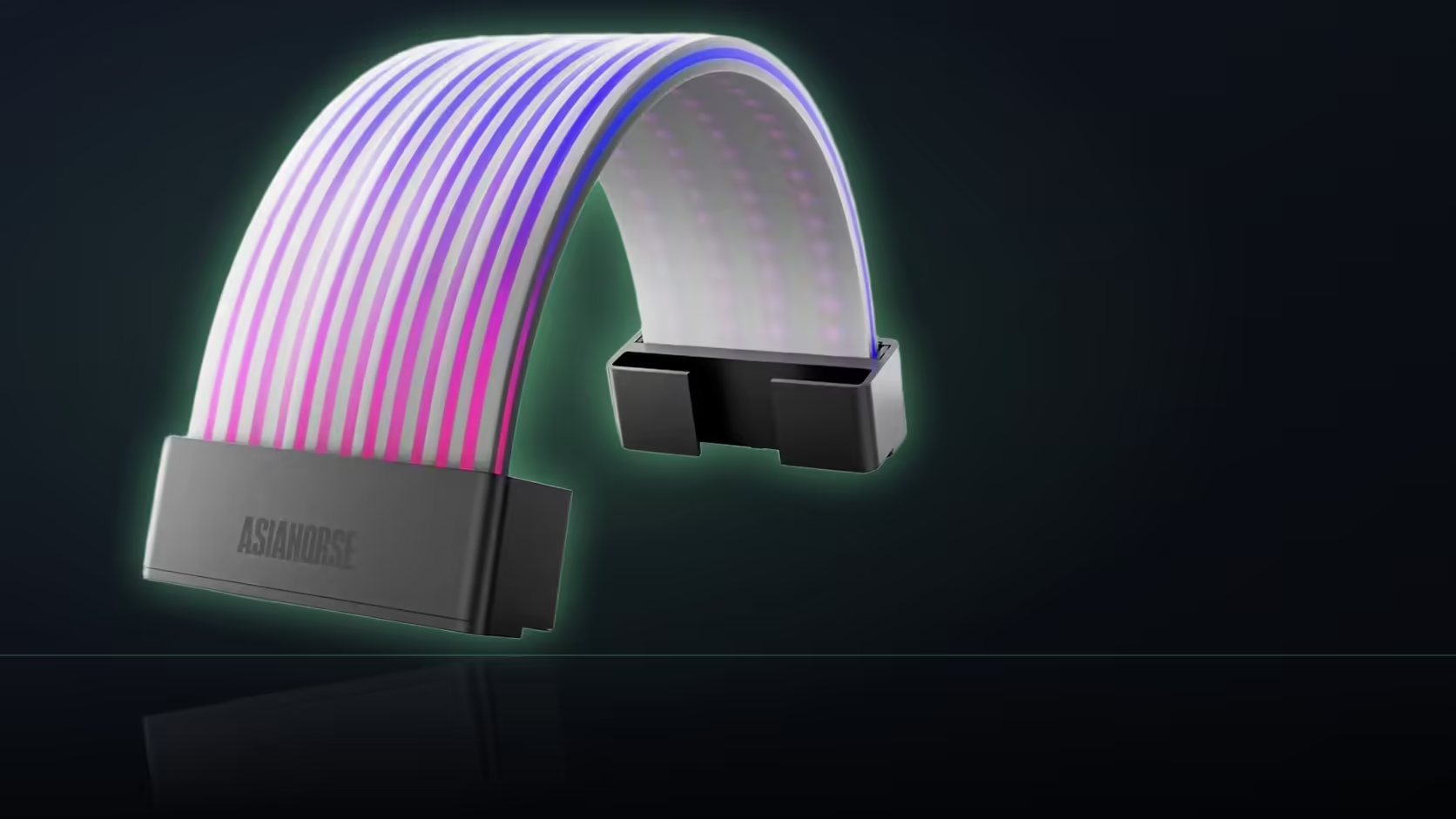
Two different products promise the same basic outcome - a build that looks lit from cable to connector - and they get there in completely different ways. AsiaHorse's Aurora ARGB cover kit dresses a length of cable with lit strands, while a Hydrus ATX cable puts its glow at the connector head instead. Neither is wrong, but they answer different questions about where light should actually sit in a case, and the difference is worth working through before either goes in a cart.
Quick Answer
The Aurora kit (R699) lights a span of cable across two runs, while a single Hydrus ATX cable (R599) lights the connector point instead. Aurora covers more visible area because it dresses length rather than a single point; Hydrus concentrates its effect where the cable meets the socket. Which lights "more" depends on whether you're after a line of light crossing the case or a lit accent at one spot.
🔦 Covering a span versus lighting a connector
The Aurora kit is two shells: one shaped for the 24-pin motherboard run and one for the eight-pin graphics run, each clipping over the cable that's already installed. Between them they carry 81 addressable LEDs on the board cover and 80 on the graphics cover, styled as individually glowing strands rather than one continuous bar. The effect reads as a line of light tracing the path the cable actually takes through the case.
A Hydrus ATX cable takes the opposite approach. Its illuminated section sits in the connector head itself - the point where the cable meets the board or the power supply - rather than anywhere along the run. That gives a single bright point rather than a traced line, and it changes how much of the interior actually shows light at any one moment.
Why the shape of the light matters more than the brightness
Neither product is dimmer or brighter than the other in any meaningful sense; addressable LEDs are addressable LEDs. What differs is coverage. Two spans of cable, each carrying dozens of individual LEDs, simply occupy more of the case interior than one lit connector does. If the goal is a visible line of light running from the power supply up towards the board and across to the graphics card, the covers do considerably more of that job.
📏 What "more visible" actually means in a build
A single lit point can still dominate a case if it sits somewhere the eye lands naturally - directly behind a glass panel, say, or right at the front of a shrouded power supply area. Two lit spans, by contrast, tend to read as structure: they give the interior a sense of direction, drawing a line the eye can follow rather than a spot it simply notices. Whether that's a benefit depends entirely on what else is going on inside the case. A busy interior with several other lit components might actually read better with a single accent point than with two more lines competing for attention, while a sparse build with plenty of open space can use the extra structure the covers provide.
It's also worth remembering that "more" coverage isn't automatically "better" - it's simply a different design decision, and the right one depends on the rest of the build rather than on either product in isolation.
🔌 The wiring is closer than the effect suggests
Both approaches sync through the same kind of connection: a 5V 3-pin addressable header on the motherboard. Neither needs a controller box, and neither needs a SATA lead. That means the choice between them doesn't come down to installation complexity - it comes down entirely to where you want the light to sit. A build could even run both, provided the board has headers to spare, letting a lit connector and a pair of lit spans work together rather than compete.
For anyone tidying the runs either product sits over, a look through Evetech's cable management range is worth a stop before deciding on either lighting approach. And for a wider sense of how case lighting choices stack up against each other, the case lighting selection on site covers more than just cable-adjacent products.
💰 The price gap is smaller than it looks
At R699 for the Aurora pair against R599 for a single Hydrus cable, the per-item cost is close enough that price isn't really the deciding factor here. What buyers are actually choosing between is two lit spans covering roughly 161 addressable LEDs combined, or one lit connector doing a smaller, more concentrated job. Someone building around a glass side panel that frames the board connector directly might find the single cable does everything they need; someone with an open-air case and long cable runs on display might find the covers make far better use of the same rough budget.
Neither decision is wrong on its own terms. What matters is being honest about which part of the case actually gets looked at day to day - a glass panel angled towards the board tends to reward a concentrated point of light, while a full side window showing the whole cable path rewards the spans. Working that out before ordering either product saves the cost of buying the wrong one and finding out only once the panel's back on.
Frequently Asked Questions
Which cable runs does the Aurora kit dress?
One shell is shaped for the 24-pin board run and the other, the longer of the pair, is shaped for the eight-pin graphics run.
Where does the Hydrus lighting sit by comparison?
In the connector head itself, so the glow shows at the socket rather than anywhere along the length of the cable.
Which product lights up more of the case?
The Aurora covers, since two lit spans cover considerably more visible area than a single lit point at one connector.
Does more coverage automatically look better?
Not always - a single point can read as a quiet, deliberate accent, while two lit spans become a much more prominent part of the interior.
Do both use the same kind of connection?
Yes. Both sync over a 5V 3-pin addressable header, so either can follow whatever lighting scheme the board is already running.
Could a build use both products together?
It can, provided enough headers are free - a lit connector and two lit spans occupy different parts of the case, so they don't compete for space.
How does the pricing compare?
The Aurora kit is R699 for two shells, and a single Hydrus ATX cable runs R599, so the two options sit close together on price.
Deciding between a lit span or a lit connector?
Browse Evetech's cable lighting and management accessories to see how each approach fits your case.