Quick Answer
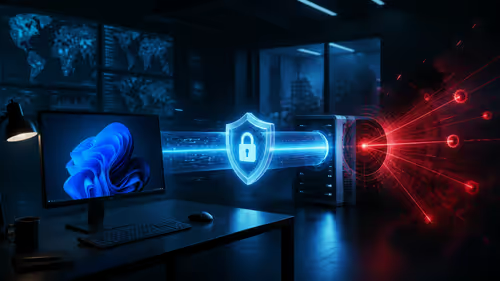
Intelligent voltage stabilisation (IVS) uses digital feedback controllers that sample output rail voltages thousands of times per second and adjust the switching duty cycle in real time, keeping the 12V rail within plus or minus 0.5% of nominal under both steady-state and transient load conditions. This is a significant improvement over analogue-controlled PSUs, which can allow 2% to 4% rail deviation during sudden load changes from modern GPUs.
How Digital Power Control Works 🔧
Traditional analogue-controlled PSUs use an error amplifier and comparator to measure output voltage. These circuits respond to voltage deviations in microseconds but have limited bandwidth and cannot distinguish between a slow load ramp and a fast transient spike without producing overshoot or undershoot. Digital control platforms replace the analogue feedback loop with a microcontroller or DSP that samples the output voltage at MHz rates, applies proportional-integral-derivative (PID) filtering in software, and adjusts the PWM duty cycle of the switching transistors with sub-microsecond latency. The result is that the 12V rail stays within 50mV of its nominal 12.0V during the rapid 150% transient excursions that RTX 50-series GPUs generate, instead of drooping to 11.5V or below as older designs do.
Benefits for Modern GPU and CPU Power Delivery 💡
CPUs and GPUs translate 12V PSU input to their internal operating voltages (often 0.9V to 1.4V) via on-die voltage regulators (VRs). When the rail droops to 11.4V or below during a transient, the VR has less headroom and its own regulation can degrade, causing the CPU or GPU core voltage to momentarily undershoot. This manifests as a crash or a visible frame stutter. IVS prevents the input droop that triggers this cascade. For South African gamers running Ryzen 9 9950X CPUs and RTX 5090 GPUs in warm climate conditions, clean input power also helps VRMs run cooler.
Real-World Implementation Examples 🖥️
The Corsair HXi and AXi series use proprietary digital control ASICs with real-time monitoring accessible through Corsair iCUE software. The ASUS ROG Thor series integrates a digital controller that feeds data to the OLED display and Armoury Crate. Seasonic Prime units use a PMIC-based feedback architecture that achieves sub-1% regulation across the full load range. For South African buyers choosing between these platforms, the software ecosystem may matter if you want detailed per-rail monitoring data logged over time. All three share the core benefit of faster transient response versus analogue designs.
Use Software Monitoring to Baseline Your Rails ⚡
After installing a new digital PSU, open the manufacturer's monitoring software and run a 30-minute gaming session while logging the 12V rail. A healthy reading stays within 11.88V to 12.12V throughout. If you see dips below 11.8V during GPU load peaks, check all cable seating, particularly the 12V-2x6 connection at the GPU end.
FAQ
Does IVS make a difference if I am not overclocking?
Yes. Even at stock settings, RTX 50-series and RX 9000-series cards generate 150% transient excursions that older PSUs struggle to handle. IVS benefits all users of current-gen hardware, not just overclockers.
Can I retrofit IVS to an older PSU?
No. Intelligent voltage stabilisation is a hardware feature of the PSU's control circuitry, not a firmware upgrade or software feature. Obtaining the benefit requires replacing the PSU with one that incorporates a digital control platform.
Does digital power control improve power factor?
Digital control primarily improves transient response and regulation. Power factor correction is handled by a separate PFC stage. High-quality units combine active PFC with digital output control for both high power factor (above 0.99) and tight regulation.
Want stable, clean power for your gaming or workstation build?
Evetech stocks PSUs from brands with proven digital control platforms, covering the full wattage range from 850W to 1,600W with full local warranty and ATX 3.1 compliance.