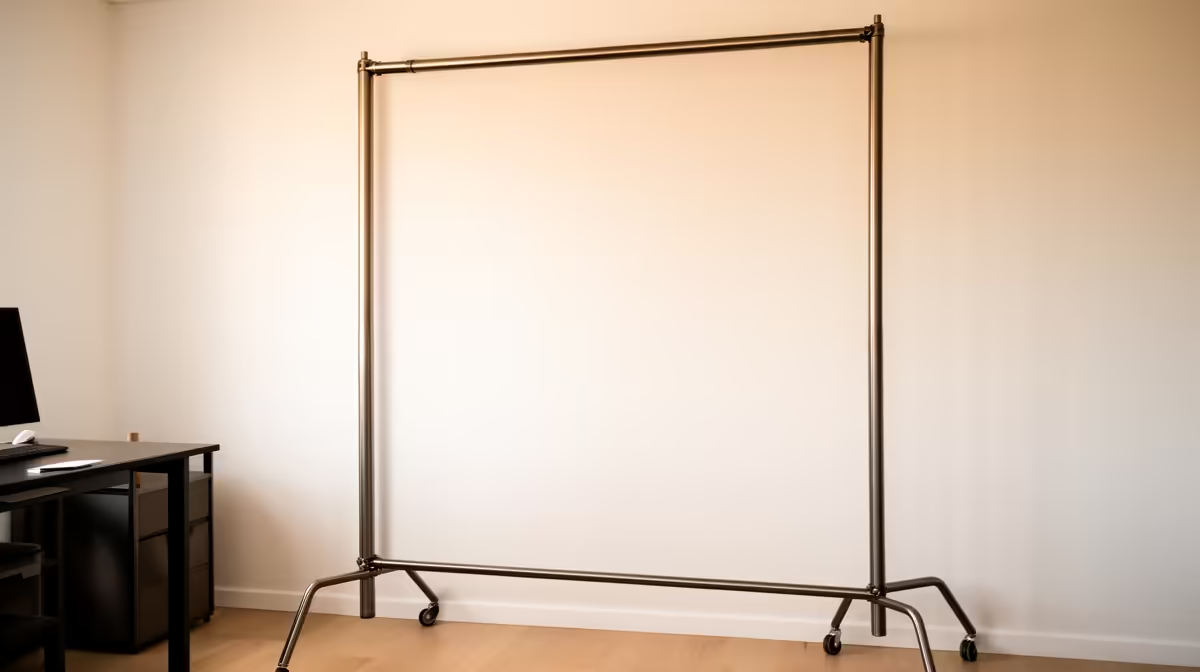
A busy bookshelf or an unmade bed behind you on a video call is not technically a problem, but it communicates carelessness in a context where the opposite impression costs you nothing to create. Upgrading a South African work-from-home space with a backdrop stand is one of the most visible improvements you can make to how you present on camera, and the best part is that it takes up no permanent space in a room that needs to function as more than a studio.
Quick Answer
A 199cm backdrop stand with a 300cm crossbar hangs a clean fabric drop behind your seated frame and then collapses into a 90cm bag when the workday ends. It costs no wall space, requires no drilling, and converts a study or spare bedroom into a professional-looking call environment in about five minutes.
🏠 The South African Work-From-Home Context
Remote and hybrid work is no longer a temporary arrangement for a large portion of South African professionals. Cape Town, Johannesburg, Pretoria, and Durban all have significant populations working from residential spaces that were designed for living, not presenting. A one-bedroom flat in Braamfontein, a townhouse study in Durban North, a shared house in Claremont -- these are functional work environments, but they are rarely photogenic from the neck down.
The challenge is that most South African rental properties and owned homes have limited space per room. The spare bedroom that serves as a home office also doubles as storage, an occasional guest room, and whatever else does not fit elsewhere. A permanent backdrop installation -- wall-mounted rails, ceiling tracks -- converts that room into a dedicated studio and effectively removes its other functions. For people who need the space to switch roles daily or weekly, that trade-off is not worth making.
A portable backdrop stand solves this by existing only when you need it. The rest of the time it lives in a carry bag in a cupboard or along a skirting wall, taking up less floor space than a bicycle.
What the stand actually changes on camera
The improvement is visual clarity. A plain, evenly coloured backdrop eliminates competing background information so the viewer's eye goes to your face rather than the clutter behind you. On a modern display at higher resolution, the bookcase three metres behind you is clearly readable. A backdrop removes that entirely.
📐 Sizing the Stand for a Home Office Frame
A seated work-from-home frame on a standard webcam is typically a head-and-shoulders view, roughly 80 to 100cm wide and 60 to 70cm tall in the final image. That is the area the backdrop needs to cover. In practice, you want significantly more than that, because moving slightly in your chair should not take you off the clean background edge.
A backdrop width of 200 to 300cm and a height of 150 to 199cm covers a seated frame with comfortable margins on all sides. The crossbar on a 199cm stand typically extends from 100cm to 300cm, so you can narrow it for a compact setup or stretch it for a wider frame.
Positioning the stand behind your chair at about one metre of distance gives you the visual separation that makes the backdrop look like a natural background rather than a fabric sheet two centimetres from your head. At 1m or more, soft natural light from a window in front of you will gently illuminate both you and the backdrop without creating a shadow from your body onto the fabric.
🎨 Choosing a Backdrop Colour for Calls
Grey is the most consistently flattering backdrop colour for professional calls. A mid-tone neutral grey reads as authoritative without being stark, flatters the majority of skin tones, and does not create the colour spill issues that a white or coloured backdrop introduces when the room light shifts through the day.
White is the second most popular choice. It reads as clean and corporate, performs well with a dedicated key light in front, but can blow out and look harsh if it catches strong direct light. In South African homes with large windows and bright afternoon sun, a white backdrop that is not carefully lit can become distractingly bright.
Avoid green or blue if you ever use video conferencing software with virtual background features enabled. The software's background removal algorithm occasionally picks up green or blue fabric as a background to replace, producing an intermittent artefact during the call. Virtual background removal also struggles with complex edges -- textured hair, earrings, glasses frames -- producing a fringe artefact that a physical backdrop never creates. If how you look on calls matters professionally, a real backdrop delivers a cleaner result than software removal on any platform.
⏱️ Fitting the Setup Into a Daily Routine
One genuine concern people raise about portable stands is the setup time. The honest answer is that once you have assembled and disassembled the stand two or three times, the process becomes routine. Extending the legs, locking the centre column height, threading the crossbar through the backdrop sleeve, and tensioning the crossbar adjusters takes about five minutes with both hands. Breakdown is faster: loosen, retract, roll, bag.
If you have calls every working day, you can leave the stand up during the week and pack it away on Friday afternoon. The crossbar tucks behind your desk chair and the stand feet spread wide but flat, so the visual intrusion during non-call hours is minimal. The bag-and-store routine is really for the weekend or when the room needs to be genuinely clear.
A hook on the back of a door or inside a wardrobe is enough to store the 90cm bag vertically. The stand does not need a special cabinet or significant clearance -- it stores like a sports bag.
Pro Tip ⚡
If you are in Cape Town or Durban where coastal light quality is strong, position the stand so a window with soft indirect light faces you. The stand backdrop behind you stays evenly lit from your own key light (the window) and looks considerably better than in a light-controlled interior room.
Frequently Asked Questions
Why would a backdrop stand improve how I look on calls?
It removes background information that distracts from your face and voice. A plain, neutral backdrop directs the viewer's eye where you want it. This is the same principle broadcasters and corporate presenters use, applied to a residential work setup.
What stand dimensions work for a typical seated home office frame?
A 199cm-height stand with a crossbar that extends to 280 to 300cm is the standard recommendation. This gives you enough height to clear your head with room to spare and enough width to stay on the backdrop if you move slightly left or right during a call. Narrower or shorter stands are available and cost less, but the margins become tight.
How does the stand store in a small flat or townhouse?
Fully collapsed, the poles retract to around 90cm. The whole kit fits into a single carry bag that stores behind a door, in a wardrobe, or under a bed. It occupies less floor space than a vacuum cleaner and needs no dedicated storage furniture.
Can I leave the backdrop up full-time in a shared living space?
The stand feet occupy roughly 150cm wide by 80cm deep. In a room shared with other residents or used as a dining space in the evenings, permanent placement may not be practical. That is exactly the situation the portable format is designed for -- it disappears when the room needs to be something else.
What backdrop colour performs best on video calls in South African homes?
Mid-tone grey performs most consistently. It reads as neutral and professional, holds up across the strong direct sunlight common in coastal SA homes, and does not clash with most clothing colours. White works with controlled front lighting but can overexpose in bright natural light. Saturated colours should be avoided for professional calls.
Ready to present more professionally on every work-from-home call?
Browse the backdrop stand range at Evetech for portable setups that give you a clean background in five minutes and pack away when the room moves on to something else.