Quick Answer
Vapor chamber cooling runs cooler than standard heat pipes on high-TDP GPUs, typically by 5 to 12 degrees Celsius under sustained load, because the vapor chamber transfers heat across the full die surface instantly rather than relying on copper pipes to conduct heat away from specific contact points. On mid-range GPUs with lower thermal loads, the difference narrows to 2 to 5 degrees and may not justify the cost premium.
How Vapor Chambers Outperform Heat Pipes on Flagship GPUs 🔧
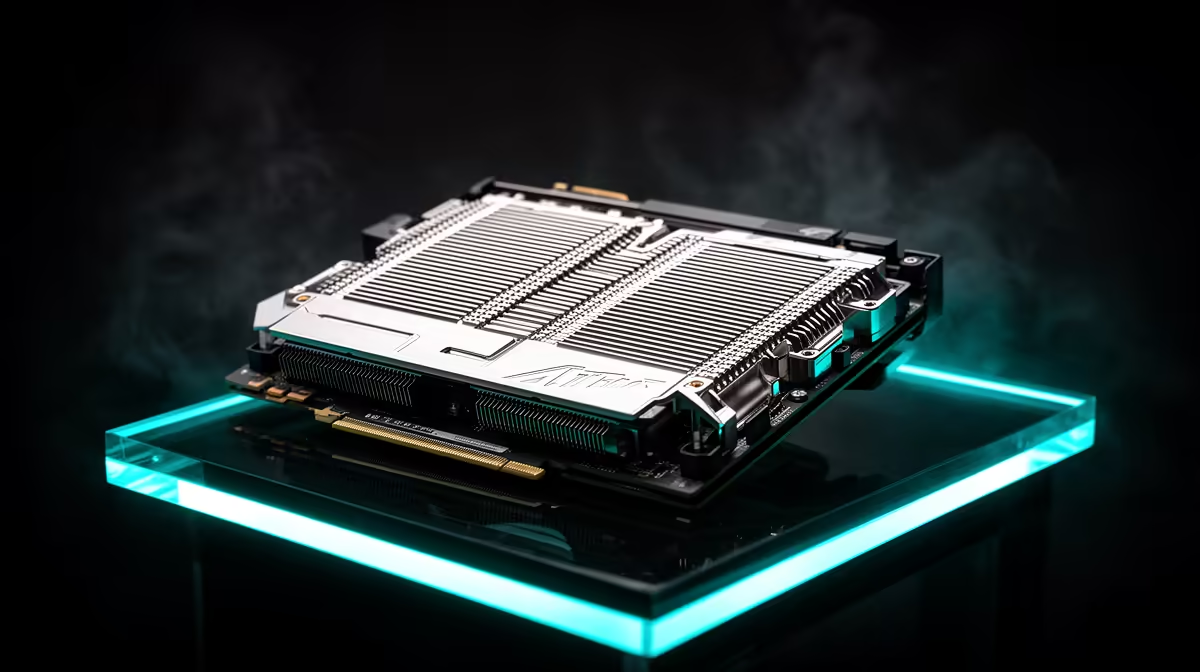
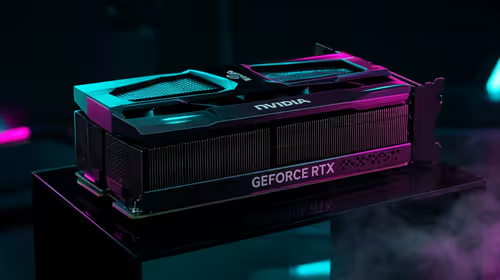
A GPU die is small but produces hundreds of watts of heat in that compact area. Standard heat pipes conduct heat from a copper base plate outward through pipes to the fin array, creating a temperature gradient across the die surface. A vapor chamber replaces the base plate with a phase-change chamber that distributes heat across its full surface instantly via evaporation and condensation. On a 575W TDP RTX 5090, this produces a significantly more uniform die temperature, allowing the GPU's boost algorithm to sustain higher clock frequencies before thermal limits engage. RTX 5090 and RTX 5080 cards in South Africa from approximately R35,000 and R55,000 respectively use vapor chamber bases.
Heat Pipe Performance on Mid-Range Cards 🌡️
Composite and standard heat pipe coolers on mid-range GPUs like the RTX 5070 or RX 9070 (priced around R14,000 to R18,000 in South Africa) perform very well. Their TDP of 250W to 300W is modest enough that well-designed heat pipe arrays maintain peak temperatures below 82 degrees Celsius even in warm environments. The temperature disadvantage of heat pipes only becomes notable when die heat density is very high, as on flagship cards.
Practical Implications for South African Buyers 💰
In South African summer indoor temperatures of 28 to 33 degrees Celsius in Gauteng and the Western Cape, both cooling designs see higher absolute GPU temperatures than in cooler European climates, but the thermal delta advantage of vapor chambers remains consistent. For mid-range builds, prioritise overall cooler size and fan count over base plate technology, as a large heat pipe cooler with three fans will outperform a small vapor chamber design with poor fin density.
Run MSI Afterburner to Confirm Your GPU's Sustained Clocks ⚡
After building your system, run a 20-minute gaming session with MSI Afterburner logging GPU temperature and core clock. If you see the clock frequency dropping below the GPU's rated boost clock during sustained load, thermal throttling is occurring. Improving case airflow or reapplying thermal paste will raise the sustained clock ceiling and recover real-world performance.
FAQ
Can you add a vapor chamber aftermarket to a GPU that shipped with heat pipes?
No practical aftermarket vapor chamber GPU coolers exist for specific GPU models. Third-party heatsink replacements are available for some popular GPU models but use enhanced heat pipe designs rather than vapor chambers.
Does thermal paste quality affect the comparison between vapor chamber and heat pipe GPUs?
The vapor chamber itself contacts the GPU die directly and its performance depends on the die-to-chamber interface quality from the factory. For consumer heat pipe GPUs, thermal paste application at the base plate matters more, and a professional repaste with a quality compound like Thermal Grizzly Kryonaut can close some of the gap on older heat pipe cards.
How long do vapor chambers last compared to heat pipes?
Both are sealed systems with no mechanical wear. Vapor chambers in GPU applications are rated for the same lifespan as the GPU itself, typically seven to ten years of normal use. Failure modes are extremely rare on quality products from established manufacturers.
Choosing between flagship and mid-range GPU cooling?
Evetech stocks vapor chamber RTX 50-series cards and heat pipe mid-range options with local warranty and delivery across South Africa. Compare the GPU range at Evetech to find the right cooling tier for your build.