Quick Answer
For a reliable 4K DisplayPort cable in professional workflows, the essential features are: HBR2 (21.6Gbps) bandwidth minimum for 4K at 60Hz (HBR3 for 4K at 120Hz), gold-plated contacts for long-term signal integrity, dual or triple shielding for EMI immunity, and a conductor gauge of 26 AWG or better on signal pairs.
Bandwidth Rating: The Non-Negotiable First Check 📡
A cable not rated for HBR2 minimum cannot reliably sustain 4K at 60Hz. Professional video production, CAD visualisation, and colour grading all require stable 4K at 60Hz minimum, and dropped frames or display reconnections mid-session are unacceptable. For workflows using 10-bit HDR colour monitoring at 4K, DisplayPort 1.4 at HBR3 (32.4Gbps) is the correct specification: it supports 4K at 60Hz with 10-bit colour without compression, and 4K at 120Hz using Display Stream Compression. SA post-production studios using DaVinci Resolve for HDR-grade colour work should specify HBR3 cables regardless of current monitor refresh rate, as the overhead provides stability margin for 10-bit workflows.
Connector and Build Quality Features 🔧
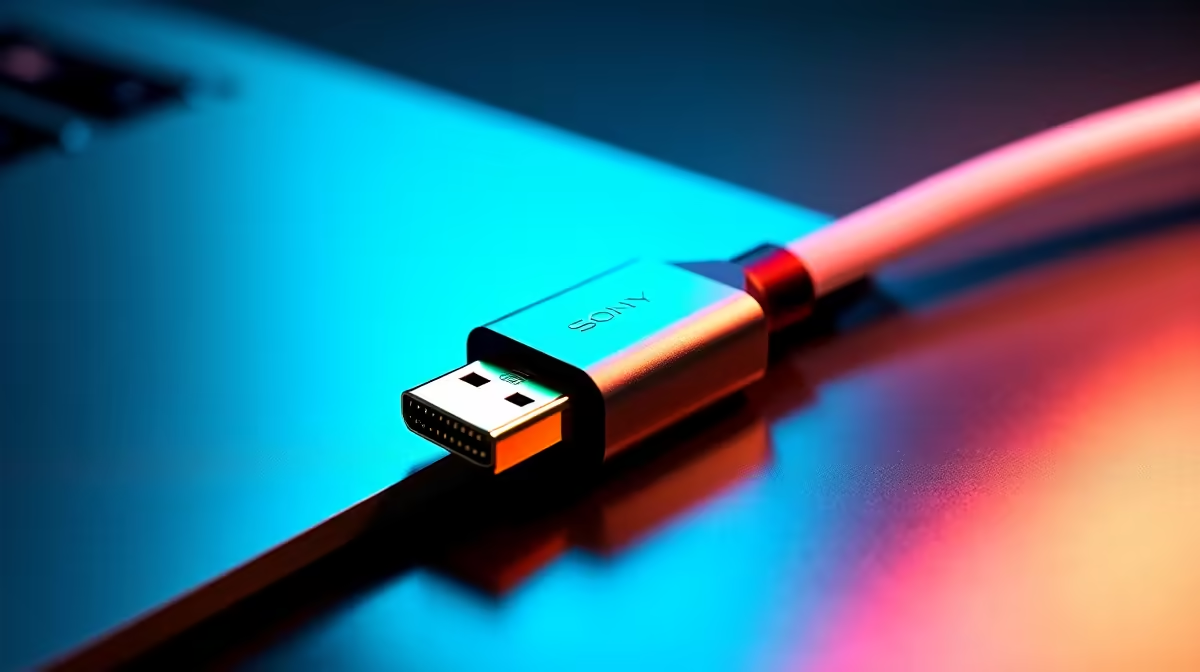
Gold-plated contacts at 15 microns or more ensure low contact resistance that does not degrade over time, critical for studio environments where cables may remain connected for years. The strain relief at both connector ends should be robust, with a flexible boot that distributes cable bend stress over several centimetres rather than concentrating it at the connector entry. A metal shell around the connector housing provides shielding continuity between the cable's braid layer and the display port's chassis ground, completing the EMI shield across the full signal path. Cables with plastic connector housings break this shielding continuity and are appropriate only in low-EMI environments.
Length and Practical Considerations 💰
Cable length should be specified at 1.5 metres for workstation-to-monitor runs and 2 metres where the PC is floor-mounted. Passive HBR3 cables maintain full bandwidth up to 2 metres reliably; beyond that, active cables are required. For broadcast environments where runs exceed 5 metres, fibre-optic DisplayPort cables are the professional solution. At Evetech, HBR2 and HBR3 passive cables in 1.5 to 2 metre lengths suit the vast majority of SA professional workstation setups at R250 to R550, a small fraction of the monitor and GPU investment they protect.
Label Cables With Bandwidth Rating at Both Ends ⚡
In a multi-monitor professional setup, unlabelled cables cause confusion when hardware is upgraded. Use a cable label or coloured silicone tie at both ends and mark the bandwidth rating (HBR2 or HBR3) and the port it connects to. This five-minute step prevents hours of diagnostic confusion when a display drops to 30Hz after a cable swap.
FAQ
Does the cable need to be VESA-certified for professional use?
VESA-certified DisplayPort cables have been tested against the full compliance suite, including signal integrity at maximum bandwidth. For professional environments where reliability is critical, VESA-certified cables provide a verified quality baseline over uncertified alternatives.
Should I use HDMI or DisplayPort for a professional 4K colour monitoring workflow?
DisplayPort is preferred because it supports higher bandwidth (HBR3 vs HDMI 2.0's ceiling), native Adaptive Sync, and multi-stream transport for daisy-chained reference monitors. HDMI 2.1 closes the gap but is less common on dedicated professional colour monitors.
Can the cable itself introduce colour errors in a calibrated display workflow?
No. DisplayPort is a digital signal and either arrives correctly or triggers error correction. Cable-related faults appear as pixel artefacts or frame drops, not colour shift. Colour accuracy depends on the GPU output settings, the monitor's calibration, and the ICC profile in use.
Equipping a professional workstation or studio monitor setup in South Africa?
Evetech stocks HBR2 and HBR3 DisplayPort cables suitable for 4K professional workflows, available with local warranty support.