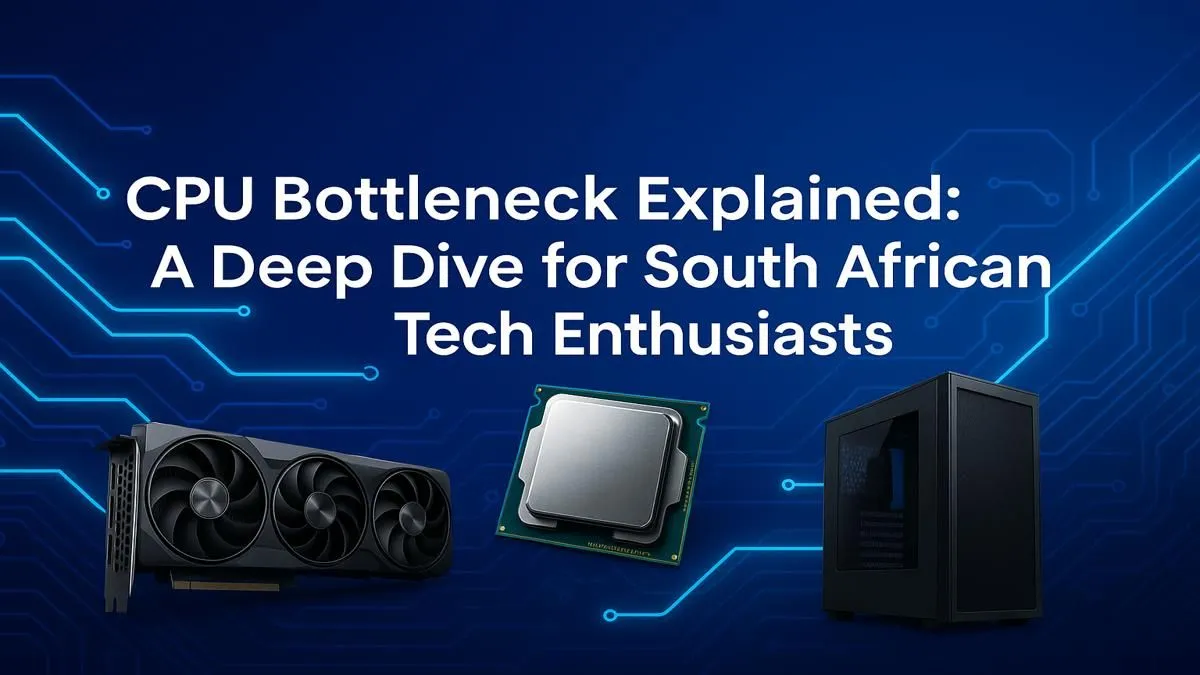
You’ve just dropped thousands of Rands on a shiny new graphics card, expecting buttery-smooth frames in Helldivers 2. Instead, your game stutters and lags, especially during intense firefights. What gives? Before you blame your GPU, consider the unsung hero of your rig: the processor. You might be experiencing a classic CPU bottleneck, and don't worry, we're here to help you diagnose and fix it right here in South Africa.
So, What is a CPU Bottleneck, Really?
Imagine a master chef (your GPU) ready to cook incredible meals at lightning speed. But they're stuck waiting for a slow kitchen hand (your CPU) to chop the vegetables and prep the ingredients. The chef is powerful but can't work any faster than the data they're being fed.
That’s a CPU bottleneck in a nutshell. Your Central Processing Unit (CPU) can't process game logic, physics, and AI data fast enough to keep your powerful Graphics Processing Unit (GPU) fully occupied. The result? Your expensive GPU sits idle, and your frame rate suffers.
How to Spot a CPU Bottleneck in the Wild
Guessing won't get you far. You need data to know for sure if your CPU is bottlenecking your performance. Luckily, it's easier to check than you might think.
The Performance Monitor Test
The most reliable method is to use a monitoring tool like MSI Afterburner with RivaTuner Statistics Server (it's free!). Fire up your favourite game and keep an eye on your component usage percentages.
- Ideal Scenario: Your GPU usage is consistently high, hovering around 95-100%. This means it's working at its full potential.
- CPU Bottleneck Sign: Your GPU usage is unusually low (e.g., below 85%), while one or more of your CPU cores are maxed out at 100%. This is the classic sign that your CPU can't keep up.
This is especially common in esports titles like Valorant or CS2 at 1080p, where the goal is to push hundreds of frames per second, putting immense strain on the processor.
Quick Diagnosis Tip ⚡
if it's a CPU or GPU limit? Try this: Increase your game's resolution (e.g., from 1080p to 1440p) but keep other settings the same. If your frame rate drops significantly, your GPU is the limiting factor (which is usually what you want!). If your FPS barely changes, you've almost certainly found a CPU bottleneck.
Your Action Plan to Crush That Bottleneck 🔧
Once you've confirmed a CPU bottleneck, you have a few options to get things running smoothly again.
Tweak Your In-Game Settings
Before reaching for your wallet, try some software fixes. In your game's graphics settings, look for options that are notoriously CPU-heavy. Lowering settings like "object detail," "shadow quality," "physics," and "particle effects" can ease the load on your processor and free up performance. Also, make sure to close unnecessary background applications like web browsers or streaming apps.
Time for a Hardware Upgrade 🚀
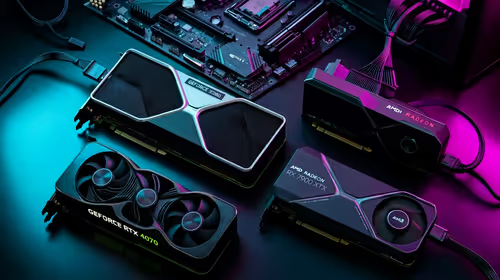
Sometimes, software tweaks aren't enough. If you're pairing a brand-new RTX 4070 with a five-year-old processor, the only real solution is an upgrade. A modern CPU is designed to handle the data throughput today's powerful GPUs demand.
The good news is that competition is fierce, meaning more power for your Rand. The incredible single-thread performance found in modern Intel CPU options often gives them an edge in high-FPS titles. On the other hand, the excellent multi-core value from the latest AMD CPU lineup makes them fantastic all-rounders for gaming and streaming.
Ultimately, every gaming PC will have a bottleneck somewhere—the goal is to ensure it's not severe enough to ruin your experience. By comparing specs and prices across all the available CPU processors online, you can find the perfect heart for your rig that lets your graphics card truly shine.
Ready to Unleash Your PC's True Power?
A balanced PC is a happy PC. Don't let an outdated processor hold your graphics card hostage. Explore our massive range of CPU processors and find the perfect upgrade to eliminate your CPU bottleneck for good.