Quick Answer
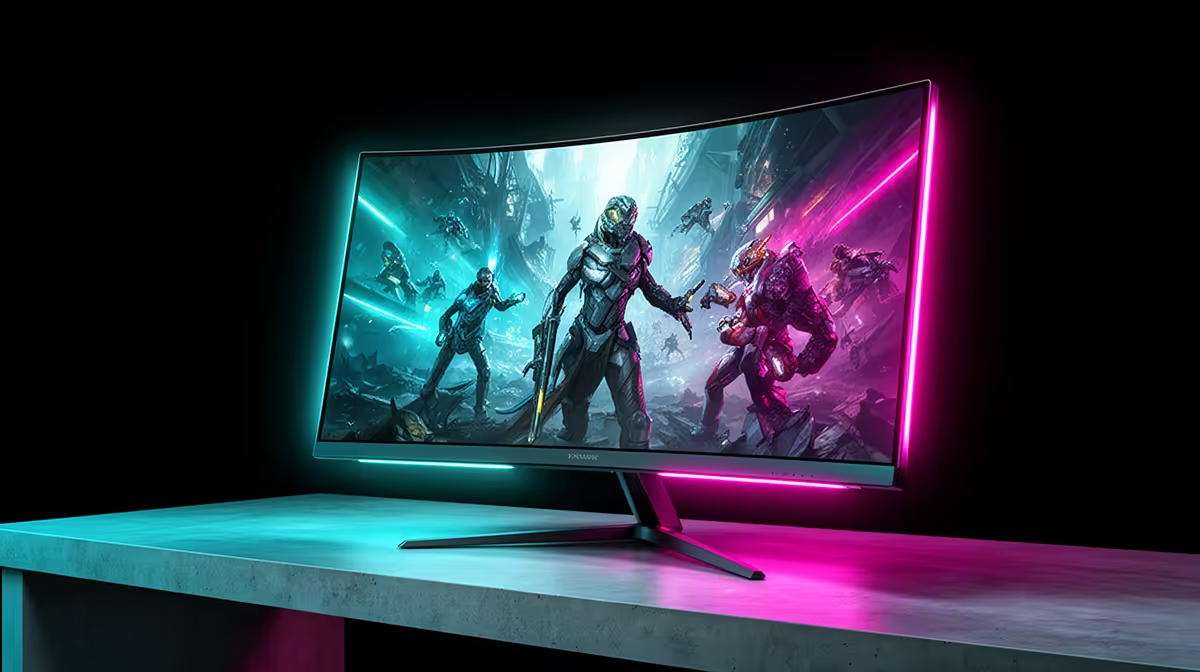
Before upgrading to a 4K 240Hz display, South African gamers need to confirm three things: their GPU can sustain above 144 fps at 4K (requiring at minimum an RTX 5080), their cable supports UHBR20 (DisplayPort 2.1a) for uncompressed 4K 240Hz, and their total budget can absorb both the monitor cost (R22,000 to R35,000) and any GPU upgrade needed to utilise it.
The GPU Reality Check Every SA Gamer Needs First 🎮
A 4K 240Hz monitor is only as useful as the GPU feeding it. At native 4K resolution, even the RTX 5080 averages around 150 to 180 fps in esports and competitive titles with DLSS 4 Quality enabled. In demanding AAA games like Alan Wake 2 or Cyberpunk 2077 at max settings, framerates drop below 120 fps on everything below an RTX 5090.
For South African gamers who primarily play CS2, Valorant, or Apex Legends, an RTX 5070 Ti can sustain well above 200 fps at 4K in those lighter titles, making 4K 240Hz viable at a total GPU-plus-monitor cost of around R35,000 to R45,000. For those who play mostly single-player AAA titles, 4K 144Hz is the more honest sweet spot where frame rates actually reach the panel's ceiling consistently.
DisplayPort 2.1a and Cables: The Detail Most Buyers Miss 📡
Native 4K at 240Hz requires 47.52 Gbps of bandwidth. DisplayPort 1.4 tops out at 32.4 Gbps, which is why it needs Display Stream Compression (DSC) to reach 4K 240Hz. DisplayPort 2.1a UHBR20 provides 80 Gbps of raw bandwidth, delivering 4K 240Hz without compression for the purest signal quality.
The cable that ships in the monitor box is not always rated for UHBR20.
Adaptive Sync, HDR and the Local Warranty Picture 🔧
All current 4K 240Hz panels support both G-Sync Compatible certification and FreeSync Premium Pro, meaning AMD and Nvidia GPU owners both benefit from adaptive sync that eliminates screen tearing without fixed-function hardware. This matters especially in South Africa where both AMD and Nvidia card holders will be buying from the same monitor shelf.
HDR performance varies. A monitor rated DisplayHDR 400 provides only marginal HDR improvement over a calibrated SDR panel. Look for DisplayHDR 1000 or True Black 400 certification for a meaningful HDR experience. On the warranty side, SA consumers are covered under the Consumer Protection Act for defective goods, and reputable local stockists provide the manufacturer's three-year warranty without the hassle of international returns that grey-market imports require.
Test Your Cable Before Blaming the Monitor ⚡
If your new 4K 240Hz display shows flickering or drops to 144Hz unexpectedly, swap in a certified UHBR20 DisplayPort cable before investigating GPU or driver settings. A non-certified cable is the most common cause of bandwidth-related issues on high-refresh 4K panels and costs under R300 to replace.
FAQ
Can I run a 4K 240Hz monitor at 1440p 240Hz if my GPU cannot hit 4K framerates?
Yes. Most 4K monitors support lower resolutions at full refresh rate. Running 1440p on a 4K panel uses a process called integer scaling or bilinear downsampling, with image quality varying by implementation. Some panels handle this well and others look soft, so check reviews specific to the model you are considering.
Does 4K 240Hz work on consoles connected to the monitor?
Current-generation consoles output a maximum of 4K 120Hz over HDMI 2.1. To use the monitor's 240Hz capability you need a PC with a compatible GPU and DisplayPort 2.1a output. The monitor still works as a console display at 4K 120Hz, which is excellent.
Are 4K 240Hz monitors available with local warranty in South Africa?
Yes. Evetech stocks premium monitors with full local manufacturer warranties, avoiding the risks associated with parallel imports where warranty claims must be handled offshore.
Planning your 4K 240Hz upgrade and need help matching the monitor to your GPU?
Evetech's range covers everything from the monitor itself to the RTX 50-series GPUs needed to push it to its limits. Shop the full ecosystem in one place.