Quick Answer
South African gamers should confirm their target resolution and refresh rate, verify PSU and case compatibility, and ensure their CPU will not bottleneck the new card before committing to a 32GB GDDR7 GPU. The rand price of these cards makes a mismatched system purchase an expensive mistake that cannot be easily corrected without additional spending.
Step One: Clarify Your Target Resolution and Use Case 🖥️
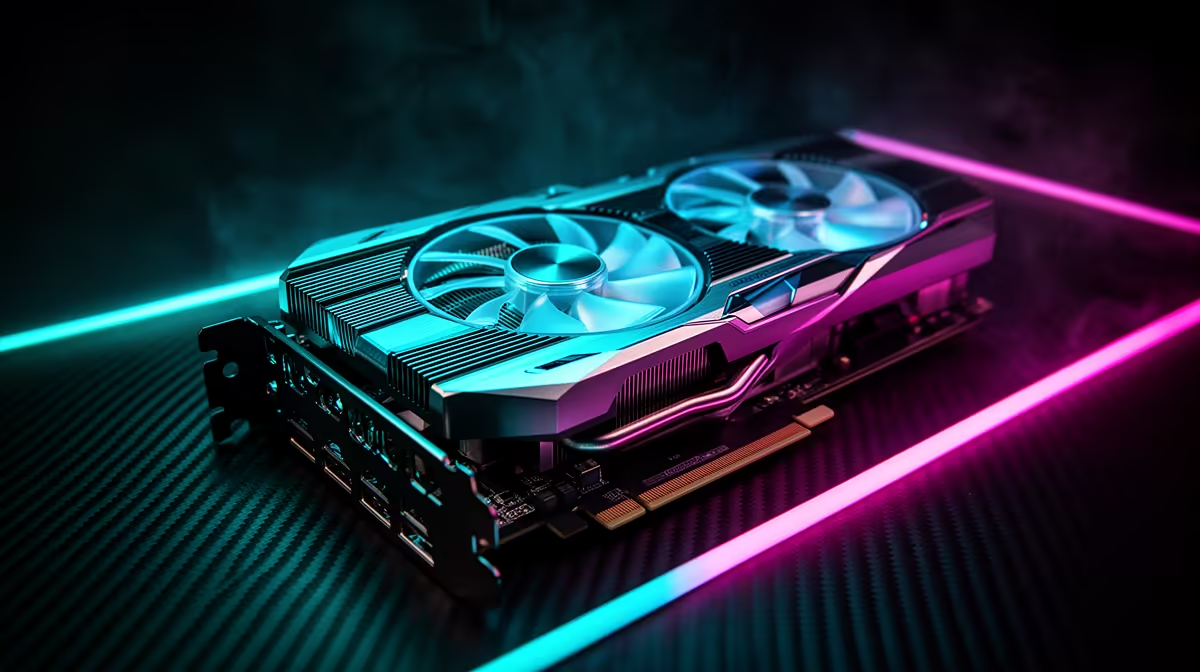
A 32GB GDDR7 graphics card makes financial sense for 4K gaming, professional creative work, or AI inference tasks. For 1080p or 1440p gaming alone, the same GPU silicon with 16GB VRAM delivers near-identical frame rates at a significantly lower price. Before committing R45,000 to R58,000 to a flagship card, write down the exact resolution, target frame rate, and any non-gaming workloads you run regularly. If your current monitor is a 1440p 144Hz screen and you have no immediate plans to upgrade to 4K, consider whether a card with 16GB GDDR7 in the R18,000 to R28,000 range meets your actual gaming needs more efficiently. The 32GB VRAM becomes genuinely advantageous at 4K ultra, in GPU-rendered 3D scenes, and for local AI inference with large models.
Checking System Compatibility Thoroughly 🔧
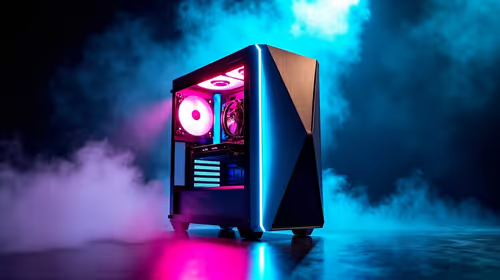
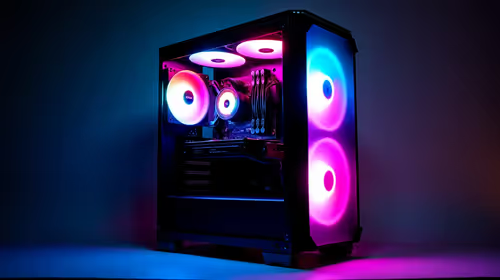
Three compatibility checks are non-negotiable. First, PSU wattage and connector: cards in the RTX 5090 class require a 1000W PSU minimum with a native or adapted 16-pin 12VHPWR connector. Second, case clearance: a three-slot GPU exceeding 340mm in length will not fit in many compact or some mid-tower cases. Measure your current case's maximum GPU length from the PCIe slot to the drive cage before ordering. Third, CPU pairing: a Ryzen 5 7600X or equivalent is the minimum processor for avoiding a meaningful bottleneck. Older processors from 2019 or earlier can cause 15 to 30 percent GPU underutilisation in CPU-limited scenarios at 4K.
The SA-Specific Financial Consideration 💰
Authorised local stock through retailers like Evetech provides price stability tied to the landed cost at import rather than daily spot rates, and includes local warranty that grey-import alternatives lack. For a card at R48,000 to R58,000, the value of a two to three year local warranty cannot be understated: a fault-related replacement handled locally avoids R1,500 to R3,000 in international courier fees and weeks of downtime. Confirm that your target card is in stock or has a verified delivery date before purchasing complementary components like a 1200W PSU, as waiting for GPU stock with those components already purchased ties up capital unnecessarily.
Check Current Stock Status Before Buying the Full Build ⚡
Before ordering your PSU, case, and CPU to accompany a planned 32GB GDDR7 purchase, confirm the GPU is in stock or has a firm expected restock date with your chosen local retailer. Building the rest of the system around a GPU that is then unavailable for two months wastes capital sitting idle.
FAQ
Should I buy a 32GB GDDR7 GPU now or wait for the next generation?
Next-generation GPU releases follow 18 to 24 month cycles. If your current setup is already limiting you at your target resolution, waiting means months of a suboptimal experience. Buy when the card meets your needs and your budget is ready rather than perpetually deferring to the next cycle.
Is a 32GB GDDR7 card more likely to have driver issues than a 16GB card?
No. Driver stability is determined by GPU architecture and driver release quality, not VRAM capacity. A 32GB variant uses identical drivers to a 16GB variant of the same GPU architecture.
Can I use a 32GB GDDR7 GPU for compute workloads beyond gaming?
Yes. The GDDR7 bandwidth and VRAM capacity make these cards highly capable for machine learning inference, scientific simulation, and data processing workloads alongside gaming.
Ready to buy a 32GB GDDR7 graphics card in South Africa?
Evetech stocks flagship GDDR7 GPUs with local warranty support. Check current availability before building your full system.