Quick Answer
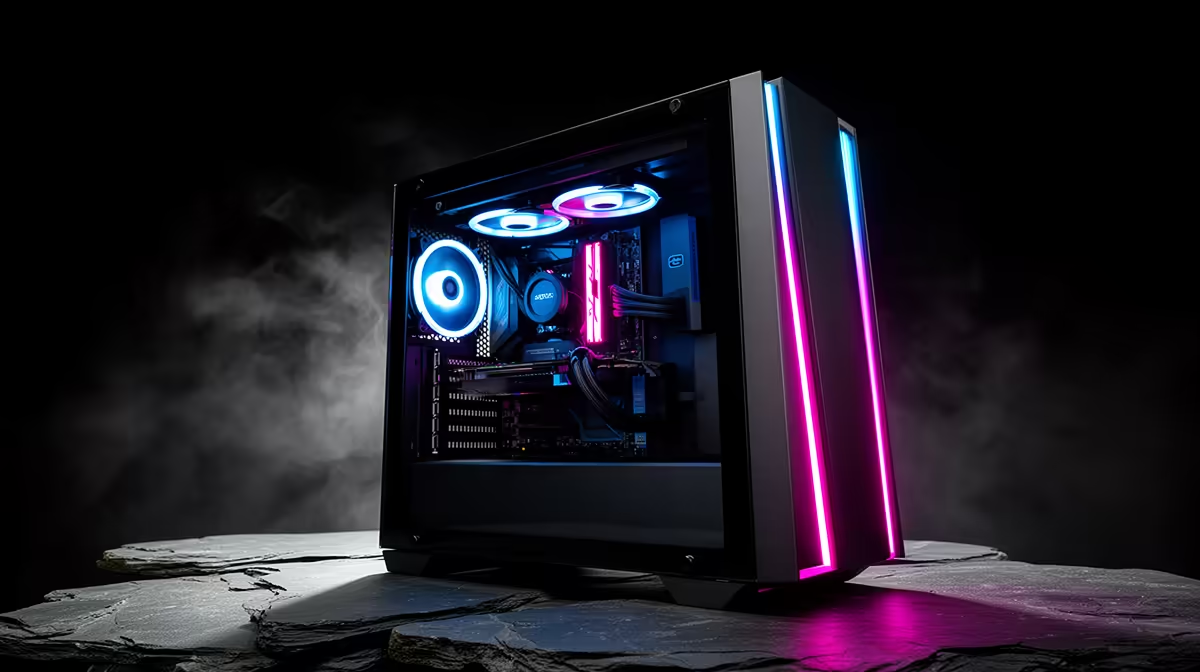
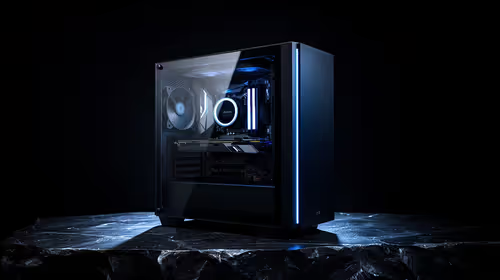
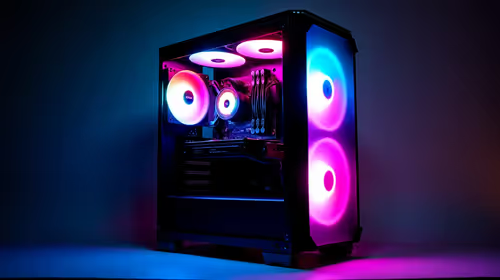
A panorama gaming case typically absorbs 7 to 12 percent of a total SA PC build budget. On a R40,000 mid-to-high-end build, that is R2,800 to R4,800. On a R70,000 flagship build with RTX 5090 and Ryzen 9 9950X, it is R4,900 to R8,400. Spending at the higher end of this range for a panorama case is justified when the rest of the build is flagship-tier hardware that deserves the visual presentation.
Calibrating Case Spend to Total Build Tier 💰
PC build budgets in SA broadly split into three tiers in 2026. Entry-to-mid builds at R15,000 to R30,000 use components like the Ryzen 5 9600X and RTX 5060 Ti or RX 9060 XT. At this tier, a panorama case at R4,500 to R6,000 consumes 15 to 30 percent of the build budget, which is disproportionate: the case would cost more relative to the GPU than is sensible. A standard glass ATX case at R2,000 to R2,800 is the correct call here. High-end builds at R45,000 to R75,000 with a Ryzen 7 9800X3D or Ryzen 9 9950X and an RTX 5080 or 5090 can absorb a R5,000 to R7,000 panorama case at 7 to 12 percent of total spend without budget distortion. At this tier, the panorama case is proportionally appropriate.
What Else Competes for the Case Budget 🔧
The panorama case premium competes with three other build line items. Storage: the difference between a 1TB NVMe and a 2TB NVMe at current SA pricing is R400 to R900, a far more practical upgrade in most builds than a panorama aesthetic. Cooling: the gap between a 240mm and a 360mm AIO is R600 to R1,000 and delivers measurable thermal benefits. RAM: stepping from 32GB to 64GB DDR5 adds R1,200 to R1,800 and benefits content creation and heavy multitasking workloads. If any of these components are under-specced for the intended workload, resolve them before spending the panorama case premium.
Making the Case Cost a One-Time Decision 🛡️
A quality panorama ATX case purchased at R5,500 to R7,000 today should survive three to four hardware upgrade cycles before the form factor or connectivity standards it offers become limiting. This means the case cost amortises across R120,000 to R200,000 worth of component upgrades over eight to twelve years of use. Seen from this angle, the panorama case is among the lowest long-term cost-per-year items in the build, despite being one of the higher single-purchase prices.
Price Check the Fan Budget Separately ⚡
Panorama cases often ship without fans. Factor in five to six matched ARGB fans at R300 to R400 each (R1,500 to R2,400 total) when comparing panorama case prices to cases with fans included. A panorama case at R5,500 with no fans may effectively cost R7,000 to R7,900 fully equipped, which changes the budget comparison against a R4,500 case with three pre-installed fans.
FAQ
At what total build budget does a panorama case start making sense in SA?
When the total component spend exceeds R40,000, a panorama case at R4,500 to R6,000 sits at or below 15 percent of the budget, which is a reasonable allocation. Below R30,000 in total build cost, panorama cases represent a disproportionate spend relative to the components they house.
Should a first-time builder spec a panorama case?
A first-time builder benefits more from a standard glass ATX mid-tower at R2,000 to R2,800 because it provides easy access for troubleshooting and component adjustment during the build process. Panorama cases with complex front panel assemblies and multiple glass sections are slightly more involved to work inside during initial builds.
Does a panorama case hold its resale value in South Africa?
PC cases hold resale value moderately well in SA compared to components like CPUs and GPUs that depreciate quickly. A R6,000 panorama case bought today might sell for R2,500 to R3,500 in three years if kept in good condition, which is a reasonable depreciation rate for a premium peripheral.
Fitting a panorama case into your SA build budget?
Browse Evetech's full range of ATX and panorama gaming cases to find the right spec at the right price for your hardware tier.