Quick Answer
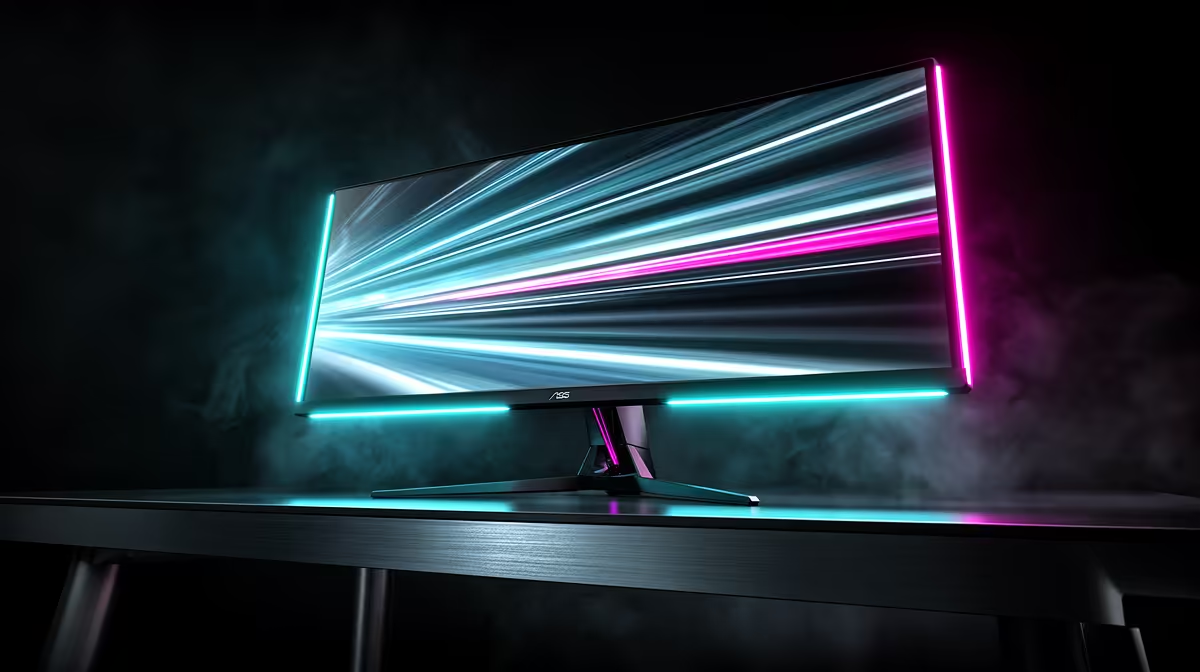
144Hz makes ultrawide gaming feel fluid by delivering a new frame every 6.9 ms instead of 16.7 ms at 60Hz. FreeSync removes screen tearing by synchronising the monitor's refresh to your GPU's actual frame rate. Together they eliminate the two biggest sources of visual disruption in gaming without the input lag that VSync introduces.
Why 144Hz Feels Different on an Ultrawide 🎮
The wider field of view on a 34-inch or 49-inch ultrawide makes peripheral motion more visible than on a standard 16:9 display. Peripheral frames update at the same rate as the centre, so at 60Hz the entire wide scene refreshes sluggishly and motion blur in the far corners becomes obvious during fast turns. At 144Hz the scene updates fast enough that peripheral motion looks continuous. Racing games like Forza Horizon and sim titles respond immediately to steering inputs, and in shooters your crosshair tracks targets with noticeably less smear. South African gamers who game on local servers at 20 ms to 40 ms ping benefit significantly from 144Hz because high refresh rates expose and exploit the low-latency connection.
How FreeSync Works on Ultrawide Resolutions 📡
At 3840x1080 or 3440x1440, ultrawide resolutions push GPUs harder than standard 1080p, causing frame rates to vary more widely between scenes. A GPU averaging 110 fps might dip to 65 fps during a complex explosion sequence. Without FreeSync, this variation causes visible tearing when fps exceeds the monitor's fixed refresh and stuttering when fps drops below it. FreeSync instructs the monitor to hold the frame buffer until the GPU signals completion, then refresh immediately. The result is smooth output at whatever frame rate your GPU delivers between the sync range limits, typically 48Hz to 144Hz on FreeSync Premium certified displays. This range suits most mid-range GPU users whose frame rates vary across that band in typical gaming sessions.
FreeSync Premium vs Standard FreeSync for Ultrawide 🔄
FreeSync Premium requires a minimum 120Hz refresh rate, low framerate compensation (LFC), and low flicker. LFC is critical: when fps drops below the lower sync range limit (commonly 48Hz), LFC multiplies the frame rate by 2 or 3 to keep the monitor refreshing within its sync band, preventing the jarring drop to VSync-style tearing. For ultrawide gaming where frame rates can dip in open-world scenes, FreeSync Premium is worth prioritising over standard FreeSync. Current 144Hz ultrawide monitors with FreeSync Premium start from around R9,000 to R11,000 at Evetech.
Nvidia GPU + FreeSync Tip ⚡
Nvidia GPUs from the RTX 20-series onward support FreeSync monitors via the G-Sync Compatible standard. Enable it in Nvidia Control Panel under Display, Set up G-SYNC. This gives you adaptive sync benefits on a FreeSync ultrawide without needing a dedicated G-Sync module monitor, saving significant cost.
FAQ
Does FreeSync work with a console connected to an ultrawide monitor?
Some consoles support VRR (variable refresh rate) over HDMI 2.1, which is compatible with FreeSync on monitors that support HDMI-based VRR. Check your specific monitor's spec sheet to confirm HDMI VRR support alongside FreeSync.
Will a mid-range GPU like an RTX 4060 benefit from FreeSync on an ultrawide?
Yes, significantly. The RTX 4060 at 3840x1080 often varies between 70 and 120 fps depending on the game and settings, exactly the range where FreeSync delivers the most benefit by eliminating tearing without VSync stutter.
Is there any downside to enabling FreeSync all the time?
Minimal. Some users report slightly increased input lag when fps drops near the lower sync threshold, and a very small number of games show minor flickering with FreeSync active. Both are edge cases: the vast majority of ultrawide gaming sessions benefit from leaving FreeSync on permanently.
Want 144Hz and FreeSync on your next ultrawide?
Evetech stocks a full range of FreeSync Premium ultrawide gaming monitors to match AMD and Nvidia GPU setups, shop the range today.