Quick Answer
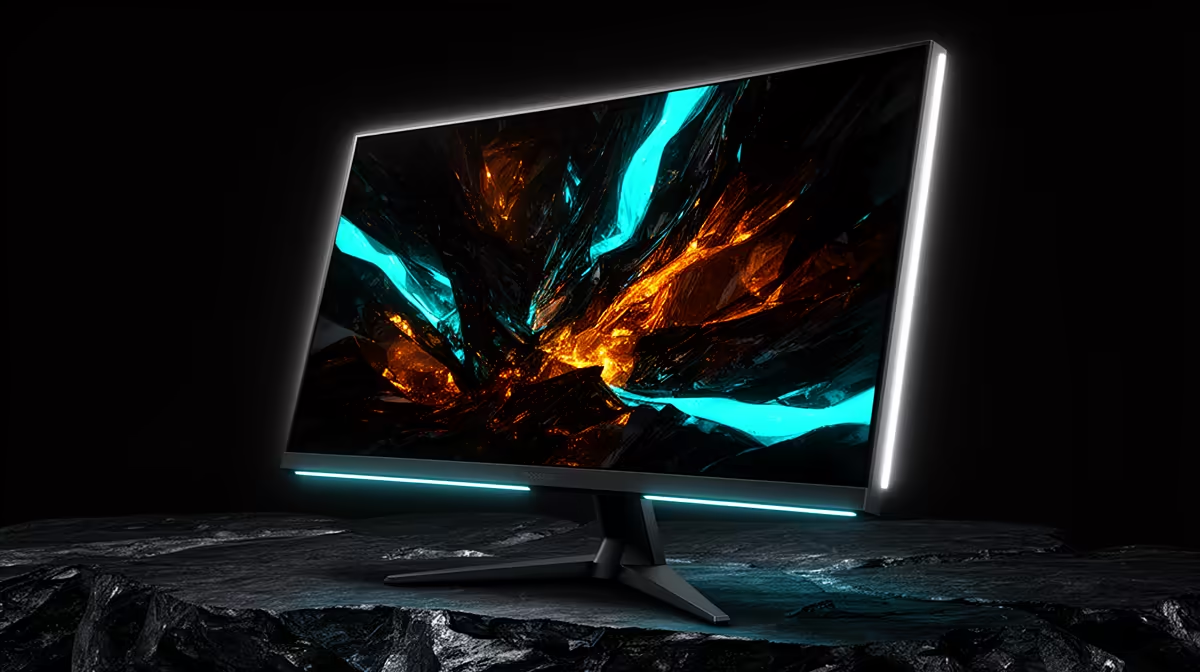
Dark areas look flat on monitors because the panel's contrast ratio is too low to separate near-black shades, or because gamma is calibrated for general use rather than dark-scene gaming. Shadow Boost (found on BenQ panels) is a targeted gamma lift for shadow tones that brightens dark areas without blowing out highlights.
Why Monitors Crush Shadow Detail 🔍
An LCD monitor produces dark areas by blocking backlight through liquid crystal layers. IPS panels typically achieve 800:1 to 1500:1 contrast ratios, far below the 1,000,000:1 OLED can produce. Shades of grey that should appear distinct in a dungeon corridor collapse into the same near-black. The problem worsens with default gamma 2.2, which is balanced across the full luminance range but compresses the shadow zone. In games like Diablo IV or Tarkov, players miss enemies hiding in dark corners because the panel simply cannot render those tones as separate shades.
How Shadow Boost Works 💡
Shadow Boost applies a selective gamma curve adjustment. Instead of raising overall brightness (which washes out midtones), it lifts only the lower 15 to 20 percent of the luminance range. The monitor applies a different gamma curve to tones below a threshold value, expanding the shadow gradient so shades previously mapping to the same near-black now resolve as distinct grey levels. A hidden enemy in a dark doorway becomes visible without bright parts of the scene becoming overexposed. Most BenQ EX and Mobiuz panels offer Shadow Boost at three intensity levels. Setting 2 is the most commonly recommended starting point for competitive play.
Alternatives and Limitations ⚠️
Shadow Boost is a software gamma lift, not a hardware contrast improvement. It cannot add detail the panel's hardware never captured. For deepest shadow separation, OLED panels are genuinely superior because each pixel produces its own light. OLED gaming monitors are stocked at Evetech from around R12,000 for 27-inch QHD. If staying on IPS, set Shadow Boost to level 1 or 2 to avoid making the image look artificially lifted in brighter scenes. For SA gamers playing in bright rooms with ambient light, Shadow Boost at level 3 can help since lifted shadows compete better with glare.
Pair Shadow Boost With Lower Brightness ⚡
If you enable Shadow Boost at level 2 or 3, reduce your monitor's overall backlight by 10 to 15 percent. The gamma lift already makes darks brighter, and keeping overall brightness high simultaneously washes out midtones. Calibrate in the room lighting you actually game in for the most accurate result.
FAQ
Does Shadow Boost increase input lag?
No. Shadow Boost is applied at the scalar level in the monitor's image processing pipeline and does not add measurable input lag. Unlike Dynamic Contrast which actively adjusts backlight levels per frame, Shadow Boost applies a fixed gamma remapping processed in line with normal display rendering.
Is Shadow Boost the same as Black Equalizer or Black Stretch?
They achieve a similar result but differ by brand. BenQ calls it Shadow Boost; ASUS uses Black Boost; LG uses Black Stabilizer. All are selective low-end gamma lifts that expand shadow tones without affecting highlights.
Will Shadow Boost help in all games or just dark ones?
Shadow Boost is most useful in games with significant dark environments. In brightly lit games like sports titles or colourful platformers, it has little visible effect since there are few tones in the lifted range. Leave it off or at level 1 for such titles to preserve accurate colour.
Tired of losing fights in dark corners?
Evetech stocks BenQ Mobiuz monitors with Shadow Boost alongside ASUS and AOC panels with equivalent contrast-enhancement features for real dark-scene visibility.