Quick Answer
Your CPU thermal throttles when it hits its maximum junction temperature, typically 95 degrees Celsius for AMD Ryzen 9000-series or 100 degrees for Intel 14th-gen, and automatically reduces clock speed to bring temperatures down. A better liquid cooler prevents this by removing heat fast enough that the CPU never needs to throttle during normal or demanding workloads.
The Throttle Mechanism Explained 🔧
Every modern CPU has a thermal protection system that monitors die temperature continuously. When temperature approaches the Tj Max threshold, the processor reduces its clock multiplier in steps, dropping from peak boost frequencies toward base clock and cutting voltage simultaneously. A Ryzen 9 9950X boosting to 5.7 GHz under Cinebench R24 might step down to 4.2 GHz if cooling cannot keep up, losing roughly 25 percent of compute throughput. It is the chip protecting itself, but it means you are not getting the performance you paid for.
How Liquid Cooling Keeps Clocks Stable 💧
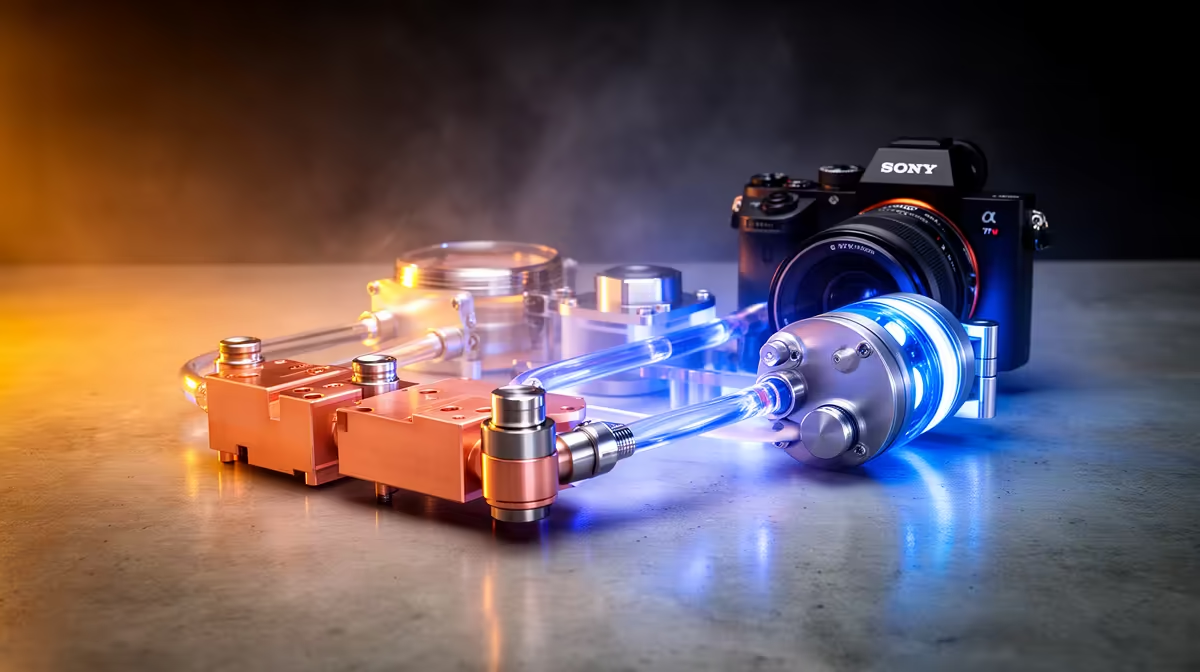
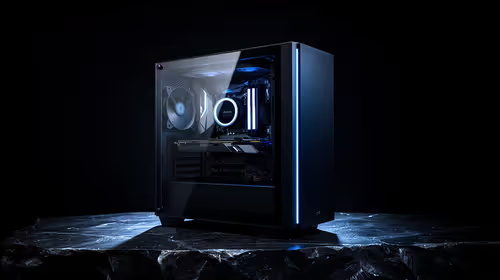
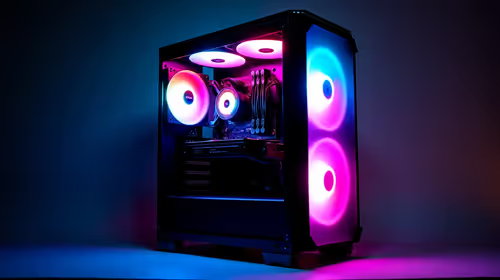
A 360mm AIO cooler removes heat from the CPU die via a copper or nickel-plated cold plate and circulates coolant to a radiator where three 120mm fans exhaust the heat out of the case. The key advantage over air cooling is the separation of heat absorption (at the CPU) from heat rejection (at the radiator). In a South African room at 28 to 32 degrees ambient, a quality 360mm AIO keeps a Ryzen 9 9950X under 85 degrees sustained, comfortably below the 95-degree throttle threshold, while a 120mm air cooler on the same chip might hit 95 degrees within minutes.
Other Causes of Throttling Beyond the Cooler 🖥️
Even with a 360mm AIO, a CPU can still throttle if the case has insufficient exhaust airflow and hot air recirculates over the radiator intake, if the thermal paste bond between the CPU IHS and the cold plate has degraded after 18 to 24 months, or if the pump fails partially and coolant flow drops. Motherboard power limits also play a role: some budget boards with thin VRM stages throttle the CPU's power delivery before temperatures become the issue, appearing as the same clock-speed reduction symptoms. Diagnosing the actual cause requires monitoring both CPU temperature and CPU package power simultaneously using HWiNFO64.
Check Package Power Not Just Temperature ⚡
When diagnosing throttle, open HWiNFO64 and watch CPU Package Power alongside CPU Temperature. If temperatures are safe (below 85 degrees) but clocks drop anyway, the throttle is power-limit-based from the motherboard VRM, not a cooling problem. Increasing the motherboard's power limit in BIOS fixes this without changing the cooler.
FAQ
Will a better cooler unlock higher boost clocks on my Ryzen CPU?
Yes, on AMD chips with Precision Boost Overdrive active. AMD's boost algorithm actively extends time-at-boost when temperature headroom exists. A chip that runs 10 degrees cooler sustainably will hold higher clock speeds for longer periods, often recovering 200 to 400 MHz average boost frequency across a long gaming or rendering session.
How do I know if my CPU is currently throttling?
Install HWiNFO64 and run the sensors view while running your most demanding workload. Watch the CPU Clock Speed, CPU Temperature, and CPU Package Power columns simultaneously. If clock speed drops while temperature is above 88 degrees, thermal throttling is the cause. If it drops while temperatures are normal, investigate power limits.
Is re-pasting the CPU worth doing before buying a new cooler?
If your system is more than two years old, absolutely try re-pasting first. Dried thermal paste on an existing AIO can add 10 to 15 degrees to CPU temperatures, causing throttling that a fresh paste application resolves completely without any hardware cost beyond a R80 to R150 tube of quality paste.
Tired of throttle events ruining your performance?
Find the right 360mm AIO liquid cooler at Evetech to give your CPU the thermal headroom it needs to hold boost clocks all session long.