Quick Answer
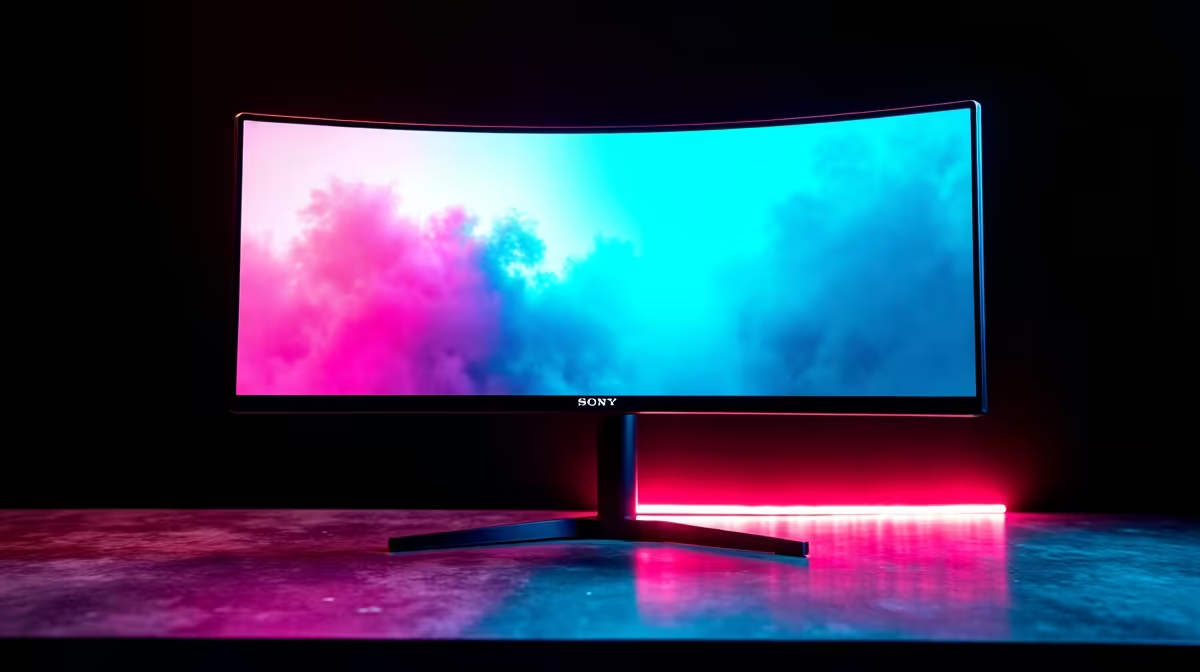
For immersive single-player and simulation gaming, a WQHD ultrawide (3440x1440, 21:9) wins clearly: wider field of view, no black bars, and a cinematic experience that standard panels cannot match. For competitive multiplayer gaming, a standard 16:9 display at 1440p or 1080p with 240Hz to 360Hz often provides more frame-rate headroom and universal game support. Choose based on what you play most.
The Case for WQHD Ultrawide 🖥️
A 34-inch WQHD ultrawide delivers roughly 33 percent more horizontal pixels than a 27-inch 2560x1440 16:9 monitor. In supported titles like Microsoft Flight Simulator, Cyberpunk 2077, and most open-world RPGs, this translates to a genuinely wider in-game field of view with peripheral detail that adds immersion. Racing simulators like iRacing or Assetto Corsa Competizione display the car interior, windscreen, and mirrors simultaneously at realistic proportions on a 21:9 panel. Pixel density at 109 PPI on a 34-inch 3440x1440 is comparable to a 27-inch 2560x1440, so text remains sharp. SA gamers can find quality 34-inch WQHD ultrawides in the R7,000 to R14,000 range locally.
The Case for Standard 16:9 🎮
Standard 16:9 monitors dominate competitive esports because every multiplayer game supports 1920x1080 and 2560x1440 natively, refresh rates extend to 360Hz, and GPU overhead is lower per frame than at 3440x1440. An RTX 5080 pushing CS2 at 1080p sustains 400-plus fps, enabling a 360Hz monitor to show a new frame every 2.7ms. That same GPU at 3440x1440 delivers around 200 to 280 fps, still feeding a 250Hz ultrawide comfortably but with less competitive headroom. Some FPS titles restrict ultrawide field of view to prevent player advantage, making a pillarboxed 16:9 image on a 21:9 screen pointless. A 27-inch 1440p 165Hz IPS monitor starts around R4,500 locally, strong value for competitive builds.
GPU Requirements and SA Pricing 💰
Driving 3440x1440 at 144Hz or higher demands noticeably more GPU power than 2560x1440. An RTX 5070 Ti handles 3440x1440 at medium-high settings in demanding titles; an RTX 5080 is the comfortable choice for maxed settings plus ray tracing. Budget an extra R6,000 to R12,000 in GPU spend if you choose ultrawide over standard 16:9, and confirm your competitive titles support 21:9 before committing. The ultrawide monitor itself costs R2,000 to R5,000 more than an equivalent-quality 16:9 at similar refresh rates.
Check 21:9 Support Before Buying ⚡
purchasing a WQHD ultrawide, check your three most-played games in windowed mode for 3440x1440 in the resolution list. Games listing only 16:9 resolutions will stretch or pillarbox on an ultrawide. Five minutes of checking ultrawide game compatibility prevents buyer's remorse after unboxing.
FAQ
Can I use a WQHD ultrawide for both gaming and office work in South Africa?
Yes. A 34-inch WQHD ultrawide replaces two 1080p monitors side by side and provides an immersive gaming experience in the same panel. For SA hybrid workers who game in the evenings, it is one of the most versatile single-monitor purchases available.
Will my existing RTX 4070 handle 3440x1440 at 144Hz?
At medium-to-high settings in most titles, yes. Demanding open-world games may require lower settings to maintain 100 to 144 fps. An RTX 5070 Ti or better is recommended for 3440x1440 at maximum fidelity and high refresh rates.
Do ultrawide monitors work with PlayStation 5?
PS5 outputs at 16:9 natively. On an ultrawide you get a centred 16:9 image with black bars, or stretched if full-screen is forced. Neither is ideal; ultrawide monitors are best suited to PC gaming setups.
Deciding between ultrawide and 16:9 for your next build?
Evetech stocks both WQHD ultrawide and standard 1440p monitors from top brands with local SA warranty.