Quick Answer
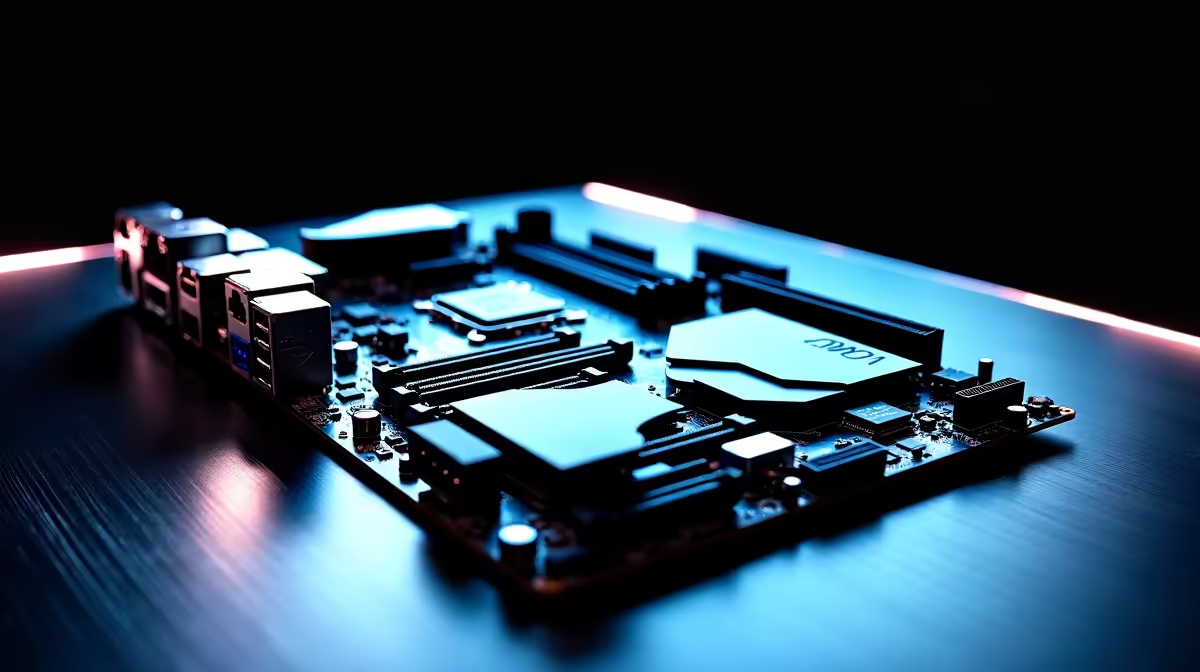
The i7-14700K pairs best with Z790 motherboards that offer robust power delivery, PCIe 5.0 support, and enough M.2 slots for a high-performance build. Budget-conscious builders can also consider B760 boards, though you'll lose overclocking headroom. For SA buyers, expect to pay between R3,500 and R10,000 for a quality Z790 board from Evetech.
Why Motherboard Choice Matters for the i7-14700K
The i7-14700K is a 20-core (8P+12E) processor with a 253W PL2 rating, which means it demands a motherboard with serious VRM capacity. Pairing it with an underpowered board risks thermal throttling under sustained loads like video encoding, 3D rendering, or long gaming sessions. The chipset you choose also determines your upgrade path, PCIe lane availability, and memory support.
Intel's 14th-gen platform uses the LGA1700 socket, meaning compatible boards span both Z790 and B760 chipsets. Z790 is the natural home for the 14700K if you want full overclocking capability, while B760 works fine for stock or light boost usage.
Top Z790 Board Tiers for the i7-14700K
Premium tier (R8,000-R10,000+): Boards like the ASUS ROG Maximus Z790 Hero and MSI MEG Z790 ACE sit at the top. These offer 20+ phase VRM configurations, 10GbE LAN, dual PCIe 5.0 M.2 slots, and Wi-Fi 6E. Overkill for most, but ideal if you're running DDR5 at XMP 6000MHz+ or doing extreme overclocking.
Mid-range sweet spot (R4,500-R7,000): The ASUS ProArt Z790-Creator, Gigabyte Z790 AORUS Elite AX, and MSI MAG Z790 Tomahawk WiFi all live here. These boards deliver 16-18 phase VRMs, PCIe 5.0 x16 for graphics, and at least three M.2 slots. They handle the i7-14700K's full power draw without breaking a sweat and represent the best value for SA PC builders.
Entry Z790 (R3,500-R4,500): The MSI Z790-A Pro and Gigabyte Z790 UD AX handle stock and mild overclocking well. VRMs are adequate but you'll want to monitor CPU temperatures during sustained heavy loads.
B760 option: If you're not overclocking, the B760M Pro RS or Gigabyte B760M Aorus Elite offers surprisingly solid power delivery at R2,200-R3,200. You won't unlock the 14700K's full manual OC potential, but daily performance is near-identical.
DDR4 vs DDR5: Which Makes More Sense in SA?
This is a real decision for SA buyers. DDR5 kits remain significantly pricier than DDR4 in ZAR, with a 32GB DDR5-6000 kit running R1,800-R2,500 versus R900-R1,400 for a comparable DDR4-3600 set. The i7-14700K supports both, depending on your board choice.
For gaming, the performance gap between DDR4-3600 and DDR5-6000 is typically under 5% in FPS. For content creation and productivity workloads, DDR5's higher bandwidth shows more clearly, with gains of 10-20% in memory-intensive tasks. If your build is gaming-primary, DDR4 on a compatible board saves meaningful money. If you're doing media production or simulation work, DDR5 pays back the premium over time.
Key Features to Prioritise
VRM phases and quality: Look for at least 14+1 phases with high-quality chokes and doublers. Board marketing inflates phase counts, so check independent VRM reviews before buying.
PCIe 5.0 x16 slot: Essential for RTX 5000-series or future GPU upgrades. Most Z790 boards include this as standard.
M.2 slot count: Three or more M.2 slots give you room for OS drive, game storage, and a scratch drive without touching SATA.
Thermal headroom: Good heatsinks on the VRM and M.2 slots matter, especially in SA homes where ambient temperatures in summer can sit at 28-32 degrees Celsius, leaving less thermal margin than North American benchmarks suggest.
Wi-Fi 6E: Useful if your gaming setup isn't near the router. Standard on most mid-range Z790 boards.
Frequently Asked Questions
Can I use the i7-14700K on a B760 motherboard?
Yes, the i7-14700K will run on a B760 board using its stock boost settings. You won't be able to manually overclock the CPU, but day-to-day performance is very close to a Z790 setup. B760 is a solid budget-friendly choice if overclocking isn't a priority.
Does the motherboard affect gaming FPS with the i7-14700K?
Minimally, provided the board supplies enough power. A mid-range Z790 and a premium Z790 will deliver nearly identical gaming frame rates. Differences emerge under sustained multi-threaded loads like rendering or streaming, where VRM quality and thermal management matter more.
What RAM speed should I pair with an i7-14700K Z790 build?
For DDR5, target XMP 6000MHz CL30 for the best performance-per-rand ratio. For DDR4, DDR4-3600 CL16 or 3200 CL16 are the sweet spots. Going beyond these speeds offers diminishing returns in gaming, though content creators benefit from faster memory bandwidth.
Ready to Find Your Perfect Match? Find the right processor and platform for your build at CPUs & Processors on Evetech