be quiet has announced two Dark Power Pro 14 IO power supplies for demanding PCs. The useful question for a South African buyer is not whether 1,300W or 1,600W sounds impressive, but whether the system can use that capacity and whether the full local build justifies the premium.
Quick Answer
Dark Power Pro 14 IO arrives in 1,300W and 1,600W versions with ATX 3.1 support, a native 12V-2x6 cable and a choice between active and semi-passive cooling. Retail availability is planned from 1 September 2026, but no South African date or rand price has been announced. The live Evetech snapshot instead shows what comparable high-wattage power supplies cost today: sampled 1,300W to 1,600W models ranged from R3,499 to R13,899. Buy the capacity your complete system needs, not the largest number on the box.
⚡ What Dark Power Pro 14 IO adds
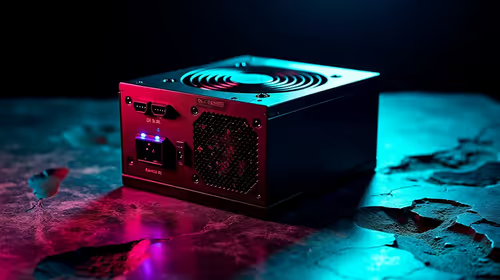
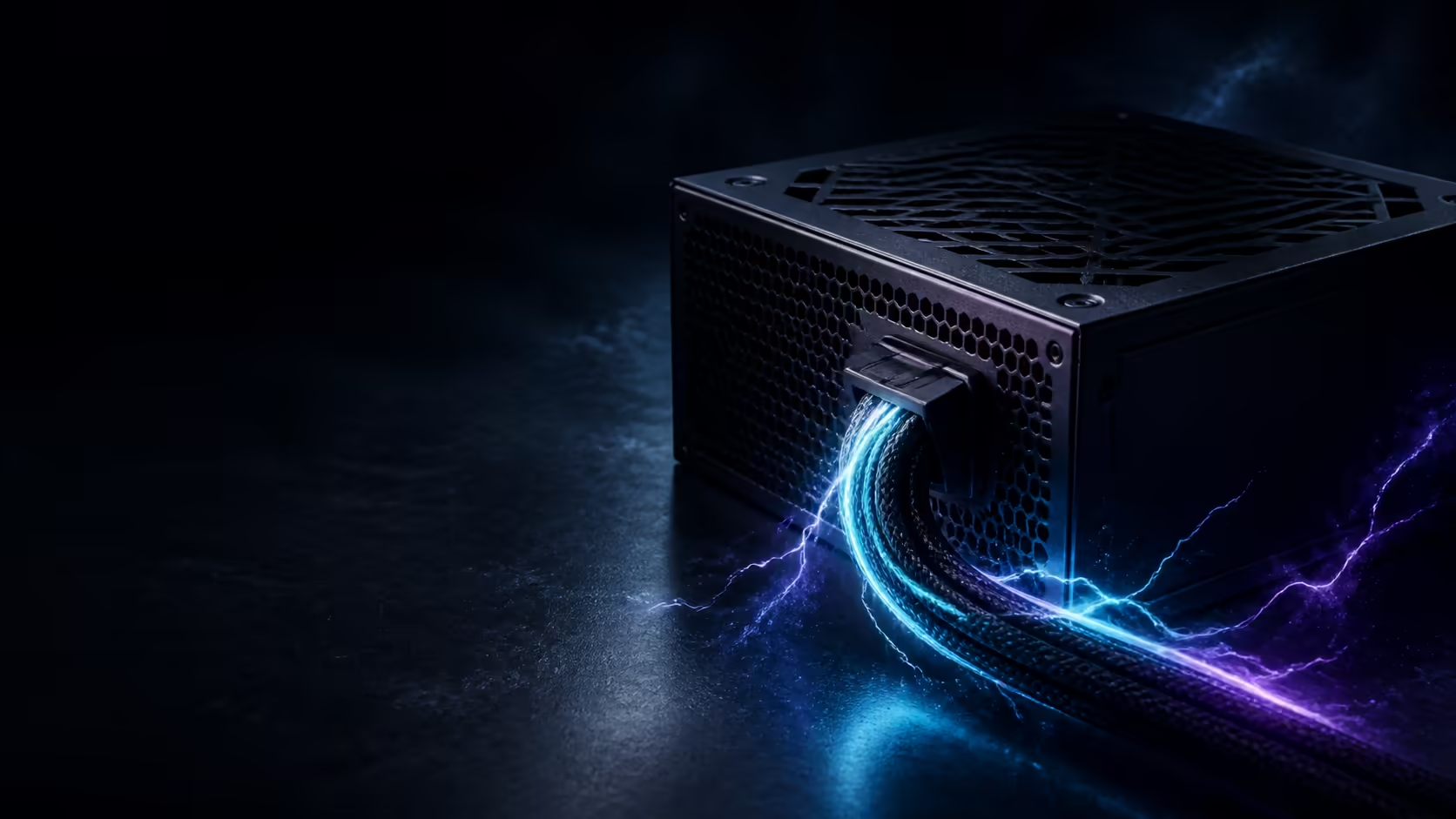
The two models are rated at 1,300W and 1,600W. be quiet lists efficiency of up to 94.9 percent, with 80 Plus Titanium and Cybenetics Titanium certifications. The units support the ATX 3.1 standard and provide a native 12V-2x6 connection for current high-power graphics cards, plus four conventional 6+2-pin PCIe connectors.
The IO name refers to a control panel on the rear. A buyer can select active cooling or semi-passive cooling without opening the case. In semi-passive mode, the fan can remain off at lighter loads and start as heat rises. That control is useful in a quiet workstation, but it does not change the need for clear airflow around the power supply.
🔌 Size the supply around the real build
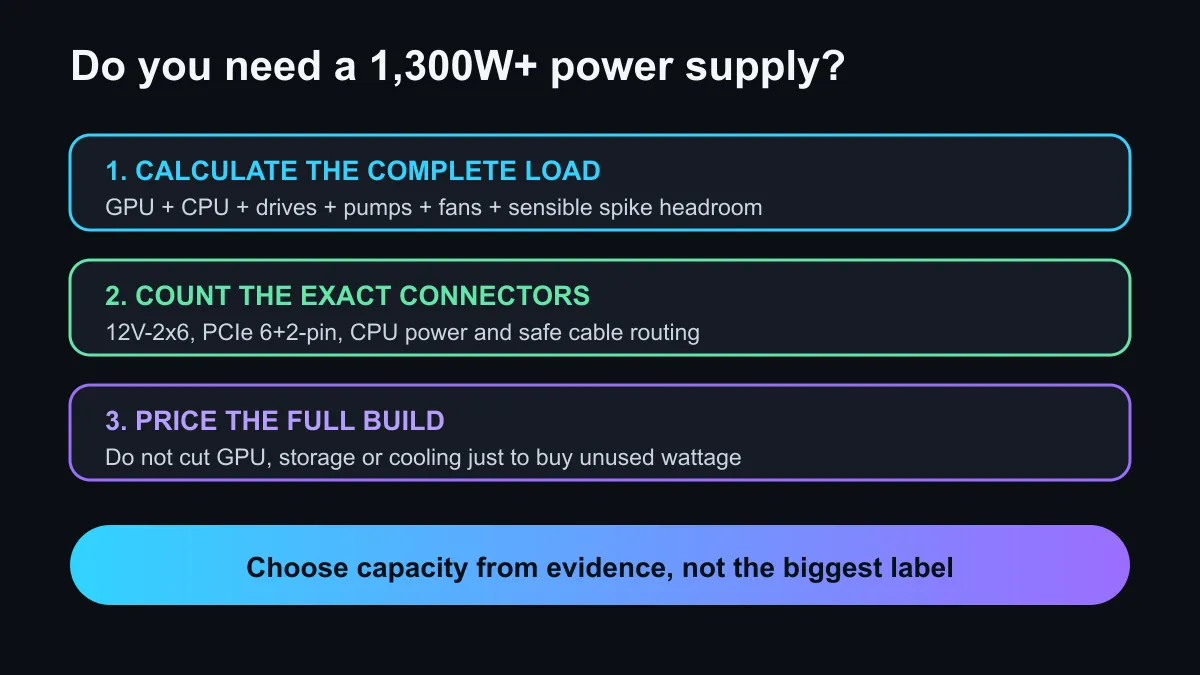
A 1,300W or 1,600W supply is aimed at systems with unusually high and sustained demand. A single mid-range graphics card and mainstream processor usually leave much of that capacity unused. Start with the graphics-card maker's recommended supply, then account for the processor, drives, pumps, fans and any power-limit tuning. Leave sensible headroom for short load spikes and future additions, but do not double the requirement without a reason.
Connector planning matters as much as wattage. A native 12V-2x6 lead reduces adapter clutter for a compatible graphics card, yet the cable must still be fully seated and routed without a sharp bend at the plug. Builders using multiple conventional PCIe devices should count the available 6+2-pin leads before ordering. The 700W-and-above PSU selection helps compare current local alternatives by capacity rather than brand alone.
💰 Put the premium in context
The 18 August catalogue read captured live high-end options at very different prices. A 1,300W unit appeared at R3,499, another 1,300W model at R6,999, and a 1,600W Titanium model at R13,899. Those are comparison points, not prices for the new be quiet range. Import timing, warranty support and final distributor stock will decide any local price.
Compare the efficiency rating, cable set, physical length, fan behaviour and local warranty alongside wattage. Titanium efficiency can reduce wasted power, but the saving depends on load and usage time. A lower-capacity quality unit may free budget for a faster graphics card, more storage or better cooling. The PSU best-seller page is useful for seeing current demand, while the electrical and connector checks remain the final test.
Wait for local listings if the rear control panel, Titanium certification and very high capacity are central to the build. Buy an available alternative if the PC is ready now and another well-reviewed supply meets the exact load, connector and warranty needs. There is no confirmed South African deadline that forces a choice.
Frequently Asked Questions
When does Dark Power Pro 14 IO launch?
be quiet plans retail availability from 1 September 2026, but a South African date has not been announced.
What capacities are available?
The announced range has 1,300W and 1,600W models.
Does it support current graphics-card power connectors?
Yes. It includes a native 12V-2x6 connection and four 6+2-pin PCIe connectors.
Do most gaming PCs need 1,300W?
No. The correct capacity depends on the exact processor, graphics card, peripherals, tuning and upgrade plan.
Building a power-hungry PC? Add the complete load first, confirm every connector, then compare high-wattage supplies with useful headroom.