An unofficial experiment has made leaked DLSS 5 files launch on GeForce RTX 30-series graphics cards. That sounds like a compatibility breakthrough until the frame-rate results arrive. In one RTX 3080 test, performance reportedly fell from about 138 FPS to 4 FPS. Other Ampere tests reached roughly 1 FPS. The lesson is simple: code starting is not the same as a feature working well.
Quick Answer
DLSS 5 does not have official RTX 30-series support in this report. Modified, leaked files were used to force the feature onto older hardware. The experiment is technically interesting, but its severe performance loss makes it unsuitable for normal gaming. A live Evetech catalogue check found two in-stock RTX 3050 cards, starting at R4,399. That is a current local price baseline for an RTX 30-series product, not a reason to install the unofficial software or an indication that every RTX 30 card behaves the same way.
Why launch and usable are different tests
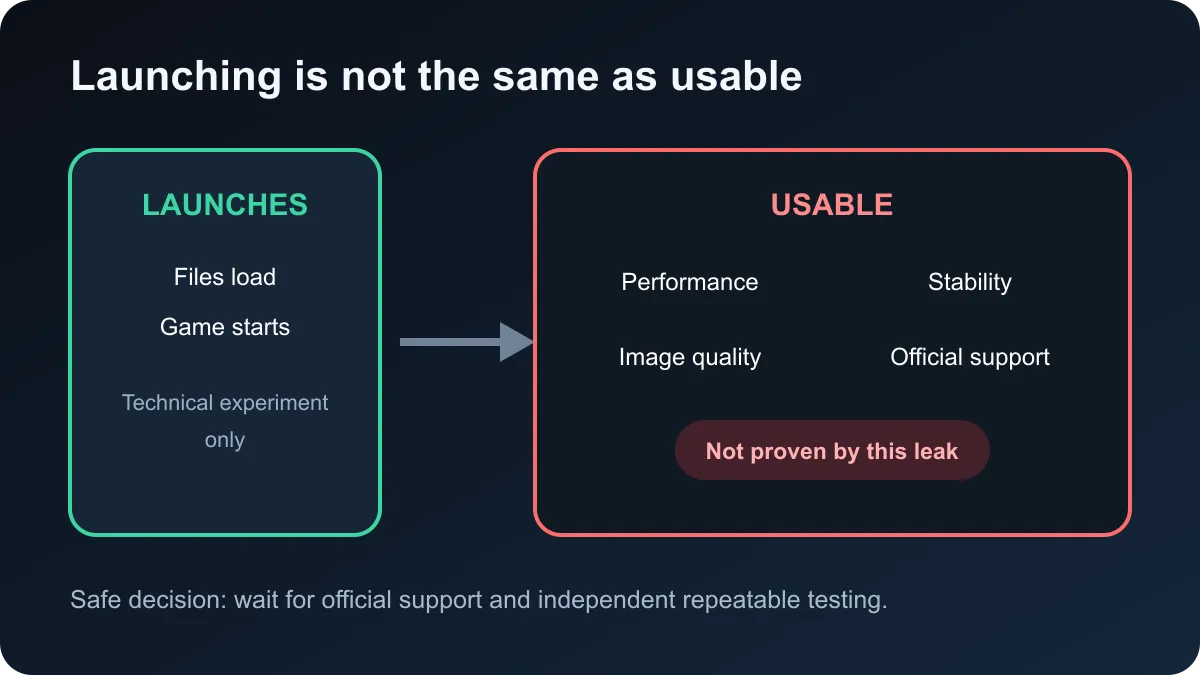
A graphics feature can pass several very different checkpoints. First, an application can recognise the files. Second, a workload can start without crashing. Third, the GPU can process the workload at an acceptable speed. Fourth, image quality and stability can survive repeated use. Finally, the hardware vendor can support the combination with tested drivers and a recovery path.
The leaked experiment appears to clear only the early checkpoints. Falling from about 138 FPS to 4 FPS is a loss of roughly 97 percent in that specific test. A separate result near 1 FPS makes the limitation even clearer. Neither number is a general benchmark for every RTX 30-series card or every game, but both reject the idea that the forced configuration is ready for everyday use.
The current graphics-card range is the right place to compare supported products by exact model. Do not turn one modified RTX 3080 result into a promise about an RTX 3050, RTX 3060 or any other Ampere card.
What the R4,399 catalogue check actually proves
The read-only production snapshot returned two live RTX 30-series listings in the graphics-card category. The Palit GeForce RTX 3050 StormX 6GB was R4,399, and the MSI GeForce RTX 3050 Ventus 2X 6G OC was R5,199. Both were marked in stock with Evetech when captured.
Those figures answer a local availability question. They do not establish a DLSS 5 upgrade price, because the new feature is not an official product sold separately. They also do not prove official DLSS 5 compatibility. Buyers comparing an entry GPU should use the graphics-card deals page to check current alternatives, then judge each card against the games, resolution and refresh-rate target that matter to them.
Why unofficial files are a bad shortcut
Leaked or modified binaries introduce risks that a frame-rate screenshot cannot measure. The files may be incomplete, altered by an unknown third party or incompatible with a future driver. A failed experiment can leave a game unstable, corrupt a local configuration or force a clean reinstall. It can also expose a PC to malware if the download source is not trustworthy.
The safer approach is to wait for official support details and independent testing. If a current RTX 30-series card already delivers acceptable performance, keep using the stable path. If a game is too slow, first reduce the expensive settings, check the resolution scale, update the official driver and measure the result. An upgrade decision should come after those checks, not from a leaked feature name.
The practical upgrade decision
An RTX 30 owner should separate three questions. Does the current card meet the target frame rate? Does the desired game officially support the feature on that card? Would a newer card improve more than image generation alone? The answers can differ by title.
For buyers shopping today, the Palit graphics-card range includes the brand behind the R4,399 live baseline. Compare VRAM, memory interface, power requirement and measured game performance rather than buying from the DLSS label alone. Official compatibility, usable speed and a safe software chain all matter.
Frequently Asked Questions
Does DLSS 5 officially support RTX 30-series cards?
No. The reported result came from leaked, modified software and does not establish official support.
How badly did performance fall?
One RTX 3080 test reportedly fell from about 138 FPS to 4 FPS, while other Ampere results reached roughly 1 FPS.
Why can a feature launch but still be unusable?
Loading a feature proves code can execute. It does not prove the older hardware can process it efficiently, correctly or safely.
What was the live South African RTX 30 baseline?
The captured Evetech catalogue had two in-stock RTX 3050 cards, starting at R4,399.
Should RTX 30 owners install the leaked files?
No. Unofficial modified files create security, stability and recovery risks without usable performance evidence.
Should an RTX 30 owner upgrade immediately?
Not for this leak alone. Compare current game performance, target resolution and official feature support first.
Ready to compare supported graphics cards? Check current stock, exact model specifications and the performance level your games actually need.