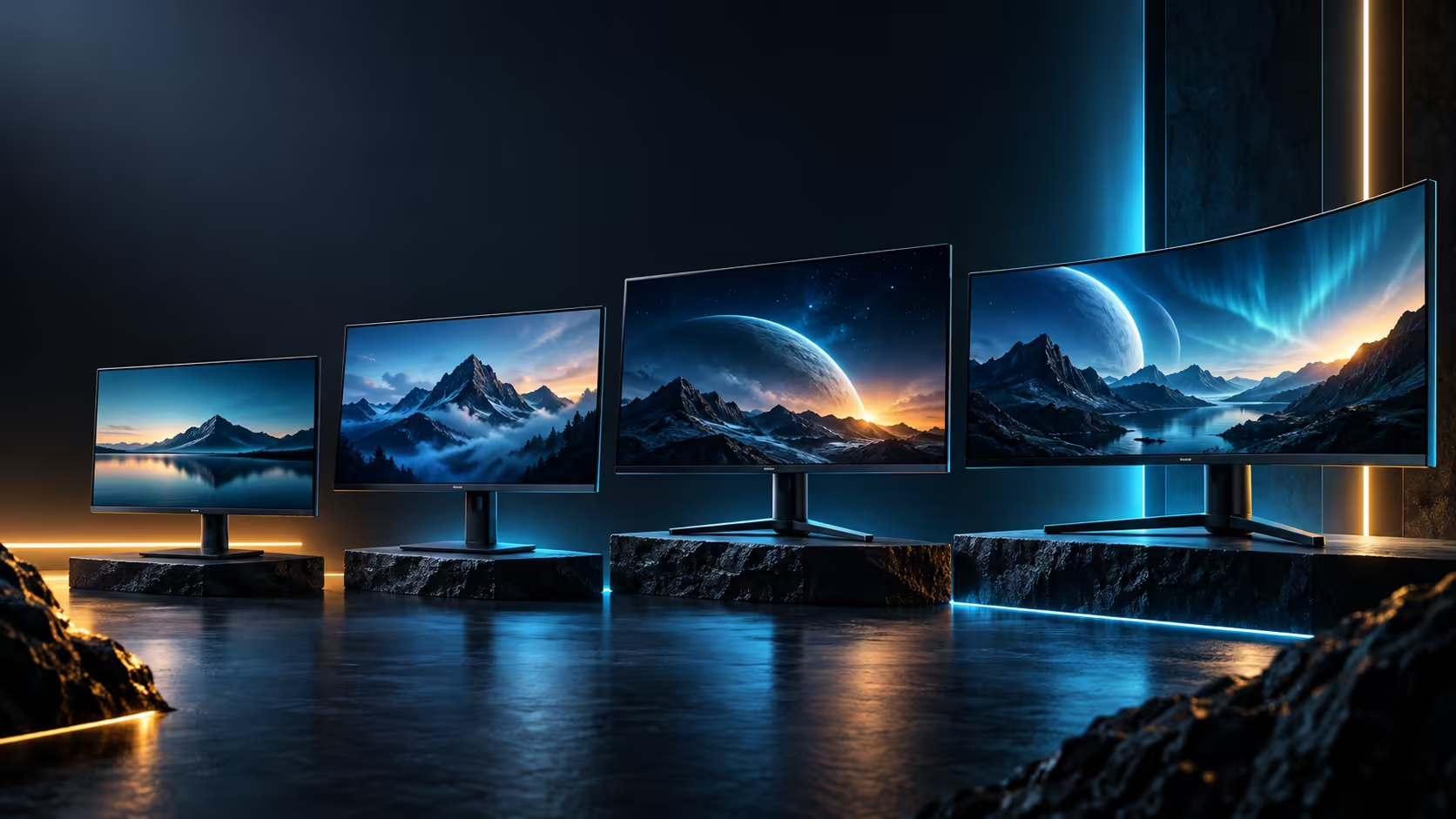
The XPG RIFT and APERTURE monitors expand one display family into four named choices instead of one flagship. RIFT R34WXC and RIFT R24F4 carry the gaming-led label, while APERTURE A27Q1 and APERTURE A27F4 address broader desk use. All four are listed with 1ms MPRT and Adaptive Sync, but that shared headline does not make them interchangeable.
Quick Answer
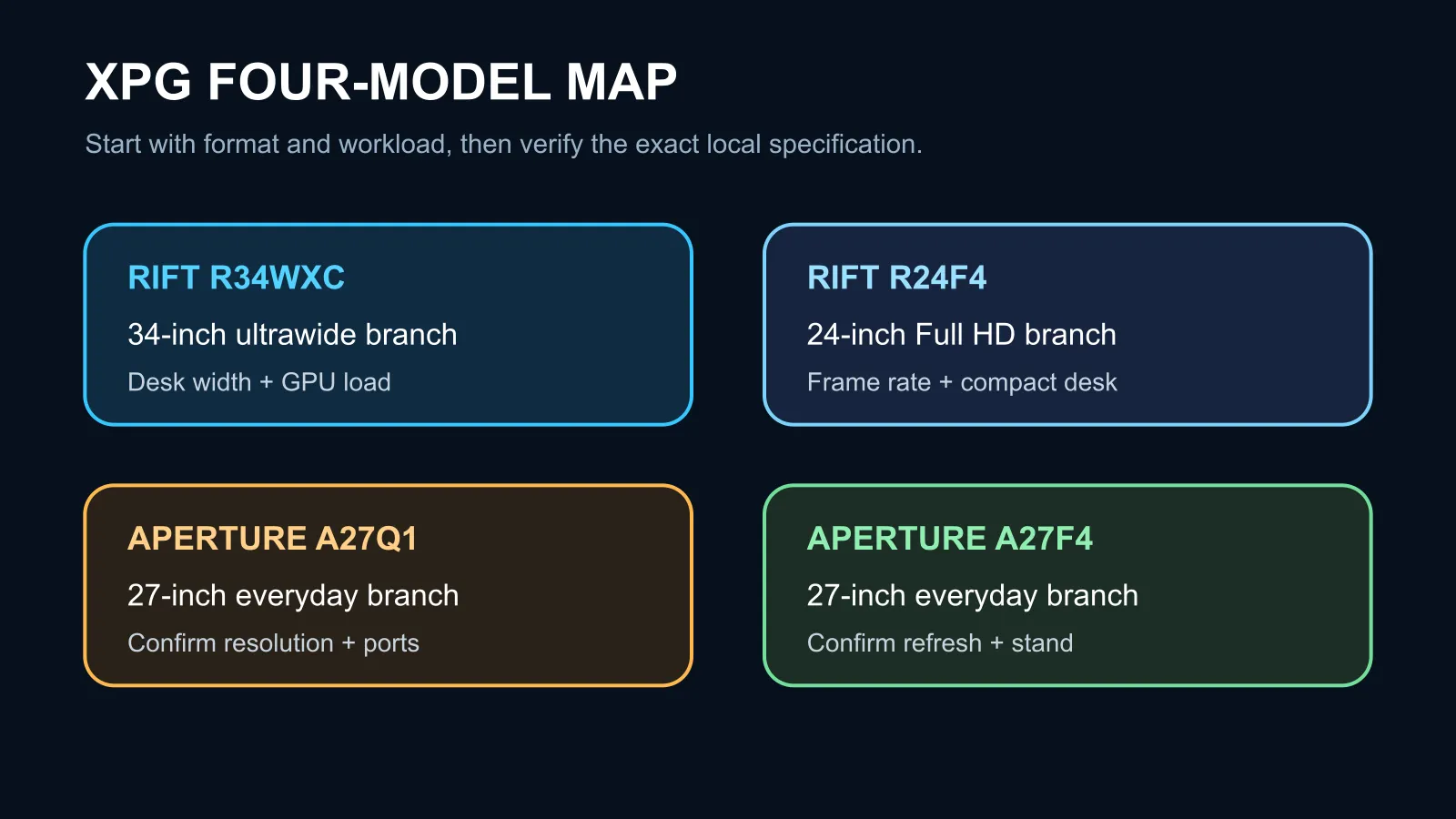
Start with resolution, screen shape and the frame rate your PC can sustain. The RIFT R34WXC is the ultrawide option, while the RIFT R24F4 is a 24-inch Full HD display. The two APERTURE models form the 27-inch branch. South African price and release timing remain unconfirmed, so compare the format rather than treating overseas launch coverage as local stock.
Four names, four different desk questions
The useful way to read this launch is as a decision tree. An ultrawide screen suits players and creators who want more horizontal room, but it occupies more desk width and asks more of the graphics card than a standard Full HD panel. A 24-inch Full HD screen is easier to place, easier to drive at high frame rates and often sharper than the same resolution stretched over a larger panel.
The APERTURE pair should be judged as general-purpose 27-inch options. Confirm the native resolution, refresh rate, ports, stand adjustment and panel type on the exact local listing before ordering. A family name is not a substitute for a model number, and one letter can separate two very different specifications.
Read the shared gaming claims carefully
The launch lists 1ms MPRT and Adaptive Sync across the group. MPRT is a motion-picture response measure, not the same thing as every grey-to-grey transition. It is useful context, but it should be read alongside refresh rate, overdrive behaviour and independent motion testing.
Adaptive Sync can reduce visible tearing when the monitor refresh follows the graphics card's changing frame output. It does not raise the PC's frame rate. Check that the intended connection supports the required resolution and refresh combination, then enable the feature in both the monitor menu and graphics settings.
The captured Evetech catalogue included a 24-inch Full HD 144Hz gaming monitor from R1,699, a second Full HD 144Hz model at R1,899 and a Full HD 180Hz option at R1,999. Those are current comparison points, not prices for the new XPG range.
A South African buyer checklist
Measure the usable desk width and viewing distance first. Next, note the games you play and record the frame rate your PC normally maintains at the intended resolution. Then compare ports, included cables, stand height, VESA mounting, warranty route and dead-pixel policy.
Do not convert an overseas launch price into a promised local figure. Freight, distribution and warranty support can change the final position. Use gaming monitors, monitor specials and monitor best sellers to compare real local options while XPG availability develops.
Build a two-column shortlist before comparing brands. Put the non-negotiable items on the left: native resolution, minimum refresh, required inputs, VESA mounting and maximum width. Put preferences such as colour, lighting and menu design on the right. This stops an attractive launch image from outweighing a missing port or a stand that cannot reach the correct height. If two models still fit, compare the warranty wording and the return path before using a small price difference as the deciding factor.
Frequently Asked Questions
Are all four models ultrawide?
No. Only the RIFT R34WXC is identified as the 34-inch ultrawide choice.
Does 1ms MPRT guarantee no blur?
No. Refresh rate, pixel transitions, overdrive and the selected mode also affect motion clarity.
Is Adaptive Sync useful for slower games?
Yes. It can smooth variable frame delivery even when the game is not competitive.
Choose the exact model by its panel and connection details, not by the family name alone.
Match the display to the PC. Compare resolution, refresh rate, ports and desk fit before chasing one headline number.