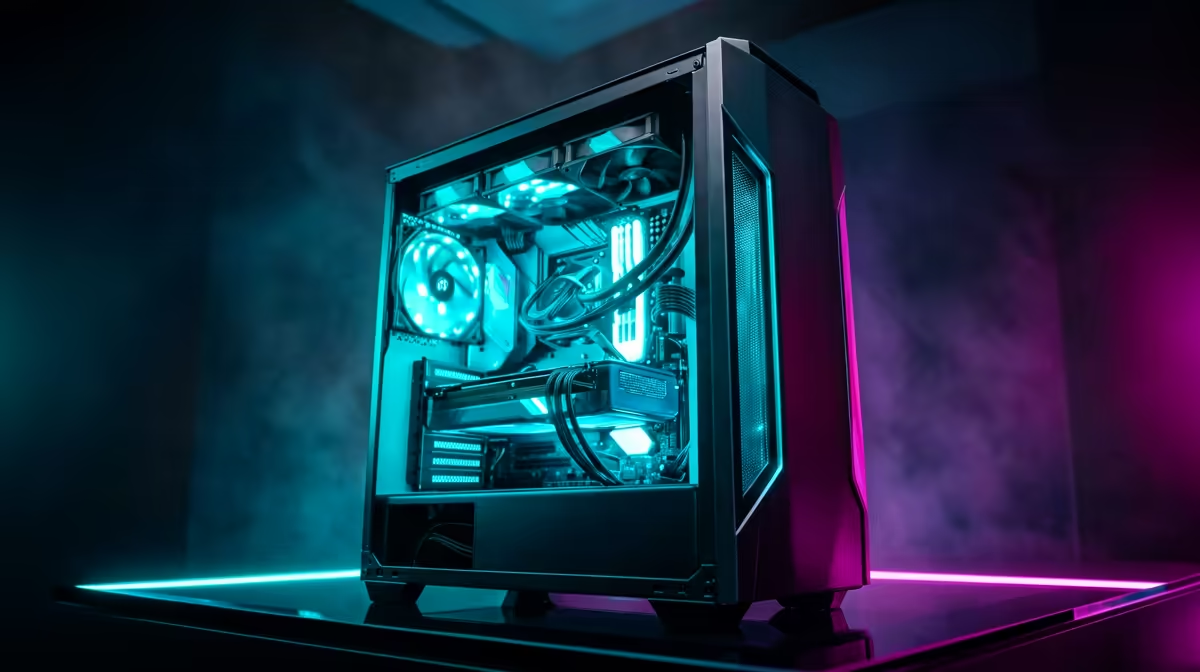
You’ve spent your hard-earned Rands on a beast of a rig and a gorgeous 4K screen. Yet, in the heat of a boss fight in Elden Ring or a tense standoff in Warzone, you see it… that tiny, infuriating stutter. It’s the ghost in the machine, telling you that you’re leaving free performance on the table. Welcome to the world of 4K gaming PC overclocking in South Africa—the art of unlocking your hardware’s hidden potential. 🚀
What is Overclocking and Why Bother for 4K Gaming?
In simple terms, overclocking is pushing your components—primarily your CPU and GPU—to run faster than their official factory speeds. Think of it as tuning a high-performance car engine. The manufacturer sets a safe, reliable limit, but with a bit of careful tweaking, there’s often more power to be found.
For 4K gaming, this isn't just a hobby for enthusiasts; it can be essential. Pushing over eight million pixels every frame is incredibly demanding. A 5-10% boost in performance from a solid overclock can be the difference between a frustrating 50 FPS and a silky-smooth 60+ FPS. This extra headroom makes demanding titles more playable and gives you a competitive edge, especially when paired with a display from our complete range of all our gaming monitors.
The Essentials for a Safe Overclock
Before you start cranking up clock speeds, let's talk prep. A successful overclocking journey relies on a solid foundation. Rushing this step is a recipe for instability and frustration.
Key Hardware Requirements:
- Serious Cooling: Overclocking generates extra heat. The stock cooler that came with your CPU probably won't be enough. A high-performance air cooler or, even better, an All-In-One (AIO) liquid cooler is non-negotiable for serious 4K gaming PC overclocking.
- A Quality Motherboard: Your motherboard's Voltage Regulator Module (VRM) delivers power to the CPU. A board with robust VRMs and good heatsinks will provide clean, stable power, preventing crashes.
- A Reliable Power Supply (PSU): Your components will draw more power when overclocked. Ensure your PSU has enough wattage overhead (we recommend at least 100-150W above your system's peak draw) and comes from a reputable brand.
Your Guide to Unlocking Max FPS Results
Ready to get your hands dirty? Remember the golden rule: go slow. Make one small change at a time, then test thoroughly for stability before proceeding. 🔧
Step 1: Establish Your Baseline
Before you change a single setting, you need to know where you're starting from.
- Download Tools: Get HWiNFO64 for monitoring temperatures and voltages, MSI Afterburner for GPU overclocking, and a benchmarking tool like Unigine Heaven or 3DMark Time Spy.
- Run Benchmarks: Run your chosen benchmark and play your favourite game for 20-30 minutes. Note down your average FPS, and your peak CPU and GPU temperatures. This is your stock performance.
Step 2: Overclocking Your GPU (The Big FPS Winner)
Your graphics card is the most critical component for 4K gaming.
- Open MSI Afterburner: You'll see sliders for Core Clock, Memory Clock, and Power Limit.
- Increase Power Limit: Max out the Power and Temperature Limit sliders. This gives the card more headroom to boost its own clocks safely.
- Adjust Core Clock: Increase the Core Clock by a small amount, say +25 MHz. Click apply.
- Test for Stability: Run your benchmark. If it completes without crashing or visual glitches (artefacts), you're good. Repeat the process, adding +15-25 MHz each time until you experience instability. Then, back it off to the last stable setting. Your GPU is what powers your display, so ensuring it's stable is key to a good experience on all PC monitors.
- Repeat for Memory Clock: Once the Core Clock is stable, do the same for the Memory Clock, using slightly larger increments of +50 MHz.
Stability is Everything ⚡
A benchmark passing once isn't enough. For a truly stable overclock, run a demanding stress test like Prime95 (for CPU) or a looping benchmark for at least an hour. Even better, just play your most demanding game. If your PC can survive a two-hour session of Cyberpunk 2077 at 4K, your overclock is likely rock-solid.
The Visual Payoff: What Results Can You Expect?
Let's be realistic: you won't double your frame rate. However, a stable overclock can often yield a 5-15% FPS boost. While that sounds small, at 4K it can be the magic bullet that pushes a game from "almost smooth" to "flawless". Seeing those extra frames render perfectly on one of the latest high-resolution 4K monitors is incredibly satisfying. ✨
The improved consistency—fewer dips and stutters—is often more noticeable than the peak FPS increase. It creates a more fluid and immersive experience, especially if you're using one of the stunning curved monitors that wrap the action around you. For hardcore tweakers, running monitoring software on a secondary screen like one of these nifty portable monitors keeps your main display clean and focused on the game.
When an Upgrade is the Smarter Move
Overclocking is a fantastic way to get more value from your current hardware. But it has its limits. If you're trying to push a five-year-old GPU to run the latest AAA titles at 4K, no amount of tweaking will close that gap.
Sometimes, the best performance boost comes from an upgrade. If your overclocking journey reveals that your monitor is the bottleneck, or if you simply crave a bigger, faster, or higher-resolution panel to match your newly-tuned rig, it might be time to check out some of the best PC monitor deals available in South Africa.
Ready to Unleash Your PC's Full Potential?
Overclocking is a powerful tool, but it's just one part of the performance puzzle. For the biggest leaps in FPS, the right hardware is key. Explore our massive range of PC components and build a machine that doesn't just play games... it conquers them.