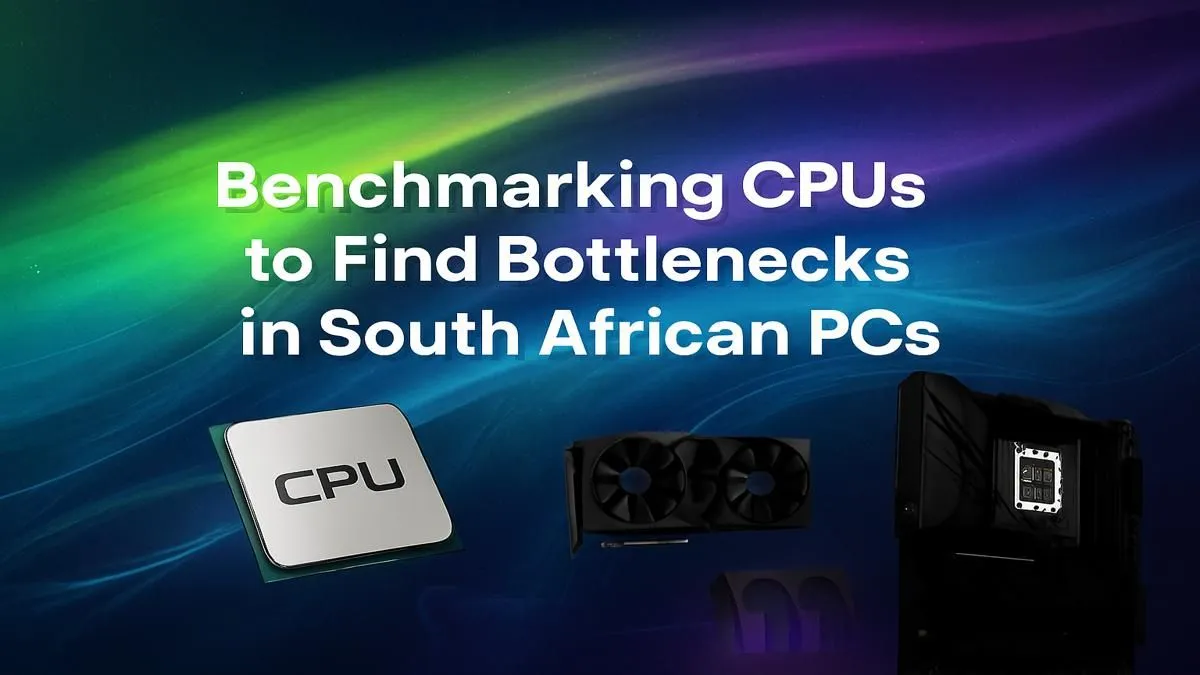
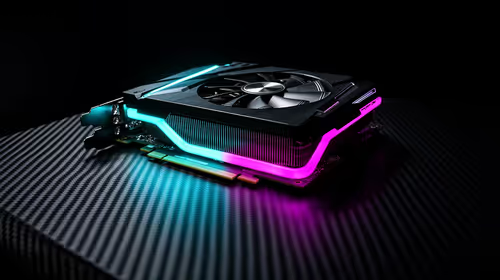
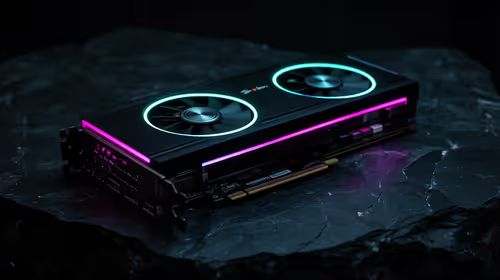
Is your beastly new graphics card not delivering the frame rates you expected? Before you blame the GPU, the real culprit might be your processor. In South Africa, where every component is a considered investment, running a CPU bottleneck test is crucial. It’s the one check that can save you from frustration and wasted cash, ensuring your gaming rig is perfectly balanced. Let's dive in and find your PC's true limits. 🚀
What Exactly is a CPU Bottleneck?
Think of your PC as a high-speed production line. Your Graphics Card (GPU) is the powerful machine that assembles the final product (the beautiful frames in your game). Your Central Processing Unit (CPU) is the manager, feeding instructions to that machine.
If the manager (CPU) can't issue instructions fast enough, the powerful machine (GPU) sits idle, waiting. That's a CPU bottleneck. Your performance tanks, not because your GPU is weak, but because your CPU can't keep up. This often results in stuttering, inconsistent frame rates, and a general feeling that your PC is underperforming, especially in CPU-heavy games like Baldur's Gate 3 or big Warzone lobbies.
How to Run an Effective CPU Bottleneck Test
You don't need fancy, paid software to diagnose the problem. A simple, in-game CPU bottleneck test will give you all the data you need. Here’s a straightforward method to find your PC's limits.
Step 1: Get Your Monitoring Tools
First, you need to see what your components are doing in real-time. We recommend MSI Afterburner, a free and powerful tool that comes with the RivaTuner Statistics Server. Install it and configure the on-screen display to show:
- GPU Usage (%)
- CPU Usage (per core, %)
- Frame Rate (FPS)
Step 2: Run a Real-World Gaming Test
Launch a game that you frequently play, preferably one that is demanding. Set your graphics to the settings you normally use (e.g., 1080p High or 1440p Ultra). Play for about 10-15 minutes in a busy area of the game to get a reliable performance baseline.
Now, pay close attention to your on-screen display.
- Ideal Scenario (GPU Bound): Your GPU usage is consistently at 98-100%. This is great! It means your GPU is working as hard as it can, and you're getting the maximum performance from it. Your CPU is doing its job perfectly.
- Problem Scenario (CPU Bottleneck): Your GPU usage is sitting well below 95% (e.g., 60-80%), while at least one of your CPU cores is maxed out at 100%. This is the classic sign of a CPU bottleneck. Your GPU has spare power, but it's waiting for the CPU to give it more work.
Quick BIOS Check 🔧
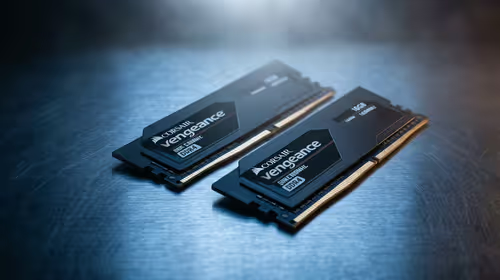
Before you assume your CPU is the problem, restart your PC and enter the BIOS. Make sure your RAM is running at its advertised speed by enabling its XMP (for Intel) or EXPO (for AMD) profile. Slow RAM can starve your CPU of data, creating a bottleneck that looks like a CPU issue but is much cheaper to fix!
Step 3: The Confirmation Test
To be absolutely sure, drop your game's resolution significantly—for example, from 1440p down to 720p—while keeping other settings the same. This drastically reduces the workload on the GPU.
If your frame rate barely increases, you have 100% confirmed a CPU bottleneck. Your CPU was already running at its maximum capacity, and even though the GPU's job became easier, the CPU simply couldn't generate frames any faster. If you've identified this as your issue, it might be time to start looking at upgrading your processor. There are many powerful and affordable CPU processors available online that can solve this problem.
What to Do After Your Bottleneck Test
If your tests confirm your processor is holding you back, the next logical step is an upgrade. The choice often comes down to two titans. For gamers who prioritise raw single-core performance for the highest possible frame rates, the latest Intel CPU line-up is a formidable option. ✨
Alternatively, if you're a streamer or content creator who needs exceptional multi-core performance for multitasking without sacrificing gaming prowess, an AMD CPU often provides incredible value and power. Both platforms offer fantastic choices for South African gamers.
Ultimately, performing a CPU bottleneck test empowers you. It turns guesswork into a clear, data-driven upgrade path, ensuring every rand you spend directly translates to better performance.
Ready to Unleash Your PC's True Power?
A CPU bottleneck can hold back even the mightiest GPU. Don't let your processor be the weak link in your gaming rig. Explore our massive range of CPU processors and find the perfect upgrade to dominate the leaderboards.