Picture this: it’s a sweltering Highveld afternoon. You’re deep into a tense firefight, and suddenly… your frames drop to a crawl. Your PC sounds like a jet engine taking off. That, my friend, is the dreaded sound of your gaming PC overheating. It’s not just annoying; it’s throttling your performance and potentially shortening your hardware’s lifespan.
Don't sweat it, though. We’ve got you covered with ten essential fixes to cool your rig down and get you back in the game. 🚀
Understanding Why Your Gaming PC is Overheating
Before we dive into the fixes, let's quickly understand the problem. When your CPU or GPU gets too hot, it automatically reduces its performance to prevent damage. This is called thermal throttling, and it's the primary cause of sudden frame drops and stuttering during intense gaming sessions.
The main culprits? Dust buildup, poor airflow, and aging components struggling to keep up with demanding modern games. A high-stakes match in Counter-Strike 2 can quickly turn a dusty PC into a very loud space heater.
Quick Fixes for an Overheating PC 🔧
These simple steps can make a massive difference and don't require you to spend a cent.
1. Give It a Proper Clean
Dust is the number one enemy of a cool PC. It insulates components and clogs fans, trapping heat inside your case.
- What to do: Power down and unplug your PC. Use a can of compressed air to blow dust out of your case fans, CPU cooler, GPU fans, and case filters. Pay special attention to heatsink fins. For stubborn dust, a soft brush can help.
2. Improve Your Airflow
Your PC needs room to breathe. If it's stuck in a tight cabinet or pushed against a wall, hot air can't escape and will just recycle back into the system.
- What to do: Ensure there are at least 10-15 cm of clear space around your PC, especially at the back and top where most hot air is exhausted. This simple change can lower temperatures by several degrees, which is crucial whether you're building in Minecraft or battling it out on a massive map.
3. Adjust Your Fan Curves
Your PC case and component fans can be told to spin faster at lower temperatures, moving more air before things get critical.
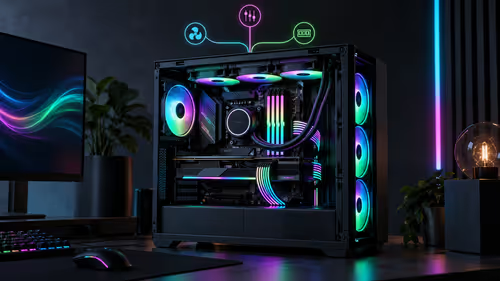
- What to do: Enter your motherboard's BIOS/UEFI (usually by pressing DEL or F2 on startup) or use software like MSI Afterburner. Look for fan control settings and switch from "Silent" to a "Standard" or "Performance" profile. You can even set a custom curve for more aggressive cooling.
Monitor Your Temps Like a Pro ❄️
Download a free tool like HWMonitor or NZXT CAM. These apps show you the real-time temperatures of your CPU and GPU. Knowing your baseline temps helps you see if your fixes are working. A gaming CPU should ideally stay below 85°C under load.
Intermediate Fixes to Stop Your PC Overheating
If the basics didn't solve your gaming PC overheating issue, it's time to get a little more hands-on.
4. Re-apply Thermal Paste
The paste between your CPU and its cooler transfers heat. Over time, it dries out and becomes less effective.
- What to do: If your PC is over 3-4 years old, it's probably time for a refresh. Carefully remove the CPU cooler, clean off the old paste from both the CPU and the cooler with isopropyl alcohol, and apply a pea-sized dot of new, high-quality thermal paste in the centre of the CPU before re-installing the cooler.
5. Check Your Room Temperature
It sounds obvious, but a hot room means a hot PC. During a South African summer, your ambient room temperature can be the biggest factor. A rig built for Fortnite will struggle more in a 30°C room than a 22°C one.
- What to do: If possible, game in an air-conditioned room or use a fan to improve air circulation around your PC.
6. Tidy Up Your Cables
A mess of cables inside your case can obstruct airflow, creating hot spots and preventing cool air from reaching your components.
- What to do: Take some time to route cables behind the motherboard tray and use cable ties to bundle them neatly. This doesn't just look better; it's a functional upgrade that helps keep your components cool while you're pushing your system to the limit in Call of Duty: Warzone 2.0.
Advanced Solutions & Upgrades for Peak Performance
When you've tried everything else, it might be time to consider a hardware upgrade to solve your overheating problems for good.
7. Upgrade Your Case Fans
The stock fans that come with many PC cases are often basic. Upgrading to higher-quality fans can significantly improve how much air is moved through your system.
- What to do: Look for fans with high static pressure for radiators and heatsinks, and high airflow (CFM) fans for case intake/exhaust. Better fans mean better cooling when exploring the neon-lit streets of Night City on a PC optimised for Cyberpunk 2077.
8. Install a Better CPU Cooler
The stock cooler included with most CPUs is designed for baseline performance, not heavy gaming.
- What to do: Investing in a good aftermarket tower air cooler or an All-in-One (AIO) liquid cooler is one of the best ways to reduce CPU temperatures. A demanding title like Microsoft Flight Simulator will push any CPU, and a better cooler ensures it stays boosted for longer.
9. Undervolt Your CPU or GPU
This is a more advanced technique where you reduce the voltage going to your component without sacrificing much performance. Less voltage means less heat.
- What to do: Use tools like Intel XTU or AMD Ryzen Master for your CPU, and MSI Afterburner for your GPU. It requires patience and testing, but it can be a powerful way to cool things down. Even in less demanding titles like Overwatch 2, lower temps mean a quieter PC.
10. Know When It's Time to Upgrade
Sometimes, a gaming PC overheating is a sign that its components are simply too old to run modern games efficiently. An older GPU might run at 100% load constantly just to play the latest titles, generating massive amounts of heat. Consistent frames are vital to surviving the battlegrounds in PUBG. If your hardware can't keep up, it will run hot.
From the sprawling world of GTA V to the next generation of AAA titles, modern gaming demands modern hardware. If you've tried these fixes and are still hitting thermal limits, your PC might be telling you it's time for a change.
Tired of Thermal Throttling? Sometimes the best fix for a gaming PC overheating is an upgrade to a modern, expertly-cooled system. Explore our massive range of high-performance Gaming PCs and find a rig that stays cool under pressure.