Cooling is the quiet part of a build that decides how stable and how loud everything else feels. Get the airflow and the cooler right and a hot SA room stops throttling your frame rates; get it wrong and the fans roar while temperatures still climb.
Quick Answer
Airflow beats fan count: three quality 120mm fans moving 60 to 75 CFM at under 30 dBA each will out-cool six cheap fans. Arctic P12 PWM fans (about R180 each) are a strong value pick, while Noctua NF-P12 redux (around R350) run quieter. Aim for a slight positive pressure to keep dust out of an SA home.
The Numbers On The Box
For cooling, four figures matter. Airflow (CFM) is how much air a fan moves; static pressure matters more through dense radiators and filters. Noise (dBA) decides whether the PC fades into the background, with anything under 30 dBA staying quiet. Fan speed (RPM) and a PWM header let the motherboard ramp cooling only when temperatures climb. For coolers, the rated TDP in watts tells you which CPUs it can hold under 80 degrees Celsius during long loads.
Build A Sensible Airflow Path
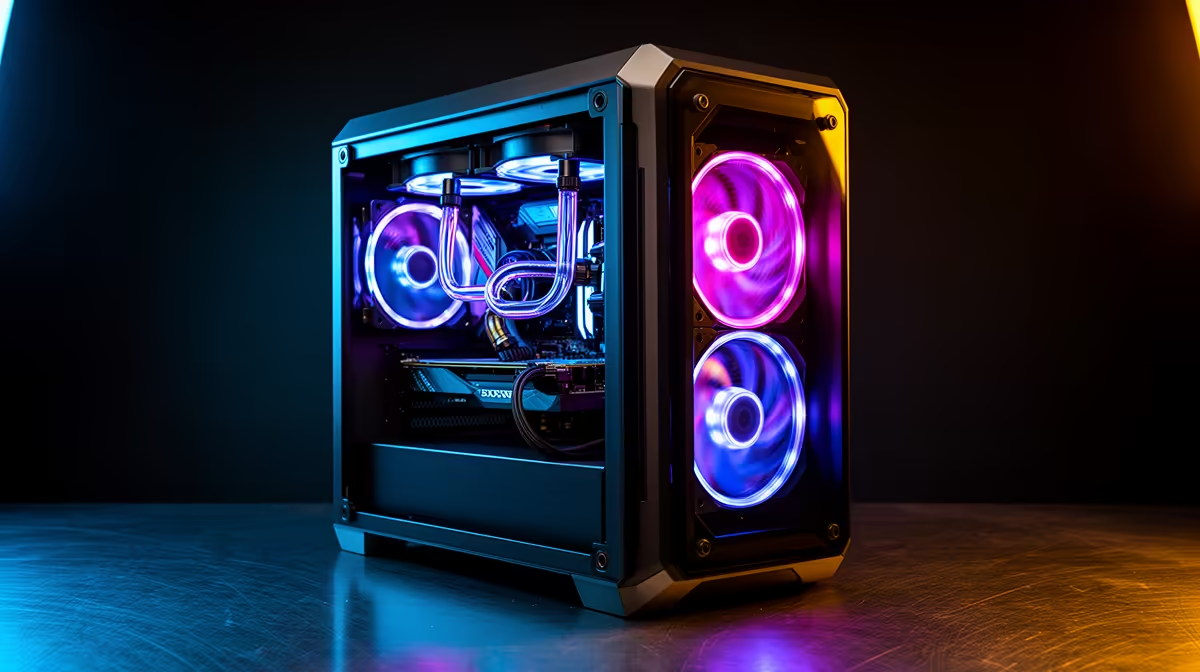
Air should enter low and front, then exit top and rear, sweeping heat off the GPU and CPU on the way. Two or three intake fans against one or two exhaust fans creates slight positive pressure, which pushes dust out through filters instead of pulling it through every gap. In a warm SA room, that filtered positive pressure keeps a build cooler and cleaner across a long summer. Match fan size to the case mounts (usually 120mm or 140mm) and use PWM headers so they idle quietly.
A Starter-To-Serious Upgrade Path
Start with what the case already supports: clean filters, set a sensible fan curve and confirm intakes are not blocked. Step two is replacing the worst-performing stock fans with Arctic P12 PWM units (about R180 each) for an instant airflow and noise win. Step three, for a hotter build, is a Thermalright Peerless Assassin (R750) or a 240mm AIO near R2,000. Each step is cheap relative to the temperature and noise it buys, so upgrade in order rather than all at once.
Tailored To Your setup
At 1440p the GPU works harder than at 1080p, so a steady 60 to 100 fps target needs a card like an RTX 4070 and case airflow that keeps it under 75 degrees Celsius. For this use, set a fan curve that idles under 30 dBA and only ramps when the CPU passes 70 degrees Celsius, and budget around R180 to R750 for the fans or cooler that suit it.
FAQ
How many case fans do I actually need?
Most mid-tower builds run well on three to four quality 120mm fans set up for slight positive pressure. More fans help only if they are arranged into a clear front-to-back, bottom-to-top path rather than fighting each other.
Is an air cooler or an AIO better value?
For CPUs up to about 105W, a R750 dual-tower air cooler matches a budget AIO in temperatures, runs silently and never leaks. Step to a 240mm AIO only for hotter chips or when you want clearance around tall RAM.
What temperature is too hot?
A CPU sitting above 85 degrees Celsius under a long load, or a GPU past 80 degrees Celsius, signals airflow or cooler limits. Better fans, a cleaner filter or a stronger cooler should pull those numbers down by several degrees.
Check your CPU temperatures under a long load first, then upgrade fans or the cooler in order from Evetech's current cooling range rather than buying everything at once.