Quick Answer
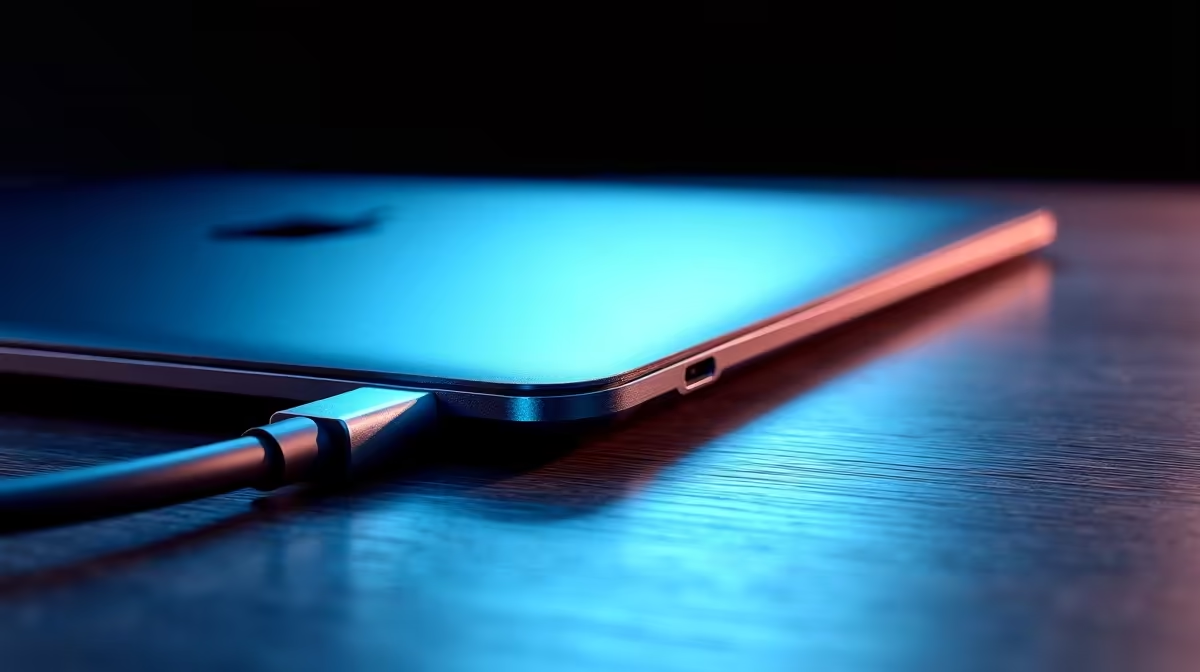
Aluminium connector housings are more durable than plastic, offer better EMI shielding through the connector shell, and resist the cracking and yellowing that affect plastic over time. For display cables you plan to keep and occasionally reconnect, aluminium housings are worth the small price premium.
How Connector Housing Affects Cable Longevity 🔧
The housing is the outer shell around the connector's contact pins and the point at which mechanical stress concentrates during insertion and removal. Plastic housings are lightweight and cheap to manufacture, but they flex under lateral pressure, can crack if the cable is pulled at an angle, and become brittle over time, particularly in SA's hot summer environments where temperatures inside a closed study can exceed 35 degrees. Aluminium housings resist flexing, maintain shape over hundreds of insertion cycles, and do not become brittle with heat or UV exposure. High-end cables from established brands also add a strain relief boot, a flexible section where the cable exits the housing, which is more effective in rubber or reinforced nylon than in cheap plastic.
EMI Shielding: An Overlooked Benefit of Aluminium Shells 📡
Display cables carry high-frequency signals. Electromagnetic interference from nearby power cables, wireless routers, or dense cable bundles can cause noise on the signal path. A properly grounded aluminium connector housing acts as an additional EMI shield, supplementing the shielding foil and braiding inside the cable jacket. This matters most at very high bandwidth, specifically 8K at 60Hz or 4K at 165Hz and above, where signal headroom is tight. Plastic housings offer no EMI rejection through the shell itself.
Price Difference and Value Assessment in ZAR 💰
Aluminium-housed display cables in the 1.8m to 2m segment typically cost R50 to R150 more than equivalent plastic-housed cables. For a cable expected to last three to five years, that premium works out to negligible cost per month. Budget cables with plastic housings at R150 to R250 are fine for a permanently installed cable that is never moved. For a cable on a portable monitor or a gaming setup that gets rearranged, the durability of aluminium justifies the extra spend. Quality cables stocked at Evetech in the R400 to R700 range typically include aluminium housings as standard.
Inspect the Strain Relief, Not Just the Shell ⚡
The weakest point on any cable is where the jacket meets the connector, not the connector shell itself. Flex a cable near the connector housing before buying. Good strain relief should feel firm but not stiff. A plastic boot that bends sharply is a failure point waiting to happen, regardless of what the shell is made of.
FAQ
Does the housing material affect DisplayPort or HDMI signal quality?
Directly, no. Signal quality is determined by the internal contact pins and cable shielding. Aluminium housings contribute to EMI suppression and mechanical durability, which indirectly supports consistent signal delivery over the cable's lifespan.
Will a plastic-housed cable fail faster in Durban's humidity compared to Johannesburg?
Humidity accelerates oxidation inside the connector, not housing degradation. However, coastal heat combined with humidity can accelerate plastic embrittlement. Gold-plated contacts inside a well-constructed housing, regardless of material, are more important for coastal environments.
How many connection cycles can an aluminium-housed cable typically handle?
Quality aluminium-housed connectors are rated for 5,000 or more insertion cycles. For a desktop cable rarely disconnected, this is a lifetime rating. For a portable monitor cable, it provides meaningful durability over years of daily use.
Want a display cable built to handle real-world SA conditions?
Evetech carries display cables with durable construction for gaming rigs and professional workstations. Explore the range at Evetech.