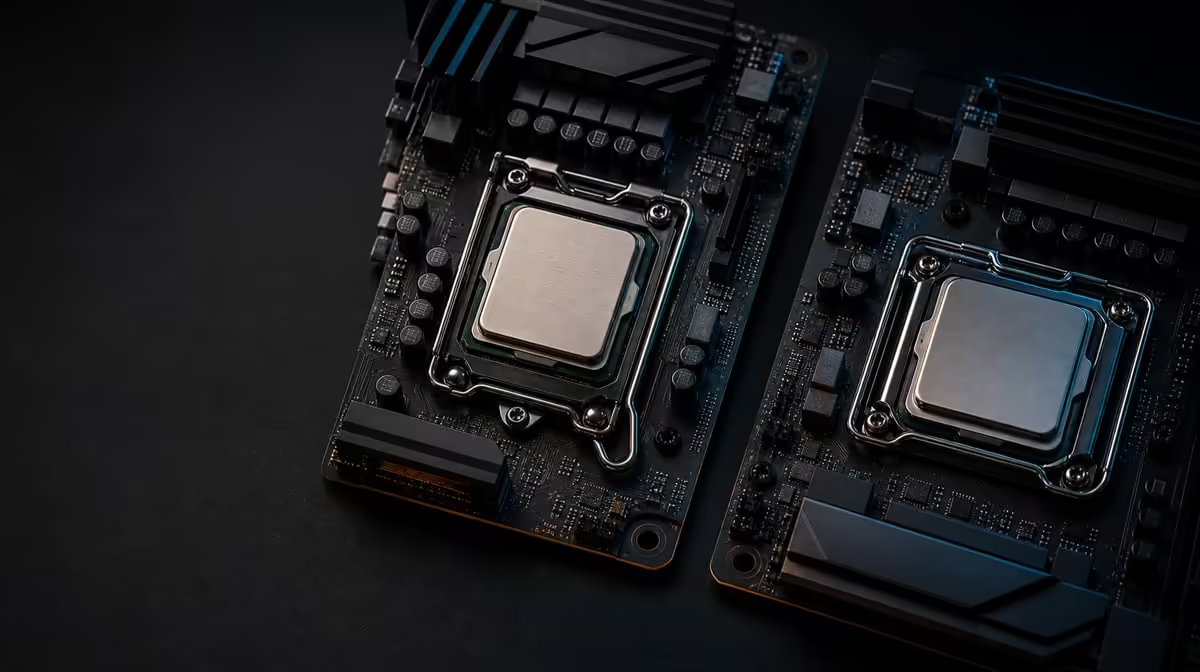
Extra processor cache can be a major gaming advantage in responsive titles, but it is not a rule that every cache-focused CPU beats every conventional design. 3D V-Cache vs standard CPUs for gaming should be decided by the title mix, graphics limit and non-gaming work. The R38,999 kit provides a concrete 144MB 9950X3D reference.
Quick Answer
Choose the R38,999 9950X3D kit when important games benefit from its 144MB GameCache and the rest of the Dark Hero, 48GB DDR5-7200 and LQ360 package fits the build. A standard desktop CPU can remain sufficient when games are GPU-limited, the frame-rate target is modest or another application favours a different balance. Compare both with the same GPU, memory, settings and workloads.
🧠 Understand the cache difference
3D V-Cache increases the on-chip cache available near the processor cores. Games that repeatedly access suitable data can reduce some trips to system memory and may improve frame performance or consistency.
The 9950X3D is specified with 144MB GameCache. That is a clear product fact, not a guaranteed uplift. Engines, scenes and patches organise data differently.
A standard CPU still has cache and can perform strongly. The relevant question is whether the extra cache solves a bottleneck in the games being played.
🎮 Match the processor to the bottleneck
High-frame-rate, CPU-limited tests can expose cache differences. Demanding 4K settings often place more work on the GPU, reducing the visible processor gap.
Use the same graphics card and repeatable scene. Keep memory, drivers and game version constant. Review frame-time consistency as well as averages.
The 48GB KLEVV DDR5-7200 in the bundle remains relevant. Cache and system memory are distinct layers, and unstable RAM can spoil the comparison.
Explore alternatives in Evetech's AMD processor range.
🧰 Include work beyond games
Streaming, creation and development tools can value processor resources differently from games. Run representative application tasks rather than assuming a gaming result predicts professional performance.
The 9950X3D's up-to-5.7GHz boost is a peak specification, not a fixed all-core clock. The included LQ360 supports cooling while workload and operating conditions govern observed behaviour.
A standard CPU may leave more money for graphics, storage or another priority. The correct comparison prices the complete PC.
💵 Judge the whole R38,999 kit
The bundle fixes an X870E Dark Hero, 48GB KLEVV memory and LQ360 alongside the processor. Every part should fit the plan; GameCache alone should not justify unused board or cooling capability.
Compare packages through Evetech's AMD upgrade kit category and exact boards through Evetech's AMD motherboard selection. Add the missing GPU, storage, power and case costs before deciding.
Choose 3D V-Cache when controlled evidence and the game library support it. Choose a standard CPU when it meets the target and produces a better-balanced total. Check current availability after both full configurations are priced.
Use a two-scene game test: one section known to stress the CPU and another representing ordinary play. If extra cache helps only the first, decide how often that condition occurs. This stops a best-case benchmark from defining the entire purchase.
Keep the intended frame cap visible as well. A standard processor that already holds the cap may be sufficient, while the 9950X3D can offer headroom where demanding scenes regularly break it.
Add one professional task to the comparison so a gaming advantage does not hide a different application trade-off.
Price the complete alternatives, including the same graphics, storage, PSU and case. A standard CPU route can redirect money elsewhere, while the 9950X3D route can justify its cost through repeated cache-sensitive gains. The winner is the balanced machine that meets the target, not the processor with the longest isolated specification.
Frequently Asked Questions
What distinguishes a 3D V-Cache CPU?
It carries additional on-chip cache that can keep more selected game data close to the processor cores.
How much cache does the 9950X3D have?
It is specified with 144MB GameCache.
Will it win every game?
No. Engine behaviour, graphics load, resolution and settings determine the result.
When can a standard CPU be sufficient?
It can be enough when games are GPU-limited, the target is already met or savings improve another essential component.
How should creation work affect the choice?
Compare the actual applications, because professional workloads can respond differently from cache-sensitive games.
Why keep the GPU unchanged?
Using the same graphics card helps isolate the processor difference.
Does DDR5 stop mattering with 3D V-Cache?
No. System memory remains necessary and should be stable throughout the comparison.
Ready to choose cache by evidence instead of treating it as an automatic win?
Compare Evetech AMD processors and complete kits with the same GPU, games and work in view.